Solar Mounting (Mechanical Design)

Click For Summary
SUMMARY

This discussion centers on designing a solar mounting system for a 6KW solar array capable of supporting 24 solar panels, each weighing 20kg, at a height of 6 meters. Key considerations include calculating wind and snow loads, with a noted wind speed of up to 40mph and a snow load assumption of 20-40 lbs/ft². Participants recommend using aluminum strut channels for the frame due to their adjustability and cost-effectiveness, while also suggesting a fixed tilt mechanism for seasonal adjustments instead of a solar tracking system, which is deemed too expensive.

PREREQUISITES
  • Understanding of structural engineering principles, particularly force calculations.
  • Familiarity with solar panel specifications and installation requirements.
  • Knowledge of materials, specifically aluminum strut channels and their applications.
  • Awareness of local weather conditions affecting solar installations, such as wind and snow loads.
NEXT STEPS
  • Research structural load calculations for solar mounting systems.
  • Explore the use of aluminum strut channels in solar panel installations.
  • Investigate fixed tilt mechanisms for solar panels and their design considerations.
  • Learn about the installation of solar panels on various roof types, including ballasted systems for flat roofs.
USEFUL FOR

Solar energy enthusiasts, mechanical engineers, DIY solar panel installers, and anyone involved in the design and installation of solar mounting systems.

jahanzebikram
Messages
12
Reaction score
1
I am planning to install a Solar system of 6KW of electricity output enough for a water pump (submersible) and a small home.
I need help in designing a mounting which can hold upto 24 solar-panels (20kg each) at a height of 6 meters from the ground, and I also need to make an adjustment mechanism for 3 tilt angles to get the best light.

Can someone please guide me as to how can I design the structure, what forces to calculate, and how to relate it to strength of materials?

I have something like this in my mind:
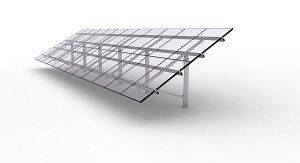
GM_clear_01_300.jpg


1280889761456_hz-myalibaba-web12_1156.jpg
 
Engineering news on Phys.org
Is wind or snow a consideration?
In general, this is a big structure to plop on top of a single pole.
It would be cheaper and stronger to support the panels near the four corners. You could still change the angle of the panel by making the support posts longer, so you could just tilt the panel up or down as needed.
US roofing standards use a 20-40 lbs/ft**2 snow load assumption, that should be ample for your panels.
Do note that solar tracking is expensive for what you get. It is usually cheaper to oversize a fixed installation, which also simplifies the maintenance requirement.
 
There is no snow here, but sometimes we experience wind-speed of up to 40mph. I used calculators provided on the internet to find out that with wind loads the total load of the panels will be around 11000 Newtons.
Yes, I believe so. I was planning on using 3 to 6 pillars in a line, not supports at the corners.
We cannot afford solar-tracking, but I would use just 3 tilt angles for different seasons, and would like to make a mechanism that will allow for only those 3 tilt angles.
And, the mounting will be a standalone structure.
 
I have managed installation of over 100 MW of utility scale ground mount PV. I am assuming here, that you are wanting to mount it on a roof, even though the images you have shown are for a ground mount system. This is because you had mentioned 6M high.

There are many companies that make specialty mounting equipment. For roofs, I am familiar with Schletter and Unirac (I wouldn't recommend Unirack for a small scale ground mount).

If you are trying to make a system yourself, the issues will be finding a way to mount to the roof without penetration. For angled roofs, there are brackets that mount underneath a shingle and extend down to the face of the roof. For flat roofs, there are ballasted systems with no attachment to the roof.

If you are trying to make something yourself, have you considered making your bracing systems with strut channel? A lot of adjustability can be obtained with it.
 
Josh111 hits the nail on the head. Absolutely right on using strut channel.
That kind of material allows for an easily assembled and easily adjusted structure.
The initial need was for serving a small house, so presumably the solar panel array will be ground mounted separate from the house.
The suggestion for mounting the panels in a frame, rather than on poles, assumes a strut channel structure for lowest cost and to allow easy adjustment of the panel angles, just by shifting the attachment points up or down. It does not allow left/right turning adjustment as a pole mount would, but such a solar tracker would make a 6kw installation much more expensive.
 
You can't go wrong using strut for frame construction (look for strut scrap at a metal junk yard).
A small strut channel solar panel pole mount for a off-grid 500W system at my house. The tilt mount is from a old KU band dish.

http://flic.kr/p/bByEv2
http://flic.kr/p/bByExv
http://flic.kr/p/boSZoA

The (movable) pole sits on top of a metal anchor plate on a concrete footing and is supported near the top with a bushing on a old (solid steel) swing-set. :blushing:
http://flic.kr/p/cAMQSU
http://flic.kr/p/bBMUST

With the cost of panels so low adding more panels instead of building an auto-tracking seemed a good way to go. I only adjust the tilt angle for summer vs winter.
 
Last edited by a moderator:
Josh111 said:
I have managed installation of over 100 MW of utility scale ground mount PV. I am assuming here, that you are wanting to mount it on a roof, even though the images you have shown are for a ground mount system. This is because you had mentioned 6M high.

There are many companies that make specialty mounting equipment. For roofs, I am familiar with Schletter and Unirac (I wouldn't recommend Unirack for a small scale ground mount).

If you are trying to make a system yourself, the issues will be finding a way to mount to the roof without penetration. For angled roofs, there are brackets that mount underneath a shingle and extend down to the face of the roof. For flat roofs, there are ballasted systems with no attachment to the roof.

If you are trying to make something yourself, have you considered making your bracing systems with strut channel? A lot of adjustability can be obtained with it.

I mentioned 6m high to consider the wind load. The system will be ground mount.

I am trying to make one myself as we don't have any companies here in Pakistan which specialize in mounting equipment (atleast I don't know), and budget is a deciding factor.
 
etudiant said:
Josh111 hits the nail on the head. Absolutely right on using strut channel.
That kind of material allows for an easily assembled and easily adjusted structure.
The initial need was for serving a small house, so presumably the solar panel array will be ground mounted separate from the house.
The suggestion for mounting the panels in a frame, rather than on poles, assumes a strut channel structure for lowest cost and to allow easy adjustment of the panel angles, just by shifting the attachment points up or down. It does not allow left/right turning adjustment as a pole mount would, but such a solar tracker would make a 6kw installation much more expensive.

Yes, I am considering aluminium strut channels for a closed frame (panels will be screwed and bound on the frame). What I would like some help with is force calculations and how to relate them the the system I would need. I went to a few dealers who create Aluminium profiles (not purpose built for mountings) which can be utilized here.
 
nsaspook said:
You can't go wrong using strut for frame construction (look for strut scrap at a metal junk yard).
A small strut channel solar panel pole mount for a off-grid 500W system at my house. The tilt mount is from a old KU band dish.

http://flic.kr/p/bByEv2
http://flic.kr/p/bByExv
http://flic.kr/p/boSZoA

The (movable) pole sits on top of a metal anchor plate on a concrete footing and is supported near the top with a bushing on a old (solid steel) swing-set. :blushing:
http://flic.kr/p/cAMQSU
http://flic.kr/p/bBMUST

With the cost of panels so low adding more panels instead of building an auto-tracking seemed a good way to go. I only adjust the tilt angle for summer vs winter.

Its looks good, however we need a bigger one, but your pictures help a lot :smile:
Thanks
 
Last edited by a moderator:
  • #10
jahanzebikram said:
Its looks good, however we need a bigger one, but your pictures help a lot :smile:
Thanks

Just be sensitive to the effect of the size difference. Your 3.5x6 meter array is big and may be near the limit of what these struts can readily handle.
 
  • #11
jahanzebikram said:
I am planning to install a Solar system of 6KW of electricity output enough for a water pump (submersible) and a small home.
I need help in designing a mounting which can hold upto 24 solar-panels (20kg each) at a height of 6 meters from the ground, and I also need to make an adjustment mechanism for 3 tilt angles to get the best light.

Can someone please guide me as to how can I design the structure, what forces to calculate, and how to relate it to strength of materials?

I have something like this in my mind:
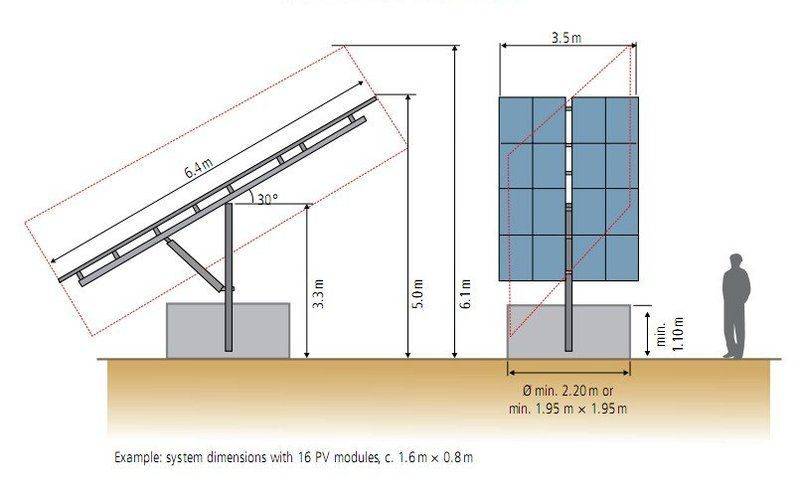
View attachment 56875

View attachment 56876

Normally, for solar tracker or solar tracking system must be considered, which has highly rugged and can withstand wind force and weather,function reliably, maintenance free for many years, safety self locking and accurate positioning tracking movement. Ideal solutions with self-locking worm gear screw jack.

When you design a bigger solar tracker or solar tracking system with make an adjustment mechanism, dc 24v gear motor screw jack with slew drive lift mechanism Will be the best choices.

1. application cases: http://www.screw-jack.com/info/Application-Solar-Panel-Tracking-System-Accurate-Positioning.html
2. video 1: http://youtu.be/zFgqDnO8Vic
3. video 2: http://youtu.be/HHFsrnt9Rbw
4. screw jack factory: http://www.screw-jack.com

Hope this is helpful for you.
 

Similar threads

Replies
2
Views
2K
Replies
1
Views
667
  • · Replies 5 ·
Replies
5
Views
4K
  • · Replies 18 ·
Replies
18
Views
3K
  • · Replies 30 ·
2
Replies
30
Views
4K
Replies
1
Views
919
  • · Replies 18 ·
Replies
18
Views
3K
  • · Replies 1 ·
Replies
1
Views
2K
Replies
8
Views
2K
Replies
3
Views
2K