Solid State Physics: Explaining Ashcroft & Mermin's Hall Effect

  • Context: Undergrad 
  • Thread starter Thread starter Rzbs
  • Start date Start date
  • Tags Tags
    Hall effect
Click For Summary

Discussion Overview

The discussion revolves around the interpretation of diagrams related to the Hall Effect as presented in Ashcroft & Mermin's solid state physics book. Participants are examining the compatibility of the signs and directions of various fields and charges depicted in the diagrams, particularly in the context of high field strength scenarios.

Discussion Character

  • Debate/contested
  • Technical explanation

Main Points Raised

  • One participant questions the compatibility of the signs in the diagrams, suggesting that the signs may be drawn incorrectly.
  • Another participant notes that the reversal of the B field could explain the apparent discrepancies in charge placement.
  • There is confusion regarding the direction of the H field and the Ey components in the diagrams, with participants seeking clarification on their orientations.
  • Some participants assert that the diagrams are not meant to be identical and represent different concepts, although they express concern about the clarity of the drawings.
  • One participant mentions that the paper discusses the Hall Effect at very high field strengths, indicating that unusual behaviors may arise compared to ordinary Hall Effect scenarios.
  • There is uncertainty about whether the charge carriers in the second diagram are positive, as the book does not provide explicit information on this point.

Areas of Agreement / Disagreement

Participants do not reach a consensus on the compatibility of the diagrams or the correctness of the signs. Multiple competing views remain regarding the interpretation of the diagrams and their intended meanings.

Contextual Notes

Participants highlight limitations in the clarity of the diagrams and express that the drawings should enhance understanding rather than confuse it. There is also mention of the diagrams being from different chapters, which may contribute to the discrepancies noted.

Rzbs
Messages
52
Reaction score
11
TL;DR
Hall effect in the high-field limit
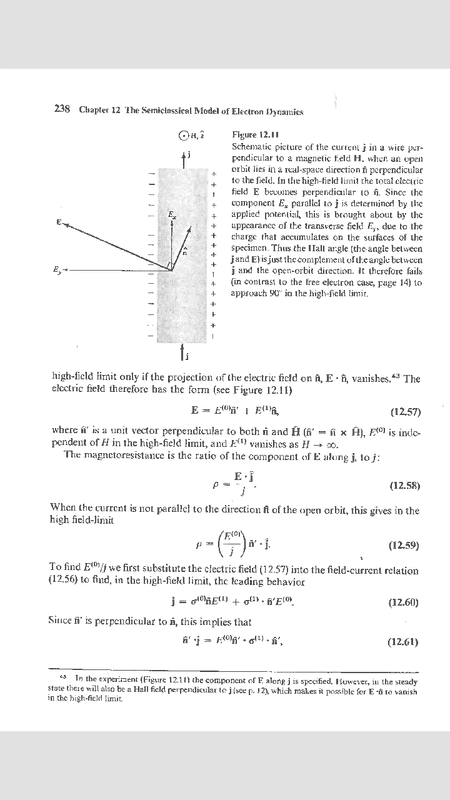
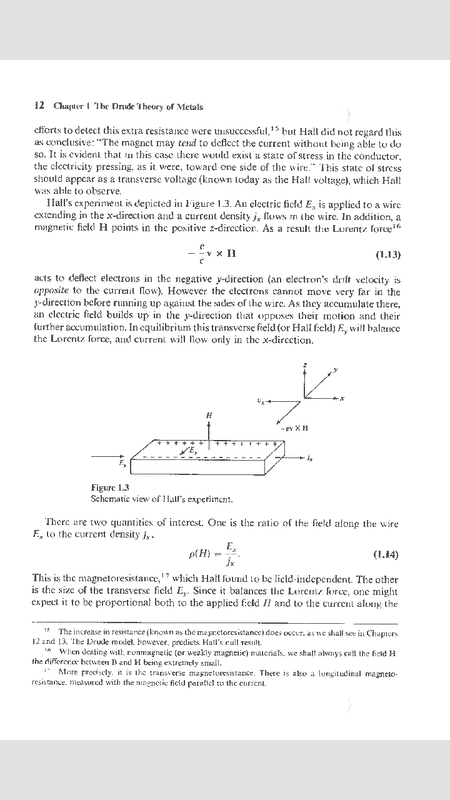
Could anyone please explain the differnce between these two picture of Ashcroft & Mermin solid state physics book:
Screenshot_20201106-163501.png
Screenshot_20201106-163413.png

Why in these two pictures the + and - signs don't compatible with each other?! I think in the pic12-11 the signs don't draw correctly. It must be vice versa I mean + signs in left and - signs in right?!
 
Physics news on Phys.org
Its OK. The B field is reversed which is why charges may appear off.
 
shjacks45 said:
Its OK. The B field is reversed which is why charges may appear off.
Thanks. So you say in the second picture the H field is along -z direction?

but It seems in two pictures the H fields are along +z direction and Js are along +x direction, but in the first picture Ey is along -y and in the next picture it's along +y! Why? What is my mistake?
 
Rzbs said:
Thanks. So you say in the second picture the H field is along -z direction?

but It seems in two pictures the H fields are along +z direction and Js are along +x direction, but in the first picture Ey is along -y and in the next picture it's along +y! Why? What is my mistake?
Second diagram had "B" next to a circle with a dot in it. If it was the other direction then it would be a circle with an x in it. Did you note that the two diagrams are about different things? They are not meant to be identical.
 
shjacks45 said:
Second diagram had "B" next to a circle with a dot in it. If it was the other direction then it would be a circle with an x in it. Did you note that the two diagrams are about different things? They are not meant to be identical.
I agree that the drawings are not well thought out but I didn't see the whole paper. Drawings should improve the quality of the paper, not obfuscate. Hall effect is a basic part of physics, BUT this paper was about Hall Effect at very high field strength and how it was different from ordinary Hall Effect normally encountered. Like anything at extremes (metallic Hydrogen at extreme Jupiter-like pressure) there are surprise changes in how materials behave.
 
  • Like
Likes   Reactions: Rzbs
shjacks45 said:
Second diagram had "B" next to a circle with a dot in it. If it was the other direction then it would be a circle with an x in it.

I know the meaning of a circle with a dot or with an x. So in second diagram +z is outward of the page.

Did you note that the two diagrams are about different things? They are not meant to be identical

The two diagrams are in Ashcroft and Mermin solid state physics book in different chapters. The second one tried to explain the unusal behavior of the first one like positive hall coefficient and behaviour of magnetoresistance.
 
shjacks45 said:
I agree that the drawings are not well thought out but I didn't see the whole paper. Drawings should improve the quality of the paper, not obfuscate. Hall effect is a basic part of physics, BUT this paper was about Hall Effect at very high field strength and how it was different from ordinary Hall Effect normally encountered. Like anything at extremes (metallic Hydrogen at extreme Jupiter-like pressure) there are surprise changes in how materials behave.
The two diagrams are about one thing and I think should be like each other. Maybe in the second one the charge careers are positive (I'm not sure because the book don't say anything about this).
 

Similar threads

  • · Replies 2 ·
Replies
2
Views
2K
  • · Replies 6 ·
Replies
6
Views
2K
  • · Replies 3 ·
Replies
3
Views
2K
  • · Replies 4 ·
Replies
4
Views
1K
  • · Replies 0 ·
Replies
0
Views
3K
  • · Replies 2 ·
Replies
2
Views
3K
  • · Replies 11 ·
Replies
11
Views
4K
  • · Replies 1 ·
Replies
1
Views
2K
  • · Replies 7 ·
Replies
7
Views
2K
  • · Replies 0 ·
Replies
0
Views
3K