Solve Boyle's Law Problem: Calculate Atmospheric Pressure

  • Thread starter Thread starter lionely
  • Start date Start date
  • Tags Tags
    Boyle's law Law
Click For Summary
SUMMARY

The forum discussion focuses on solving a Boyle's Law problem to calculate atmospheric pressure using a glass tube containing mercury. The atmospheric pressure, denoted as "A" in cm of mercury, is derived from the relationship between the air column lengths in vertical and horizontal positions. The final calculation shows that the atmospheric pressure is 75 cmHg, achieved by applying the equation P1V1 = P2V2 and solving for P. The discussion emphasizes the importance of understanding the forces acting on the mercury and how to manipulate the variables correctly.

PREREQUISITES
  • Understanding of Boyle's Law and gas laws
  • Knowledge of pressure measurement in cm of mercury
  • Familiarity with basic algebraic manipulation
  • Concept of forces acting on fluids in static equilibrium
NEXT STEPS
  • Study the derivation and applications of Boyle's Law in real-world scenarios
  • Learn about pressure measurement techniques and units, specifically cmHg
  • Explore fluid statics and the principles governing forces in fluids
  • Practice solving similar problems involving gas laws and pressure calculations
USEFUL FOR

Students studying physics, particularly those focusing on thermodynamics and fluid mechanics, as well as educators looking for practical examples of Boyle's Law applications.

lionely
Messages
574
Reaction score
2
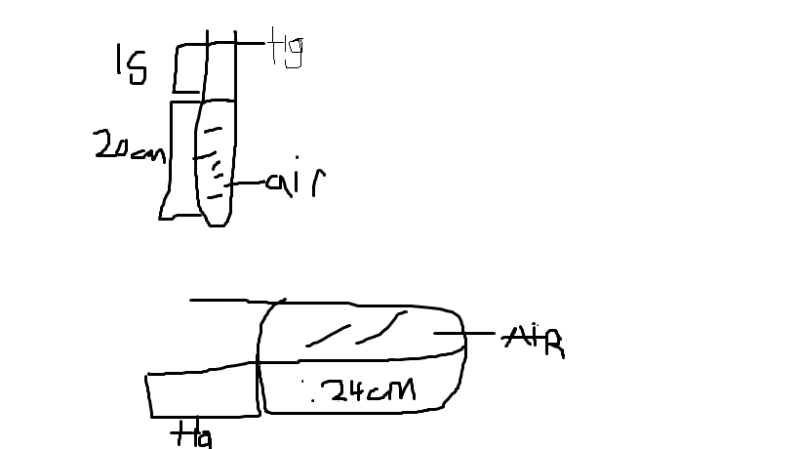
A narrow uniform glass tube contains air enclosed by a thread of mercury 15cm long.
When the tube is held vertically, with the closed end at the bottom,the air column is 20.0cm long, but when it is held horizontally the air column is 24.0cm long. Calculate the atmospheric pressure.
357f5sj.png


I drew a diagram I'm not sure if it's correct, I know that I'm supposed to subtract the mercury height from the barometric height but I don't get the correct answer. Please help me.
 
Physics news on Phys.org
hi lionely! :smile:

call the atmospheric pressure "A" (in cm of mercury)

since the mercury is stationary, what must be the pressure exerted on it by the enclosed air in each case? :wink:
 
A + the mercury heights?
 
(just got up :zzz: …)

what about the weight of the mercury? :confused:
 
Can't we just work it out in cmHg?
 
(just got up :zzz: …)

we are!

but we need to know what forces (or pressures) we have to include, and whether to add or subtract …

for that, you need to decide which forces are acting on the mercury

soo … what about the weight of the mercury (in either case)?​
 
well mg acts down, so in the second case I would assume the effect is not as great.
 
add the forces, luke! o:)
 
P1V1 = P2V2

(p+15)(20A) = P x 24A

20P + 300 = 24P

P = 300/4 = 75cmHg

Is that it ?
 
  • #10
yup! :biggrin:
 
  • #11
Thanks for your help man XD
 

Similar threads

  • · Replies 6 ·
Replies
6
Views
973
  • · Replies 3 ·
Replies
3
Views
2K
  • · Replies 6 ·
Replies
6
Views
2K
Replies
7
Views
8K
  • · Replies 6 ·
Replies
6
Views
1K
  • · Replies 1 ·
Replies
1
Views
2K
  • · Replies 4 ·
Replies
4
Views
2K
  • · Replies 7 ·
Replies
7
Views
2K
Replies
1
Views
3K
Replies
13
Views
17K