Solve Disk & Coil Spring Motion: Get Amplitude Help

Click For Summary

Homework Help Overview

The discussion revolves around a problem involving the motion of a disc and a ring of sticky putty that is dropped onto it. The subject area includes concepts from rotational dynamics and conservation of angular momentum, particularly focusing on how the addition of mass affects the amplitude of motion.

Discussion Character

  • Exploratory, Assumption checking, Problem interpretation

Approaches and Questions Raised

  • Participants are attempting to understand how to find the new amplitude of motion after a ring of putty is added to a moving disc. Questions are raised about the conservation of angular momentum and how to determine angular speed before and after the collision. Some participants are also discussing the implications of adding mass to the system and its effect on motion.

Discussion Status

The discussion is ongoing, with participants exploring different aspects of the problem. Some guidance has been offered regarding the use of conservation laws, but there is no explicit consensus on how to proceed with finding the new amplitude. Multiple interpretations of the problem setup are being considered.

Contextual Notes

There are indications of missing information regarding the specific values needed for calculations, as well as the implications of energy conservation in this context. Participants are questioning the assumptions related to the system's energy and inertia.

Lil123
Messages
8
Reaction score
0
New user has been reminded to always show their work on schoolwork problems.
Homework Statement
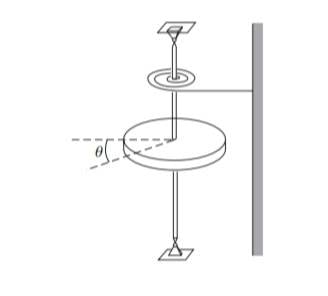
A solid disk of mass M and Raduis R is on vertical .The shaft is
attached to a coil spring that exact a linear restoring torque of magnitude C theta where theta is the angle measured from the static equilibrium position in C is a constant neglect the mass of the shaft and the spring and assume the bearing to be frictionless.


1.Show that the disk and undergo simple harmonic motion motion and find the frequency frequency of the motion


2.Suppose that the disc is moving according to theta equals to theta not sin omega t where Omega is the frequency found in part a at time T1 equals to pi by Omega a ring of sticky putty of mass M and radius R is dropped cocentrically on the disc find the new amplitude of the motion
Relevant Equations
Li =Lf
I was able to solve part 1 but I am not
Screenshot_20230620-095315_Drive.jpg
not getting how to find new amplitude of the motion . Please help me
 
Physics news on Phys.org
Lil123 said:
2.Suppose that the disc is moving according to theta equals to theta not sin omega t where Omega is the frequency found in part a at time T1 equals to pi by Omega a ring of sticky putty of mass M and radius R is dropped cocentrically on the disc find the new amplitude of the motion
Took me a while to decode that. Do you mean
"Suppose that the disc is moving according to ##\theta=\theta_0\sin (\omega t )## where ω is the frequency found in part 1.
"At time ##T_1 = \pi /\omega## a ring of sticky putty of mass M and radius R is dropped concentrically on the disc. Find the new amplitude of the motion."
?

For part 2, you need to show an attempt. You have quoted the relevant equation. Can you fill in the details for this context?
 
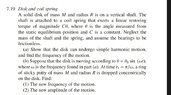
This is the above question. How do I find new amplitude of the motion ?
 

Attachments

  • Screenshot_20230620-124937_Drive.jpg
    Screenshot_20230620-124937_Drive.jpg
    51.7 KB · Views: 105
Lil123 said:
This is the above question. How do I find new amplitude of the motion ?
Using your conservation of angular momentum equation.
What is the total angular momentum of the system just before the putty hits the disc? So what is the angular speed just after?
 
haruspex said:
Using your conservation of angular momentum equation.
What is the total angular momentum of the system just before the putty hits the disc? So what is the angular speed just after?
Yes , but how do I find angular speed ? .I know angular frequency of the system before and after the putty hits the disc
 
Lil123 said:
Yes , but how do I find angular speed ? .I know angular frequency of the system before and after the putty hits the disc
You can find the angular speed before the collision either from energy conservation or from the given equation of motion.
 
Lil123 said:
...
2.Suppose that the disc is moving according to theta equals to theta not sin omega t where Omega is the frequency found in part a at time T1 equals to pi by Omega a ring of sticky putty of mass M and radius R is dropped cocentrically on the disc find the new amplitude of the motion
Relevant Equations: Li =Lf

I was able to solve part 1 but I am not View attachment 328105not getting how to find new amplitude of the motion . Please help me
If mass is added to the moving system, but not additional energy to do the work, how things must naturally change to adjust to the increased inertia and still move under the influence of the same elastic energy?

Please, see:
http://hyperphysics.phy-astr.gsu.edu/hbase/hframe.html
 
Lnewqban said:
the same elastic energy?
Mechanical energy is not conserved here. @Lil123 quoted the relevant equation.
 
Last edited:

Similar threads

Replies
5
Views
1K
Replies
3
Views
887
  • · Replies 13 ·
Replies
13
Views
2K
  • · Replies 6 ·
Replies
6
Views
2K
Replies
13
Views
4K
  • · Replies 7 ·
Replies
7
Views
3K
  • · Replies 2 ·
Replies
2
Views
2K
  • · Replies 10 ·
Replies
10
Views
3K
  • · Replies 2 ·
Replies
2
Views
1K
  • · Replies 19 ·
Replies
19
Views
1K