Solve Electricity Problems: Get Answers Now

  • Thread starter Thread starter Aravsion
  • Start date Start date
  • Tags Tags
    Electricity
Click For Summary

Homework Help Overview

The discussion revolves around two electricity-related problems involving an electric motor's efficiency and the electric potential between parallel conducting plates. The first problem concerns calculating the operating efficiency of a motor lifting a mass, while the second problem involves determining the electric potential at a specific point between two plates and the electric field magnitude.

Discussion Character

  • Exploratory, Conceptual clarification, Mathematical reasoning

Approaches and Questions Raised

  • Participants discuss the equations related to work, power, and efficiency for the motor problem, questioning how to calculate time and relate it to power. For the second problem, they explore the relationship between potential difference and distance, considering linear changes in potential.

Discussion Status

Some participants have provided guidance on listing relevant equations and exploring the relationships between variables. There is a mix of interpretations and approaches being discussed, particularly regarding the calculations for both problems.

Contextual Notes

Participants are working under the constraints of homework rules, which may limit the information they can share or the methods they can use. There is an emphasis on understanding concepts rather than providing direct solutions.

Aravsion
Messages
5
Reaction score
0
I have two problems that I have difficulty understanding and solving.

Homework Statement


The operating efficiency of a 0.5 A, 120 V electric motor that lifts 9 kg mass agaisnt gravity at an average velocity of 0.5 m/s is most nearly what percentage?

Please help me solve this problem

2. Homework Statement
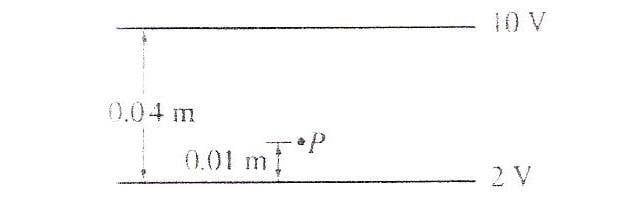
Two large, flat, parallel, conducting plates are 0.04 m apart, as shown in the picture. The lower plate is at a potential difference of 2 V with respect to ground. The upper plate is at a potential of 10 V with respect to ground. Point P is located 0.01 m above the lower plate. The electric potential at point P is? The magnitude of the electric field at point P is?
eca17b3c335b.jpg

Please help me understand and solve this problem also...
 
Physics news on Phys.org
Aravsion said:
I have two problems that I have difficulty understanding and solving.

Homework Statement


The operating efficiency of a 0.5 A, 120 V electric motor that lifts 9 kg mass agaisnt gravity at an average velocity of 0.5 m/s is most nearly what percentage?

Please help me solve this problem

2. Homework Statement
Two large, flat, parallel, conducting plates are 0.04 m apart, as shown in the picture. The lower plate is at a potential difference of 2 V with respect to ground. The upper plate is at a potential of 10 V with respect to ground. Point P is located 0.01 m above the lower plate. The electric potential at point P is? The magnitude of the electric field at point P is?
eca17b3c335b.jpg

Please help me understand and solve this problem also...

Welcome to the PF.

For (1), please list the equations for work (both mechanical and electrical). Please show your work.

For (2), please list the equations for the Electric field as a function of voltage and distance. Please show your work.
 
berkeman said:
Welcome to the PF.

For (1), please list the equations for work (both mechanical and electrical). Please show your work.

For (2), please list the equations for the Electric field as a function of voltage and distance. Please show your work.

The equation for mechanical work is Work = force x distance and for electrical it's Potential difference (V) x q (charge) = Work or Potential energy difference of the charge... Is that what you're asking?
E = F/q and also E = V/d
 
Last edited:
Aravsion said:
The equation for mechanical work is Work = force x distance and for electrical it's Potential difference (V) x q (charge) = Work or Potential energy difference of the charge... Is that what you're asking?
E = F/q and also E = V/d

For electrical work in this problem, you will use the motor's current and voltage to get the power, and you use time to convert power into work. What are the equations for that?

And then go ahead and describe how you would calculate the efficiency of the motor system in doing the mechanical work...
 
berkeman said:
For electrical work in this problem, you will use the motor's current and voltage to get the power, and you use time to convert power into work. What are the equations for that?

And then go ahead and describe how you would calculate the efficiency of the motor system in doing the mechanical work...

[tex]Power = UI[/tex] so the power of the motor is - [tex]Power = 120 \textup{ V}\times 0.5 \textup{ A}[/tex] and this equals to 60 watts. How can I find the time though?
Also, from lifting the 9 kg mass at a velocity of 0.5 m/s I can convert the 9 kg mass to its weight (9 kg * 9.8 m/s2) and then simply multiply that weight quantity by 0.5 m/s to find the power of that? In other words, [tex]Power = \frac{Work }{time} = Force \times \frac{distance}{time} = Force \times velocity[/tex]
But once again I need to find the time to find work... and then use the equation: [tex]Eff = \frac{Woutput}{Winput}\times 100[/tex]
 
If each of the powers are constant over time, and if work = power x time, then over any given time interval Δt:

[tex]\frac{W_{out}}{W_{in}} = \frac{P_{out} \times \Delta t}{P_{in} \times \Delta t} = \frac{P_{out}}{P_{in}}[/tex]
 
gneill
Thank you :) now I understand.. The answer I got was 75%...
Also, how would I approach the 2nd problem, do you have any ideas?
 
If you assume that the potential changes linearly with distance from 2V at the bottom plate to 10V at the upper plate, what is the potential at point P? Start by finding the total change in potential ΔP, and the total change in distance Δd. What ratios can you set up to relate the distance of P to the change in potential?
 
gneill
Big thanks! :smile:
I solved it like this, if my thinking was wrong please correct me:
[tex]8 \textup{ V} = 0.04 \textup{ m}[/tex] - This is because we know that the distance between the top and bottom plates is 0.04 meters and the difference in potential difference is 8 volts.
[tex]1 \textup{ V} = 0.005 \textup{ m}[/tex] - From this, we know that the bottom plate starts from 2 V and the potential difference starts escalating towards the top plate which has a voltage of 10 V. Thus, [tex]1 \textup{ V} = 0.005 \textup{ m}[/tex]
[tex]2 \textup{ V} = 0.01 \textup{ m}[/tex]
Therefore, the potential difference at point P is 4 V and the magnitude of the electric field would be - [tex]E = \frac{8 \textup{ V}}{0.04 \textup{ m}} ; E = 200 \textup{ V/m}[/tex]
 
  • #10
Looks good!
 

Similar threads

  • · Replies 16 ·
Replies
16
Views
2K
  • · Replies 26 ·
Replies
26
Views
3K
Replies
4
Views
2K
  • · Replies 2 ·
Replies
2
Views
1K
  • · Replies 2 ·
Replies
2
Views
1K
  • · Replies 6 ·
Replies
6
Views
3K
Replies
1
Views
2K
  • · Replies 18 ·
Replies
18
Views
3K
Replies
8
Views
2K