Solve Fermi-Dirac Integral: Get Help Now!

  • Context: Undergrad 
  • Thread starter Thread starter arneet
  • Start date Start date
  • Tags Tags
    Fermi-dirac Integral
Click For Summary
SUMMARY

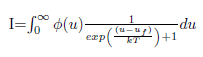
The discussion centers on solving the Fermi-Dirac integral, specifically addressing the approximation methods using Taylor's series. The integral's result is derived under the condition where the variable u exceeds the Fermi energy level (u_f). The approximation simplifies the expression 1 + (exp(u - u_f)/kT) to (exp(u - u_f)/kT), leading to the reciprocal term (exp-(u - u_f)/kT). This method clarifies the integral's behavior in the context of Fermi-Dirac statistics.

PREREQUISITES
  • Understanding of Fermi-Dirac statistics
  • Familiarity with Taylor series expansion
  • Knowledge of thermodynamic concepts, particularly temperature (kT)
  • Basic calculus skills for integral evaluation
NEXT STEPS
  • Study the derivation of the Fermi-Dirac integral in detail
  • Learn about the implications of Fermi energy (u_f) in statistical mechanics
  • Explore advanced approximation techniques in statistical physics
  • Investigate the role of temperature (kT) in quantum statistics
USEFUL FOR

Students and researchers in physics, particularly those focusing on statistical mechanics and quantum statistics, will benefit from this discussion.

arneet
Messages
8
Reaction score
0
Thread closed due to being posted in two forum sections
i am completely lost. there is an integral in my textbook in fermi dirac statistics whose result is written directly and am not able to understand . it is
integral.PNG
.
on expansion by using the method of taylor's series the result should be

result.PNG

where u_f is such that function of u is zero for u greater than uf.
please reply as soon as possible. thanks.
 
Physics news on Phys.org
I think this should have been posted in physics thread. Anyways, i will explain here...Assume u is greater than uf...so (u-uf) is so large...
so in 1+(exp(u-uf)/kT) can be approximated as (exp(u-uf)/kT)

The reciprocal of this term is (exp-(u-uf)/kT).

Hope this helps
 
  • Like
Likes   Reactions: arneet
Alpharup said:
I think this should have been posted in physics thread. Anyways, i will explain here...Assume u is greater than uf...so (u-uf) is so large...
so in 1+(exp(u-uf)/kT) can be approximated as (exp(u-uf)/kT)

The reciprocal of this term is (exp-(u-uf)/kT).

Hope this helps
thanks for replying,it helped.
 

Similar threads

  • · Replies 3 ·
Replies
3
Views
2K
  • · Replies 1 ·
Replies
1
Views
2K
  • · Replies 3 ·
Replies
3
Views
2K
  • · Replies 2 ·
Replies
2
Views
2K
  • · Replies 6 ·
Replies
6
Views
3K
  • · Replies 3 ·
Replies
3
Views
2K
  • · Replies 4 ·
Replies
4
Views
3K
  • · Replies 12 ·
Replies
12
Views
4K
  • · Replies 2 ·
Replies
2
Views
2K
  • · Replies 4 ·
Replies
4
Views
3K