Salah93
- 20
- 0
I was trying to solve this exercise:
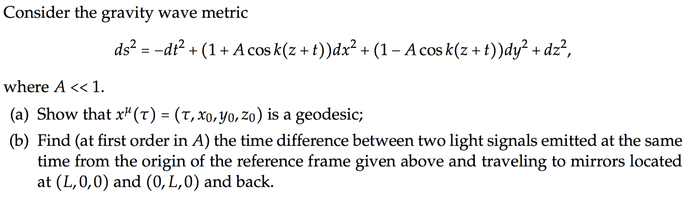
Now I was able to find the eq. of geodetics (or directly by Christoffel formulas calculation or by the Lagrangian for a point particle). And I verified that such space constant coordinate point is a geodetic.
Now, for the second point I considered$$ds^2=0$$
to isolate the$$dt$$ and find the time difference between the two routes. But I don't know how to solve for a generic path of a light ray. So I considered that maybe the text wants a light ray traveling along x-axis and the second along y axis.
I checked in other sources and all people make the same, by considering a light ray along x-axis and then setting$$dy=dz=0$$
.
But when I substitute these in my geodesic equations it turns out that they are not true even at first order in A! So these people that consider a light ray traveling along x-axis, such as in an interferometer, are not considering a light geodesic. All of this if and only if my calculations are true.
So I know that if$$ds^2=0$$
I have a light geodesic. And so it should solve my eq. of geodesics. But if I restrain my motion on x-axis what I can say is that the$$ds^2=0$$
condition now is on a submanifold of my manifold. So, the light wave that I consider doesn't not move on a geodesic of the original manifold but on one of the x axis. This is the only thing that came in my mind.
Is there any way to say that I can set
$$dy=dz=0$$
without worring? And if I can't set it how can I solve the second point?
I want also to ask is there other geodesics that go from the 3d point (0,0,0) to (L,0,0)?
Now I was able to find the eq. of geodetics (or directly by Christoffel formulas calculation or by the Lagrangian for a point particle). And I verified that such space constant coordinate point is a geodetic.
Now, for the second point I considered$$ds^2=0$$
to isolate the$$dt$$ and find the time difference between the two routes. But I don't know how to solve for a generic path of a light ray. So I considered that maybe the text wants a light ray traveling along x-axis and the second along y axis.
I checked in other sources and all people make the same, by considering a light ray along x-axis and then setting$$dy=dz=0$$
.
But when I substitute these in my geodesic equations it turns out that they are not true even at first order in A! So these people that consider a light ray traveling along x-axis, such as in an interferometer, are not considering a light geodesic. All of this if and only if my calculations are true.
So I know that if$$ds^2=0$$
I have a light geodesic. And so it should solve my eq. of geodesics. But if I restrain my motion on x-axis what I can say is that the$$ds^2=0$$
condition now is on a submanifold of my manifold. So, the light wave that I consider doesn't not move on a geodesic of the original manifold but on one of the x axis. This is the only thing that came in my mind.
Is there any way to say that I can set
$$dy=dz=0$$
without worring? And if I can't set it how can I solve the second point?
I want also to ask is there other geodesics that go from the 3d point (0,0,0) to (L,0,0)?