Solve Hydrogen Atom: 1/(r^3) 2p State Constant Problem by Jan 6

  • Thread starter Thread starter alariv8
  • Start date Start date
  • Tags Tags
    State Value
Click For Summary

Homework Help Overview

The discussion revolves around calculating expectation values for the hydrogen atom, specifically focusing on the 1/(r^3) term in the 2p state. The original poster expresses confusion regarding the divergence of integrals associated with these calculations, particularly for the 1s and 2s states, and seeks clarification on why these integrals yield infinite results.

Discussion Character

  • Exploratory, Assumption checking, Mathematical reasoning

Approaches and Questions Raised

  • Participants explore the behavior of the Gamma function in relation to the divergence of integrals. There are discussions about reparametrizing variables and the implications of using the Gamma function's properties. Questions arise regarding the validity of results obtained from integrating and how they compare to theoretical expectations.

Discussion Status

Participants are actively engaging with the mathematical concepts involved, with some suggesting that the divergence issue may be straightforward upon further examination. There is a recognition of differing results between the original poster's calculations and theoretical formulas, prompting requests for insights into these discrepancies.

Contextual Notes

Some participants mention the use of formulas from professor's notes and the potential for errors in the theoretical expectations. The original poster indicates that they have not had the opportunity to verify all calculations before an exam, which may affect the discussion's context.

alariv8
Messages
10
Reaction score
0
Hydrogen atom: 1/(r^2 )2p state constant problem //1/(r^3) exp. value

Homework Statement


Hello, I am new to this forum. I hope it is all right I uploaded problems as image files (in handwriting).

I calculated all (r^(-1), r^(-2) and r^(-3) expectation values for Hydrogen atom for 1s and 2p. Almost all calculations gave the required result - the same as the theoretical formulas with quantum numbers, but r^(-3) for 1s and 2s state give an infinity when calculating using quantum numbers and should give the same when integrating. My question: Why does this integral diverge?
The first problem:
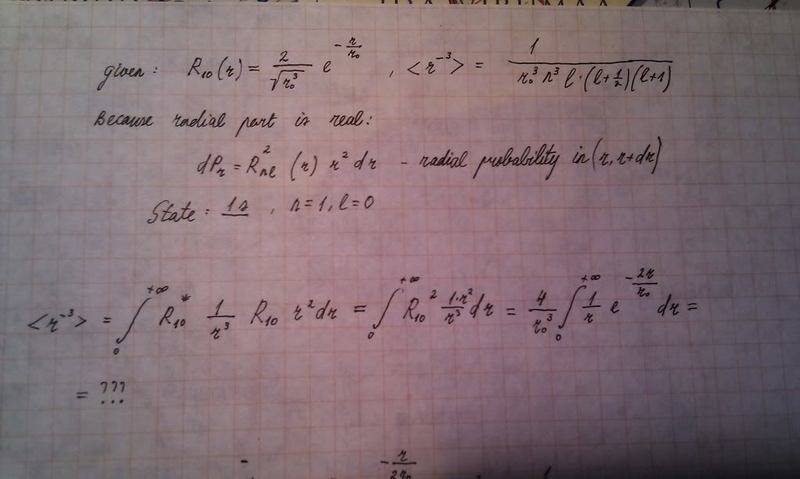
1sdivergeproblemlarger.jpg


I found out that there is a similar formula on integral-table.com

integraltableformula.jpg


but I guess there n is a natural number, am I right?


The Attempt at a Solution


Homework Statement


r^(-2) for 2p - there I have a constant problem:
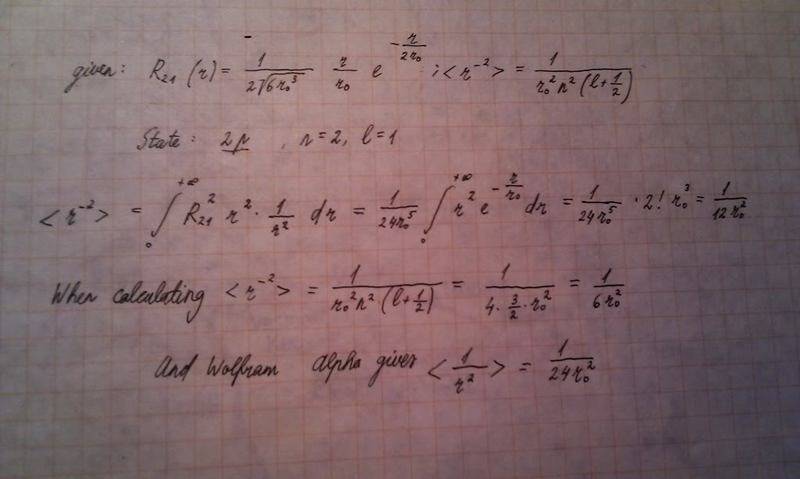
2pconstantproblem.jpg


Homework Equations


The Attempt at a Solution


Last edited:
Physics news on Phys.org


from the simple fact that [tex]\Gamma(z+1) = z\Gamma(z)[/tex] where [tex]\Gamma(z) = \int_{0}^{+ \infty} t^{z-1} e^{-t} dt[/tex]


Yeah, I knew it would settle down for Gamma function. If I got it then:

When to reparametrize r=r0t and calculate, we get the definition of Gamma function. Because in my problem, n was -1, I would have to calculate Gamma(-1). It's modulus is +infinity, because Gamma(n)= [Gamma(n+2)]/[n*(n+1)] and if n=-1, then we get division by zero and it's limit is infinity.

I hope that is more or less it? Can anybody validate this?


The constant problem still stands.


I think understand the divergence problem, quite simple actually. Integrating by parts gives Gamma(0), because one can show, that u*v limits to 0, so no recurrence relation for Gamma function needed at all, because modulus of Gamma(0) tends to infinity

GammaFunction_1000.gif


PS! I was also right at the beginning. It can be also done by the upper incomplete Gamma function. Consider the formula:

integraltableformula.jpg


What matters is on the right - I get the special case for upper incomplete gamma function (0,0) that in fact equals to Gamma(0) and this limit tends to infinity. At the same time this is also the special case for the lower incomplete gamma function, so they coincide for 0.
As you can read from http://mathworld.wolfram.com/IncompleteGammaFunction.html
and http://en.wikipedia.org/wiki/Incomplete_gamma_function the incomplete gamma function is the generalized gamma function.


The second problem is more fundamental now - actually I had differences (*1/2) in 2 cases. In one case, Alpha got the same answer as me (integrating), but theoretical formula differs by *1/2.
The other one is the one of which I have the second picture here - there I had a mistype, now Alpha gives the same answer there too, but the result with theoretical formula still differs *1/2.

So now the problem is - the theoretical formula with quantum numbers doesn't give the same answer as my integral and Wolfram Alpha!


Can anybody give me an insight what is going on? I don't know if I should find any similar formulas from a textbook, these formulas I took from professor's notes.

Thanks!
 
Last edited:


I figured even integration by parts wasn't necessary, only a change of variable.

I passed the exam and the professor did not find any mistakes in my integrals.

There is a chance that at least r^(-2) expectation value formula with quantum numbers may be slightly faulty. I did not have time to check them before the exam but the professor promised to check and maybe some day I will know where the rub was.
 

Similar threads

  • · Replies 5 ·
Replies
5
Views
2K
  • · Replies 1 ·
Replies
1
Views
4K
  • · Replies 21 ·
Replies
21
Views
2K
  • · Replies 1 ·
Replies
1
Views
3K
Replies
5
Views
2K
Replies
2
Views
2K
  • · Replies 10 ·
Replies
10
Views
3K
Replies
3
Views
2K
  • · Replies 4 ·
Replies
4
Views
5K
  • · Replies 4 ·
Replies
4
Views
2K