Solve Ray Optics Problem to Find delta y

Click For Summary

Homework Help Overview

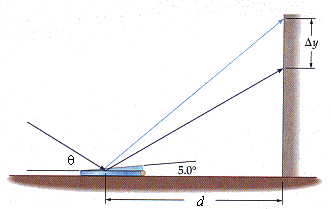
The problem involves ray optics, specifically the reflection of light from a tilted mirror. The original poster is trying to determine how much higher a spot of light will be on a wall when a mirror is tilted at a specific angle.

Discussion Character

  • Exploratory, Assumption checking

Approaches and Questions Raised

  • The original poster attempts to calculate the change in height of the light spot using trigonometric relationships, but questions arise regarding the correct angles to use after tilting the mirror.

Discussion Status

Participants are actively discussing the implications of tilting the mirror on the angles involved in the reflection. Some guidance has been offered regarding the need to reconsider the angles based on the new orientation of the mirror.

Contextual Notes

There is a focus on the correct interpretation of angles relative to the mirror's surface, and participants are exploring how the law of reflection applies when the mirror is not flat. The original poster has received feedback indicating that their initial angle assumptions may be incorrect.

FlipStyle1308
Messages
264
Reaction score
0
Here is the problem I am working on:

Sunlight enters a room at an angle of theta = 32° above the horizontal and reflects from a small mirror lying flat on the floor. The reflected light forms a spot on a wall that is d = 1.9 m behind the mirror, as shown in Figure 26-42. If you now place a pencil under the edge of the mirror nearer the wall, tilting it upward by 5.0°, how much higher on the wall (delta y) is the spot?
26-42alt.gif


Here is what I have done:

delta y = yf - yi = d tan thetaf - d tan thetai = (1.9m)(tan37 - tan32) = 24.45 cm

In WebAssign, I submitted both 24.45 cm and 24 cm, but neither was accepted. What am I doing wrong? My instructor said my answer is not close to that in WebAssign.
 
Physics news on Phys.org
FlipStyle1308 said:
Here is what I have done:

delta y = yf - yi = d tan thetaf - d tan thetai = (1.9m)(tan37 - tan32) = 24.45 cm

In WebAssign, I submitted both 24.45 cm and 24 cm, but neither was accepted. What am I doing wrong? My instructor said my answer is not close to that in WebAssign.
You have the wrong angle. When the mirror's flat, the normal line to its surface points straight up. But when it's tilted, where does the normal line point? Now apply the law of reflection about that new normal.
 
Draw a separate diagram for the second situation, and put in the angles carefully.

Edit: Doc beat me to it.
 
Doc Al said:
You have the wrong angle. When the mirror's flat, the normal line to its surface points straight up. But when it's tilted, where does the normal line point? Now apply the law of reflection about that new normal.

When the mirror's tilted, the normal line points upward, away from the wall, right? So does this mean the angle I should replace is supposed to be 85 degrees?
 
FlipStyle1308 said:
When the mirror's tilted, the normal line points upward, away from the wall, right? So does this mean the angle I should replace is supposed to be 85 degrees?
When you tilt the mirror, the angle θ changes, so the reflection angle changes. But these angles are relative to the plane of the mirror, and the mirror is no longer flat on the table.
 
OlderDan said:
When you tilt the mirror, the angle θ changes, so the reflection angle changes. But these angles are relative to the plane of the mirror, and the mirror is no longer flat on the table.

Okay, so I drew myself a picture. Originally the normal line is straight up, as Doc Al said. As the mirror is tilted 5 degrees, the normal line is now pointing 5 degrees in the upper left direction. Theta changes and increases to 37 degrees. But on the other side of the normal line, theta is 42 degrees, is that right? So I replace 37 with 42, or am I still doing something wrong?
 
FlipStyle1308 said:
Okay, so I drew myself a picture. Originally the normal line is straight up, as Doc Al said. As the mirror is tilted 5 degrees, the normal line is now pointing 5 degrees in the upper left direction. Theta changes and increases to 37 degrees. But on the other side of the normal line, theta is 42 degrees, is that right? So I replace 37 with 42, or am I still doing something wrong?
I would give the angle on the right a name other than theta, since the angle you need to locate the spot is now theta + the 5 degree rotation, but yes, 42 degrees is the angle between the reflected beam and the floor.
 
OlderDan said:
I would give the angle on the right a name other than theta, since the angle you need to locate the spot is now theta + the 5 degree rotation, but yes, 42 degrees is the angle between the reflected beam and the floor.

Thank you!
 
Last edited:

Similar threads

  • · Replies 16 ·
Replies
16
Views
2K
Replies
13
Views
4K
  • · Replies 4 ·
Replies
4
Views
2K
  • · Replies 5 ·
Replies
5
Views
7K