Solve RLC Circuit Problem - Small & Large Frequencies

Click For Summary

Homework Help Overview

The discussion revolves around an RLC circuit problem, specifically analyzing the behavior of the circuit at very small and very large frequencies. Participants are exploring the implications of frequency changes on current flow through the circuit components.

Discussion Character

  • Exploratory, Conceptual clarification, Assumption checking

Approaches and Questions Raised

  • Participants discuss the effects of frequency on the reactance of the inductor and capacitor, noting that at low frequencies, the inductor behaves like a short circuit and the capacitor like an open circuit, while at high frequencies, the opposite is true. There are questions about the implications of these behaviors on current flow.

Discussion Status

The discussion is active, with participants providing insights into the behavior of circuit components under varying frequency conditions. Some guidance has been offered regarding the replacement of components based on frequency, but no consensus has been reached on the final analysis.

Contextual Notes

Participants are working within the constraints of a homework assignment, which may limit the depth of analysis or the use of certain equations. There is an emphasis on understanding the conceptual framework rather than deriving specific solutions.

spacemanrussell
Messages
6
Reaction score
0
RLC Circuit problem. Please Help!

Homework Statement


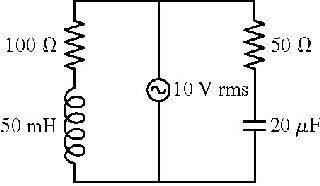
In the figure, what is the current supplied by the emf when the frequency is very small?

What is the current supplied by the emf when the frequency is very large?
knight_Figure_35_52.jpg

Homework Equations

I am not sure but:

wo=1/sqrt(LC)

Vr=IR

Vl=IXl

Vc=IXc
 
Last edited by a moderator:
Physics news on Phys.org
When the frequency is very small. XL = 2*pi*f*L is nearly zero and XC = 1/2*pi*f*C is near open circuit, and most of the current will flow through inductor branch
When the frequency is very high. XL = 2*pi*f*L very high and XC = 1/2*pi*f*C is near zero and most of the current will flow through capacitor branch.
 
For high enough frequencies you can replace the inductor with an open circuit, and replace the capacitor with a short circuit. For low enough frequencies you can replace the inductor with a short circuit and the capacitor with an open circuit.
 
Thank You!

I am pretty sure I will be able to get it now.
 

Similar threads

  • · Replies 21 ·
Replies
21
Views
2K
  • · Replies 8 ·
Replies
8
Views
2K
  • · Replies 3 ·
Replies
3
Views
1K
  • · Replies 3 ·
Replies
3
Views
2K
Replies
1
Views
2K
  • · Replies 14 ·
Replies
14
Views
3K
  • · Replies 3 ·
Replies
3
Views
3K
  • · Replies 8 ·
Replies
8
Views
2K
Replies
8
Views
2K
Replies
5
Views
3K