Solve Weird Matrix Equation to Get Values for P

  • Context: Graduate 
  • Thread starter Thread starter maistral
  • Start date Start date
  • Tags Tags
    Matrix Weird
Click For Summary

Discussion Overview

The discussion revolves around a matrix equation related to systems of ordinary differential equations (ODEs) and the search for a matrix \( P \) that relates two numerical matrices. Participants explore the existence and uniqueness of \( P \), eigenvalues of the matrices involved, and potential methods for finding \( P \).

Discussion Character

  • Exploratory
  • Technical explanation
  • Debate/contested
  • Mathematical reasoning

Main Points Raised

  • One participant expresses curiosity about finding values for \( P \) after encountering a matrix in their notes on Laplace transforms.
  • Another participant argues that \( P \) does not exist because the eigenvalues of the left and right matrices are different.
  • A third participant suggests that \( P \) exists but is not unique, having found a possible \( P \) using Mathematica but lacking a rigorous method.
  • One participant provides eigenvalue findings, noting one real eigenvalue and a complex-conjugate pair for the left matrix, while the right matrix has eigenvalues \(\{-3,-2,-1\}\), concluding that the matrices cannot be similar.
  • A later reply corrects a mistake regarding the right matrix's eigenvalues, suggesting that the two matrices may differ only by the arrangement of numerical values.
  • Another participant proposes using a reflection matrix as a potential solution and discusses a general approach for diagonalizable matrices with the same spectrum, indicating that if the eigenvalues are distinct, \( P \) would be unique up to rescaling.

Areas of Agreement / Disagreement

Participants do not reach a consensus on the existence of \( P \). Some argue it does not exist due to differing eigenvalues, while others believe it exists but is not unique. The discussion remains unresolved regarding the correct approach to finding \( P \).

Contextual Notes

Participants note potential errors in the original problem statement and discuss the implications of eigenvalue differences on the similarity of matrices. There are also references to assumptions about diagonalizability and the uniqueness of \( P \) based on eigenvalue properties.

maistral
Messages
235
Reaction score
17
So while I was trying to browse some notes with regard to Laplace transforms in solving systems of ODE, this matrix came up:
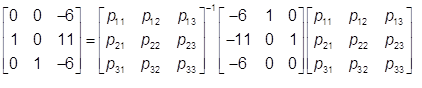
matrix eqn.png

I could easily just use RK4 and call it a day to nuke the systems of ODE, but this actually made me curious. Apparently one can transform the matrix DE into another form, then this appeared.

How do I get the values for P?
 
Physics news on Phys.org
I don't think such ##P## exists. The numerical matrices on the left and right have different eigenvalues.
 
S.G. Janssens said:
I don't think such ##P## exists. The numerical matrices on the left and right have different eigenvalues.
It exists and is not unique.

I was able to obtain a possible ##P## using Mathematica. However, I do not know how to do it in a rigorous fashion.
 
What do you find for the eigenvalues of the left and right numerical matrices? For the one on the left I get one real eigenvalue and a complex-conjugate pair, while for the matrix on the right I get ##\{-3,-2,-1\}##. So these two matrices cannot be similar.

(If such ##P## would exist, it would not be unique indeed, because every nonzero multiple of ##P## would also qualify.)
 
  • Like
Likes   Reactions: DrClaude
S.G. Janssens said:
What do you find for the eigenvalues of the left and right numerical matrices? For the one on the left I get one real eigenvalue and a complex-conjugate pair, while for the matrix on the right I get ##\{-3,-2,-1\}##. So these two matrices cannot be similar.
I made a mistake and used +11 instead of -11 in the right matrix. My guess is that there is an error in the OP and that the two matrices differ only by the arrangement of the numerical values.
 
  • Like
Likes   Reactions: S.G. Janssens
assuming the stated typo, consider using the reflection matrix

##\mathbf J = \left[\begin{matrix}0 & 0 & 1\\0 & 1 & 0\\1 & 0 & 0\end{matrix}\right]##

which is a permutation matrix (and involutary)

note:
For the nice case of diagonalizable matrices with the same spectrum (and in particular the extra nice case where all eigenvalues are distinct), the general approach is
##\mathbf S^{-1} \mathbf A \mathbf S= \mathbf D ##
and
##\mathbf U^{-1} \mathbf B \mathbf U= \mathbf D ##

so
##\mathbf U^{-1} \mathbf B \mathbf U= \mathbf S^{-1} \mathbf A \mathbf S ##
## \mathbf B = \mathbf U\mathbf S^{-1} \mathbf A \mathbf S\mathbf U^{-1} ##
setting ##\mathbf P:= \mathbf S\mathbf U^{-1}##
gives
## \mathbf B = \mathbf P^{-1} \mathbf A \mathbf P ##

the fact that the eigenvalues are distinct proves that ##\mathbf P## is unique (up to rescaling)

but in this case I could just eyeball the problem as a graph isomorphism and come up with ##\mathbf J##
 
Last edited:
  • Like
Likes   Reactions: DrClaude

Similar threads

  • · Replies 12 ·
Replies
12
Views
3K
  • · Replies 2 ·
Replies
2
Views
2K
Replies
6
Views
3K
  • · Replies 1 ·
Replies
1
Views
2K
  • · Replies 4 ·
Replies
4
Views
3K
  • · Replies 15 ·
Replies
15
Views
4K
Replies
4
Views
4K
  • · Replies 5 ·
Replies
5
Views
5K
  • · Replies 1 ·
Replies
1
Views
2K
  • · Replies 9 ·
Replies
9
Views
4K