Solving a Differential Equation: dy/dt = t/(y + 1)

Click For Summary

Homework Help Overview

The discussion revolves around solving the differential equation dy/dt = t/(y + 1) with the initial condition y(2) = 0. Participants are exploring the steps involved in isolating y after integrating the equation.

Discussion Character

  • Exploratory, Mathematical reasoning, Problem interpretation

Approaches and Questions Raised

  • The original poster attempts to integrate the equation and expresses confusion about isolating y and the appearance of constants in the solution. Some participants suggest completing the square and applying the initial condition to evaluate constants.

Discussion Status

Participants are actively discussing the integration process and the subsequent steps needed to isolate y. There is a focus on ensuring the initial condition is applied correctly, and multiple interpretations of the integration steps are being explored.

Contextual Notes

There is mention of confusion regarding the constants that arise during the integration process and the implications of the initial condition on the solution.

magnifik
Messages
350
Reaction score
0
Can someone help me find the solution for this

dy/dt = t/(y + 1) with initial condition y(2) = 0

here's what i have done so far
(y + 1) dy = t dt
y2/2 + y = t2/2 + C

i am confused on how to isolate y.
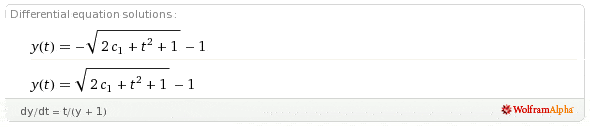
this is the solution
rmim21.gif
without using the initial condition. where did the + 1 in the square root and - 1 outside of the square root come from?
 
Physics news on Phys.org
First, multiply both sides by 2. Then complete the square on the LHS.
 
Don't forget, use y(2)=0, to evaluate C. (or c1).
 
After you've separated your variables and integrated both sides (which you have done correctly), multiply both sides by 2 to get rid of your coefficents and take the square root of both sides to solve for t. Then apply your condition.
 
TJ@UNF said:
After you've separated your variables and integrated both sides (which you have done correctly), multiply both sides by 2 to get rid of your coefficents and take the square root of both sides to solve for t. Then apply your condition.
Once you have multiplied both sides by 2, you will still have y^2+ 2y on the left side and just "taking the square root" won't give you y. Complete the square as Char. Limit said in the very first response to this thread.
 
Thanks for the help!
 

Similar threads

Replies
3
Views
2K
  • · Replies 10 ·
Replies
10
Views
2K
  • · Replies 4 ·
Replies
4
Views
2K
  • · Replies 3 ·
Replies
3
Views
2K
  • · Replies 8 ·
Replies
8
Views
2K
Replies
12
Views
2K
Replies
6
Views
2K
Replies
7
Views
2K
  • · Replies 12 ·
Replies
12
Views
3K
Replies
5
Views
2K