mhrob24
- 53
- 9
- Homework Statement
- Moving a force to a point not on the line of action
- Relevant Equations
- M = FD
This isn’t a HW problem per say, but it’s an example shown in my statics textbook that is used to try an explain that you need to add a couple moment to move a force to a point not on the line of action, and I’m just not seeing how the direction of the couple moment is correct. See the image below:
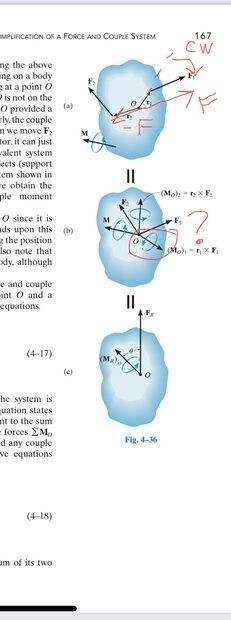
Using the RHR (extending r1 and crossing into F1)and adding an opposite pair of forces at the point you are moving the force to (point “O”), the direction of the moment vector to me looks like it should be pointing to the left (into page, clockwise moment)….but the book is showing the opposite. The only way I see that moment vector direction being correct is if -F is applied What am I not seeing here? I feel like I understand the concept, but this specific example is tripping me up.
Using the RHR (extending r1 and crossing into F1)and adding an opposite pair of forces at the point you are moving the force to (point “O”), the direction of the moment vector to me looks like it should be pointing to the left (into page, clockwise moment)….but the book is showing the opposite. The only way I see that moment vector direction being correct is if -F is applied What am I not seeing here? I feel like I understand the concept, but this specific example is tripping me up.