Solving a Power Screw Question - Get Help Here

  • Thread starter Thread starter Saladsamurai
  • Start date Start date
  • Tags Tags
    Power Screw
Click For Summary
SUMMARY

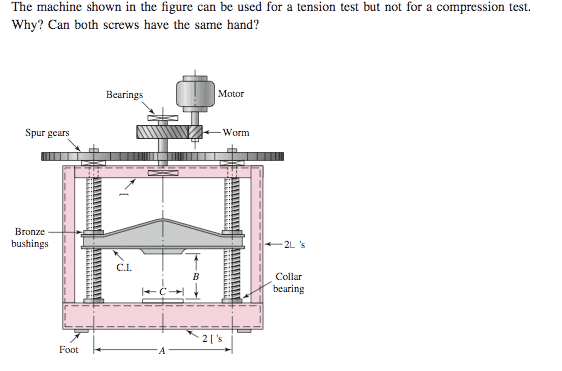
The discussion focuses on the proper setup for a power screw mechanism in tensile testing, specifically addressing the placement of the tensile specimen at the "B" dimension. It is confirmed that both screws must have the same hand for correct operation. The original explanation in the design text is criticized for its lack of clarity. Additionally, it is noted that the absence of thrust bearings at the top of the screws prohibits the machine from being used for compression tests due to potential galling of the upper channel web material.

PREREQUISITES
  • Understanding of power screw mechanisms
  • Familiarity with tensile testing procedures
  • Knowledge of thrust bearings and their applications
  • Basic principles of material science related to galling
NEXT STEPS
  • Research the design and function of thrust bearings in mechanical systems
  • Learn about the implications of galling in material selection for mechanical components
  • Study the principles of tensile testing and its setup
  • Explore different types of power screws and their applications in engineering
USEFUL FOR

Mechanical engineers, materials scientists, and students studying mechanical design or testing methodologies will benefit from this discussion.

Saladsamurai
Messages
3,009
Reaction score
7
I was reading through some examples in my Design text when I came across this one.
Picture7-3.png
This was their solution:

Picture8-1.png


I am not sure that I completely follow it. Can someone help shed some light on what's going on here?

I am assuming that the specimen to be put under tension goes where the "B" dimension is right?
 
Engineering news on Phys.org
Yes, the tensile specimen goes where the B dimension is. Both screws must have the same hand. My impression is, their explanation is very poorly written. Here is the answer I arrived at before reading their solution. The machine is missing thrust bearings at the top of the screws. Therefore, the machine should not be used for a compression test, because galling of the upper channel web material might occur. Plus, the diagram shows only a small-diameter shank inside the upper channel.
 

Similar threads

Replies
5
Views
2K
  • · Replies 22 ·
Replies
22
Views
6K
  • · Replies 3 ·
Replies
3
Views
8K
  • · Replies 6 ·
Replies
6
Views
5K
  • · Replies 4 ·
Replies
4
Views
11K
  • · Replies 28 ·
Replies
28
Views
3K
  • · Replies 5 ·
Replies
5
Views
2K
  • · Replies 3 ·
Replies
3
Views
3K
  • · Replies 1 ·
Replies
1
Views
3K
