Solving an Exact Differential Equation (#1)

Click For Summary

Discussion Overview

The discussion revolves around the process of solving an exact differential equation, specifically addressing the assumptions made in the integration steps and the nature of the constants involved in the solution.

Discussion Character

  • Technical explanation
  • Debate/contested

Main Points Raised

  • One participant expresses confusion about the steps being taken in the solution process.
  • Another participant challenges an assumption made regarding the equality of two expressions involving $x$ and $y$, stating that it is incorrect.
  • A proposed integration approach is presented, breaking down the integral into two parts and providing a specific solution involving arctangent and logarithmic functions.
  • A question is raised about whether the constant of integration should depend on $x$, indicating a potential oversight in the previous steps.
  • A later reply acknowledges the point about the constant and suggests an edit to address it.

Areas of Agreement / Disagreement

Participants do not reach a consensus on the assumptions made in the integration process, and there are competing views regarding the nature of the constant of integration.

Contextual Notes

There are unresolved questions about the assumptions underlying the integration steps and the dependency of the constant on $x$.
r-soy
Messages
170
Reaction score
1

Attachments

  • 866864662.jpg
    866864662.jpg
    72.3 KB · Views: 103
Physics news on Phys.org
Re: show exat or not and solve

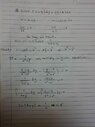
the same idea here as well ,but i don't understand what you are doing exactly !
 
Re: show exat or not and solve

Welcome to MHB, rsoy! :)

Your problem seems to be that you assume $\dfrac{x+y}{x^2+y^2} = \dfrac 1 {x+y}$.
But this is not true.So instead your next step for the first part of the expression would be (edited):
$$\begin{aligned} \int^y \frac{x+y}{x^2+y^2}dy &= \int^y \frac{x}{x^2+y^2}dy &&+ \int^y \frac{y}{x^2+y^2}dy &\\
&= \arctan \left(\frac y x \right) &&+ \frac 1 2 \ln(x^2+y^2) &+ C(x) \end{aligned}$$
 
Last edited:
Re: show exat or not and solve

I like Serena said:
Welcome to MHB, rsoy! :)

Your problem seems to be that you assume $\dfrac{x+y}{x^2+y^2} = \dfrac 1 {x+y}$.
But this is not true.So instead your next step for the first part of the expression would be:
$$\begin{aligned} \int^y \frac{x+y}{x^2+y^2}dy &= \int^y \frac{x}{x^2+y^2}dy &&+ \int^y \frac{y}{x^2+y^2}dy &\\
&= \arctan \left(\frac y x \right) &&+ \frac 1 2 \ln(x^2+y^2) &+ C \end{aligned}$$

Shouldn't the resultant constant be a function of x !
 
Re: show exat or not and solve

ZaidAlyafey said:
Shouldn't the resultant constant be a function of x !

Good point!
Edited.
 
thaaanks
 

Similar threads

  • · Replies 3 ·
Replies
3
Views
1K
  • · Replies 2 ·
Replies
2
Views
2K
  • · Replies 5 ·
Replies
5
Views
3K
  • · Replies 2 ·
Replies
2
Views
4K
  • · Replies 52 ·
2
Replies
52
Views
8K
  • · Replies 1 ·
Replies
1
Views
2K
  • · Replies 3 ·
Replies
3
Views
3K
  • · Replies 3 ·
Replies
3
Views
2K
  • · Replies 14 ·
Replies
14
Views
5K
  • · Replies 5 ·
Replies
5
Views
3K