Solving Infinite Square Well: Eigen Functions & Solutions

Click For Summary

Discussion Overview

The discussion revolves around the derivation of eigenfunctions for an infinite square well potential, specifically comparing solutions for wells defined on different intervals: from 0 to L and from -a to +a. Participants explore the implications of these different definitions on the resulting eigenfunctions.

Discussion Character

  • Exploratory, Technical explanation, Conceptual clarification

Main Points Raised

  • One participant expresses confusion over the derivation of eigenfunctions for an infinite square well, noting a discrepancy between their own findings and course notes.
  • Another participant explains that solutions on the interval [-L/2, L/2] can be obtained from those on [0, L] by a translation of the coordinate system.
  • A third participant acknowledges the explanation provided, indicating that it clarifies their understanding.
  • Another participant suggests that visualizing the ground state solutions for both cases will reveal that they are identical except for the position of the origin.

Areas of Agreement / Disagreement

Participants appear to agree on the method of translating solutions between the two intervals, but the initial confusion regarding the presence of cosine solutions indicates some unresolved uncertainty about the implications of these different definitions.

Contextual Notes

The discussion does not resolve the broader implications of using different intervals for the infinite square well, nor does it address any assumptions underlying the derivations of eigenfunctions.

Who May Find This Useful

Students and educators in quantum mechanics, particularly those studying potential wells and eigenfunction solutions.

mr_whisk
Messages
7
Reaction score
0
Hi all,

Sorry if this question is not very challenging, but I am driving myself to confusion...

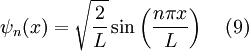
I happily derived the eigen functions for an infinite square well spanning from 0 to L and found them to be:
20276c56b7727f9948f8a7cacfc05d52.png


...in agreement with wikipedia.

However my course notes derive solutions for an inf sq well between -a and +a.

Surely L=2a, no?

In the notes n=1,3,5... produces cosine solutions and n=2,4,6... produce sine solutions.

Why is there now cosine solutions?

Please help, I'm going crazy :)
 
Physics news on Phys.org
You can get the solutions on [-L/2 , L/2] from the solutions on [0, L] by replacing x by x + L/2 (i.e. moving the solutions to the left by L/2). For example, sin(πx/L) becomes sin((π/L)(x + L/2)) = sin(πx/L + π/2) = cos(πx/L).
 
Thankyou dx,

That's brilliant, it all makes sense :)
 
Draw a graph of the ground state (n = 1) solution for both cases. You'll see that the two graphs are identical except for the origin (x = 0) being in different places relative to the walls of the well. Likewise for n = 2, etc.
 

Similar threads

  • · Replies 6 ·
Replies
6
Views
2K
  • · Replies 1 ·
Replies
1
Views
1K
Replies
7
Views
2K
  • · Replies 15 ·
Replies
15
Views
5K
  • · Replies 5 ·
Replies
5
Views
2K
  • · Replies 1 ·
Replies
1
Views
1K
  • · Replies 13 ·
Replies
13
Views
11K
Replies
2
Views
2K
  • · Replies 39 ·
2
Replies
39
Views
14K
  • · Replies 2 ·
Replies
2
Views
2K