Finite square well ##\psi(x)## solution for ##-a < x < a##

Click For Summary
SUMMARY

The discussion centers on the solution for the finite square well in quantum mechanics, specifically addressing the wave function ##\psi(x)## for the region ##-a < x < a##. It clarifies that ##\psi(x)## represents a time-independent wave function, while ##\Psi(x,t)## denotes a time-dependent wave function. The conversation highlights the importance of separating solutions into components ##\phi_1(x)## and ##\phi_2(x)## due to the linearity of the Schrödinger equation, allowing for simplified calculations. The sine term's omission in the region ##0 < x < a## is discussed, emphasizing that while the general solution includes both sine and cosine terms, focusing on one can streamline the analysis.

PREREQUISITES
  • Understanding of quantum mechanics principles, particularly wave functions
  • Familiarity with the Schrödinger equation and its linearity
  • Knowledge of finite square well potential and its implications
  • Basic grasp of mathematical functions, including sine and cosine
NEXT STEPS
  • Study the derivation of the finite square well solution in Griffiths' "Introduction to Quantum Mechanics"
  • Learn about the implications of time-independent vs. time-dependent wave functions
  • Explore the mathematical techniques for solving the Schrödinger equation
  • Investigate the physical significance of boundary conditions in quantum mechanics
USEFUL FOR

Students and professionals in physics, particularly those studying quantum mechanics, as well as educators seeking to clarify concepts related to wave functions and the finite square well potential.

gfd43tg
Gold Member
Messages
949
Reaction score
48
Hello, in Griffith's section on the Finite Square Well, ##\psi(x)## (what is the name of this anyway?, I know ##\Psi(x,t)## is called the wave function but how do I call just ##\psi(x)##?)

Anyways,

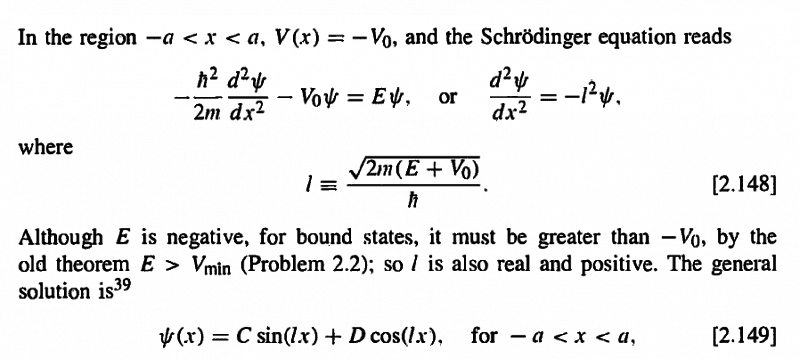
The solution is
upload_2015-3-4_22-45-2.png

For x < a and x > a, the terms that are infinite as x approaches infinity are said to be not physical, so the author concludes that they are not part of the solution, however that should not be the case here.

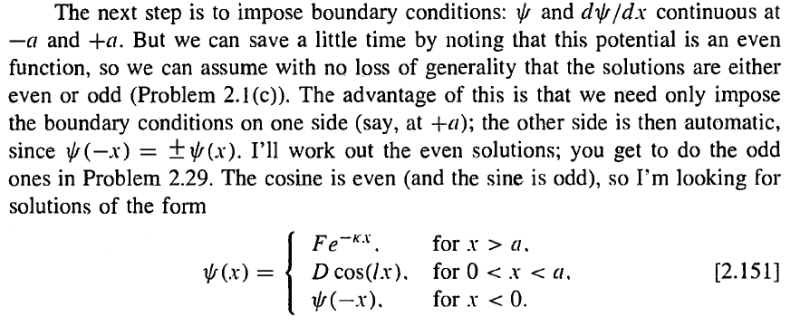
Then he clumps all the solutions together
upload_2015-3-4_22-46-36.png

But what happened to the sine term in the region 0 < x < a??
 

Attachments

  • upload_2015-3-4_21-11-45.png
    upload_2015-3-4_21-11-45.png
    22.5 KB · Views: 523
  • upload_2015-3-4_21-12-8.png
    upload_2015-3-4_21-12-8.png
    37.8 KB · Views: 581
Physics news on Phys.org
##\Psi(x,t)## is a time-depemdent wave function, ##\psi(x)## is a time-independent wave function / stationary state.

Since the Schroedinger equation is linear, if you have a solution of the type ##\psi(x) = \phi_1(x) + \phi_2(x)##, you can study the two ##\phi_i(x)## separately, and then recombine the results. It is true that the full, general, solution is the one with sine and cosine, but to understand the physics it's enough to work out the rest of the calculations just for one of the two, which simplifies the math. If you try to redo the calculations with the sine, you will see that Eq.[2.154] will become ##k = - l \cot(la)## , ...
 

Similar threads

  • · Replies 10 ·
Replies
10
Views
2K
  • · Replies 1 ·
Replies
1
Views
1K
  • · Replies 9 ·
Replies
9
Views
2K
  • · Replies 1 ·
Replies
1
Views
2K
  • · Replies 1 ·
Replies
1
Views
2K
  • · Replies 6 ·
Replies
6
Views
2K
  • · Replies 2 ·
Replies
2
Views
1K
  • · Replies 15 ·
Replies
15
Views
5K
  • · Replies 2 ·
Replies
2
Views
2K
  • · Replies 1 ·
Replies
1
Views
2K