Solving Laplace Equation in Cylindrical Coordinates - Potential Outside Cylinder

Click For Summary

Homework Help Overview

The discussion revolves around solving the Laplace equation in cylindrical coordinates, specifically focusing on the potential outside a cylinder with specified boundary conditions. The potential is zero on the side and bottom of the cylinder, while the top has a potential V_0. Participants are exploring the implications of these conditions on the solution approach.

Discussion Character

  • Exploratory, Conceptual clarification, Mathematical reasoning, Assumption checking

Approaches and Questions Raised

  • Participants discuss the use of Bessel functions in the solution, noting the differences between Bessel functions of the first kind (Js) and second kind (Ns). Questions arise regarding the appropriate form of the potential outside the cylinder, particularly concerning the z-dependence and whether hyperbolic functions should be used.

Discussion Status

The discussion is active, with participants providing insights into the boundary conditions and the nature of the potential. Some express concerns about the complexity of the solution and the potential need for piecewise functions to address the varying conditions in different regions.

Contextual Notes

Participants note that the problem may involve a surface charge to satisfy the boundary conditions, which could complicate the differentiability of the potential at the surface of the cylinder. There is also a suggestion that the problem may not yield a simple series solution due to the complexities of the space outside the cylinder.

ricky123
Messages
2
Reaction score
0
The potential on the side and the bottom of the cylinder is zero, while the top has a potential V_0. We want to find the potential outside the cylinder.
laplace.png

Can I use the same boundary conditions as for case of inside cylinder potential?
What is different?
 
Physics news on Phys.org
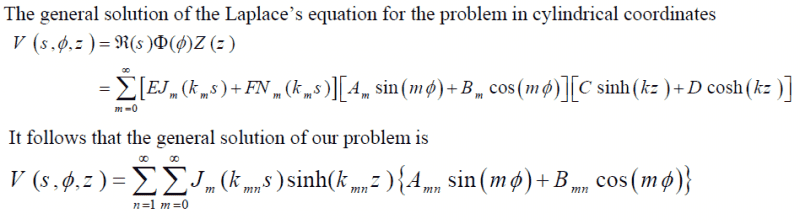
The difference is about the functions used in the expansion. The Js are Bessel functions of the first kind and have no singularity, so there is nothing about them. But there is a point about the Ns. They're called Bessel functions of the second kind, Weber functions or Neumann functions. They have a singularity at the origin and because we want a finite potential everywhere, we don't use the Ns for inside the cylinder. But because outside the cylinder, the Ns are finite too, you can use them in the potential too and don't have to use only Js in the s-dependent part.
Boundary conditions are the same. Just there are two added, the equality of the two potentials (for inside and outside of the cylinder) and their derivatives should be equal at the surface of the cylinder.
 
Thanks for your reply.
The general solution for potential outside the cylinder is than
\Phi(\rho>a, \varphi, z)=\sum_{m=0}^{\infty}\sum_{n=1}^{\infty}\big(J_{m}(k_{mn}\rho)+N_{m}(k_{mn}\rho)\big)\sinh(k_{mn}z)[A_{mn}\sin(m\varphi)+B_{mn}\cos(m\varphi)].
Is there sin hyp function in z dependence part?
Or must we split function on two part, for z>L and z<L and use exp function for z-dependent part? Because hyp functions don't vanish when z goes to infinity.
\Phi(\rho&gt;a, \varphi, z&gt;L)=\sum_{m=0}^{\infty}\sum_{n=1}^{\infty}\big(J_{m}(k_{mn}\rho)+N_{m}(k_{mn}\rho)\big)\mathrm{e}^{-k_{mn}z}[A_{mn}\sin(m\varphi)+B_{mn}\cos(m\varphi)]
\Phi(\rho&gt;a, \varphi, z&lt;L)=\sum_{m=0}^{\infty}\sum_{n=1}^{\infty}\big(J_{m}(k_{mn}\rho)+N_{m}(k_{mn}\rho)\big)\mathrm{e}^{k_{mn}z}[C_{mn}\sin(m\varphi)+D_{mn}\cos(m\varphi)]
What is the right way?

There is a sketch for a better illustration:
valj.png
 
Shyan said:
The difference is about the functions used in the expansion. The Js are Bessel functions of the first kind and have no singularity, so there is nothing about them. But there is a point about the Ns. They're called Bessel functions of the second kind, Weber functions or Neumann functions. They have a singularity at the origin and because we want a finite potential everywhere, we don't use the Ns for inside the cylinder. But because outside the cylinder, the Ns are finite too, you can use them in the potential too and don't have to use only Js in the s-dependent part.
Boundary conditions are the same. Just there are two added, the equality of the two potentials (for inside and outside of the cylinder) and their derivatives should be equal at the surface of the cylinder.

His cylinder is finite and part of the z axis is contained in the outside as well. His boundary conditions are specified on the full cylinder surface and there is no need to add further conditions. There is in general going to be a surface charge in order to fulfill the given boundary conditions, so the potential may not be differentiable on the surface.

Furthermore I suspect this problem will not admit a simple series solution since the outside of the cylinder is a relatively nasty space to work in. The eigenfunctions are going to be fairly nasty and you will probably have to patch solutions in different parts of space with corresponding solutions to match the boundaries.
 

Similar threads

Replies
1
Views
2K
Replies
11
Views
3K
  • · Replies 13 ·
Replies
13
Views
3K
  • · Replies 2 ·
Replies
2
Views
2K
  • · Replies 19 ·
Replies
19
Views
4K
  • · Replies 6 ·
Replies
6
Views
5K
Replies
3
Views
2K
  • · Replies 2 ·
Replies
2
Views
2K
  • · Replies 1 ·
Replies
1
Views
4K
  • · Replies 1 ·
Replies
1
Views
4K