Solving MOSFET Circuit Problem with Q1 & Q2

  • Thread starter Thread starter etf
  • Start date Start date
  • Tags Tags
    Circuit Mosfet
Click For Summary
The discussion focuses on a circuit involving NMOS (Q1) and PMOS (Q2) transistors, with specific parameters provided for each. The user encounters a contradiction when calculating the drain current ID1, which does not align with the expected current based on the given values and assumptions about saturation. The conversation highlights the need for a proper circuit diagram to clarify the contradictions and emphasizes the importance of including Early voltages in the calculations. A solution is proposed using equations that account for channel modulation, leading to derived values for Vds1, Vgs2, and the output voltage Vout. The user also notes that the simulation software Multisim fails to simulate the original circuit correctly, indicating potential errors in the circuit diagram.
etf
Messages
179
Reaction score
2
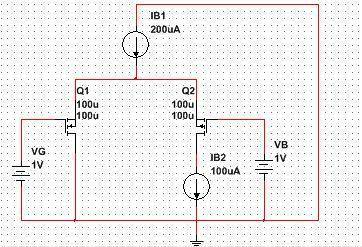
Here is my circuit:

kolo.JPG


Q1 is NMOS and Q2 is PMOS.
Q1: VT1=0.7V, beta1=2mA/V^2
Q2: VT2=-0.9V, beta2=1.8mA/V^2.
I assumed that both transistors work in saturation. In this mode it must be:
Q1: VG1S1 > VT1, VG1D1 < VT1, ID1=beta1*(VG1S1-VT1)^2/2,
Q2: VS2G2 > -VT2, VD2G2 < -VT2, ID2=beta2*(VS2G2+VT2)^2/2.

We see on scheme that ID2=IB2. Using KCL we get ID1=IB1-ID2=100uA.
Using KVL we get VG1S1=VG. If we put VG1S1=VG in our equation for drain's current in saturation mode we get that ID1=9*10^(-5) A so our equation doesn't hold? (ID1=IB1-ID2=100uA.) :confused:
 
Last edited:
Engineering news on Phys.org
I am confused.
Q1 is a voltage follower that sets the voltage to the common source and 200uA current source.
Q2 can only have 100uA current sink.
Q1 current must carry the difference which is –100 uA, (backwards).
But Q2 is controlled by VB between the drain and gate, not the source.

You have specified voltages and currents and the V~I relationships.
There is no degree of freedom, so you have an over-specified contradiction.

Can you produce a circuit diagram that shows the circuit you are modelling, as it would be implemented between supply rails. That should identify the contradiction.
 
  • Like
Likes 1 person
This is example from my textbook. Here is complete text and original scheme:
Find modes of operation of MOSFETs, their Q points, output DC voltage and voltage gain Av. VG=1V, Vt1=0.7V, Vt2=-0.9V, VA1=VA2=20V, beta1=2mA/V^2, beta2=1.8mA/V^2, IB1=200uA, IB2=100uA, VB=1V.

You can see solution below "Rezultat".
 

Attachments

  • 24052014886.jpg
    24052014886.jpg
    31.6 KB · Views: 601
Last edited:
MOSFET circuit contradiction

Just to mention that NI Multisim 13.0 refuses to simulate original circuit, but if I put VG=1.0162V (100*10^-6 approximately equals 2*10^(-3)*(1.0162-0.7)^2/2 so relation ID1=beta1*(VG1S1-VT1)^2/2 is satisfied) instead of Vg=1V Multisim simulates circuit.
 
Last edited:
Since there are finite Early voltages (VA1=VA2=20V) I must include these voltages in drain's currents like this:
ID1=(beta1/2)*((VG1S1-VT1)^2)*(1+lambda*VD1S1),
ID2=(beta2/2)*((VS2G2+VT2)^2)*(1+lambda*VS1D1),
where lambda is coefficient of channel modulation, lambda=1/VA.
 
You show as a "folded cascode" amplifier (CS + CG).
First what you need is to use this equation
Id1 = 0.5*β*(Vgs1 + Vt1)^2 * (1 + λ*Vds1) and solve is for Vds1.
Because from inspection we know that Vgs1 = 1V and Id1 = 100μA.
After we solve this we get Vds1 = 2.22222V. Thanks to this we can find Vgs2 and solve for Vsd2.
Vgs2 = - 1.22222V and Vsd2 = 1.40309V

And Vout = Vds1 - Vsd2 = 2.22222V - 1.40309V = 0.81913V

And simulation (LTspice) shows similar result.

Edit... And your multisim digram is completely wrong. Q1 is upside down and you have no VDD source.
 

Attachments

  • ff.PNG
    ff.PNG
    4.9 KB · Views: 614
Last edited:
  • Like
Likes 1 person
Thread 'I thought it was only Amazon that sold unsafe junk'
I grabbed an under cabinet LED light today at a big box store. Nothing special. 18 inches in length and made to plug several lights together. Here is a pic of the power cord: The drawing on the box led me to believe that it would accept a standard IEC cord which surprised me. But it's a variation of it. I didn't try it, but I would assume you could plug a standard IEC cord into this and have a double male cord AKA suicide cord. And to boot, it's likely going to reverse the hot and...

Similar threads

  • · Replies 19 ·
Replies
19
Views
4K
  • · Replies 2 ·
Replies
2
Views
3K