MHB Solving Problem w/ Norm Space Proof: Advice & Resources

  • Thread starter Thread starter SamJohannes
  • Start date Start date
  • Tags Tags
    Norm Proof Space
Click For Summary
The discussion revolves around solving a problem related to norm spaces, specifically focusing on the 1-norm defined as the sum of absolute values of vector components. Participants clarify the definition of the norm and its relation to a chosen basis, emphasizing the use of the triangle inequality in proving properties of the norm. Sam seeks further clarification on the implications of expressing a vector as a linear combination of basis vectors and its relevance to continuity in part (b) of the problem. The conversation highlights the importance of understanding continuity in the context of normed spaces and provides a structured approach to tackling the problem. Overall, the exchange fosters a collaborative environment for problem-solving in mathematical analysis.
SamJohannes
Messages
13
Reaction score
0
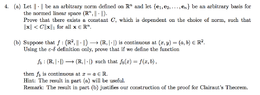
View attachment 3159

Hi guys, I've attached a problem that I've been struggling with for a while now. I was wondering if anyone had some advice on how to approach it (in particular part a) or some resources they could recommend to me?Thanks in advance, Sam
 

Attachments

  • MTH2015_Assign_2_S2_2014_pdf__page_1_of_2_.png
    MTH2015_Assign_2_S2_2014_pdf__page_1_of_2_.png
    31.4 KB · Views: 130
Physics news on Phys.org
Hi Sam, and welcome to MHB!

I assume that $\|\mathbf x\|_1$ is defined as $\sum|x_j|$, where $x_j\ (1\leqslant j\leqslant n)$ are the coordinates of $\mathbf x$ with respect to some basis. It is not clear to me whether that basis is meant to be the given basis $\{\mathbf e_1,\ldots,\mathbf e_n\}$, or the standard basis for $\mathbb{R}^n$?

In the first of those two cases, define $$C = \max_{1\leqslant j\leqslant n}\|\mathbf e_j\|$$. Then $ \|\mathbf x\| = \left\| \sum x_j\mathbf e_j\right\| \leqslant \sum|x_j|\|\mathbf e_j\| \leqslant C\sum|x_j| = C\|\mathbf x\|_1.$ A similar proof will work if the norm $\|\mathbf x\|_1$ is defined with respect to some other basis (such as the standard basis).
 
Thanks for the response Opalg, it's good to be here.

You're right, ∥x∥1 is the 1-norm.
I don't understand the bit ∥x∥=∥∥∑xjej∥∥. Is this true for all norms? Sorry if the question sounds silly, I'm relatively new to the topic.

-Cheers, Sam
 
SamJohannes said:
I don't understand the bit ∥x∥=∥∥∑xjej∥∥. Is this true for all norms?
You are told that $\{\mathrm e_1,\ldots,\mathrm e_n\}$ is a basis. So every vector $\mathrm x$ can be (uniquely) written as a linear combination of the basis vectors: $\mathrm x = \sum x_j\mathrm e_j$. Then $\|\mathrm x\| = \left\|\sum x_j\mathrm e_j\right\|$. The next step is to use the triangle inequality to say that this is $\leqslant \sum|x_j|\|\mathrm e_j\|.$
 
Thanks Opalg. That's helped a lot.
 
Any thoughts on part b?
 
SamJohannes said:
Any thoughts on part b?

Hi Sam,

To prove part (b), fix $\varepsilon > 0$; by continuity of $f$ at $(a,b)$, we can choose a $\delta > 0$ such that for all $(x,y)$, $||(x,y) - (a,b)|| < \delta$ implies $|f(x,y) - f(a,b)| < \varepsilon$.

Here's where I'll use the result of part (a). Let $\eta := \frac{\delta}{C}$, where $C$ is the constant in part (a). For all $x$, $|x - a| < \eta$ implies $||(x,b) - (a,b)||_1 = |x - a| < \eta$. So, $||(x,b) - (a,b)|| < C\eta = \delta$. Hence, $|f_b(x) - f_b(a)| = |f(x,b) - f(a,b)| < \varepsilon$. Since $\varepsilon$ was arbitrary, $f_b$ is continuous at $a$.
 

Similar threads

  • · Replies 5 ·
Replies
5
Views
2K
  • · Replies 8 ·
Replies
8
Views
2K
  • · Replies 2 ·
Replies
2
Views
4K
  • · Replies 102 ·
4
Replies
102
Views
7K
  • · Replies 3 ·
Replies
3
Views
2K
  • · Replies 6 ·
Replies
6
Views
2K
Replies
40
Views
4K
  • · Replies 13 ·
Replies
13
Views
735
Replies
41
Views
6K
  • · Replies 1 ·
Replies
1
Views
2K