Solving series-parallel circuits

  • Thread starter Thread starter LR5
  • Start date Start date
  • Tags Tags
    Circuits
Click For Summary
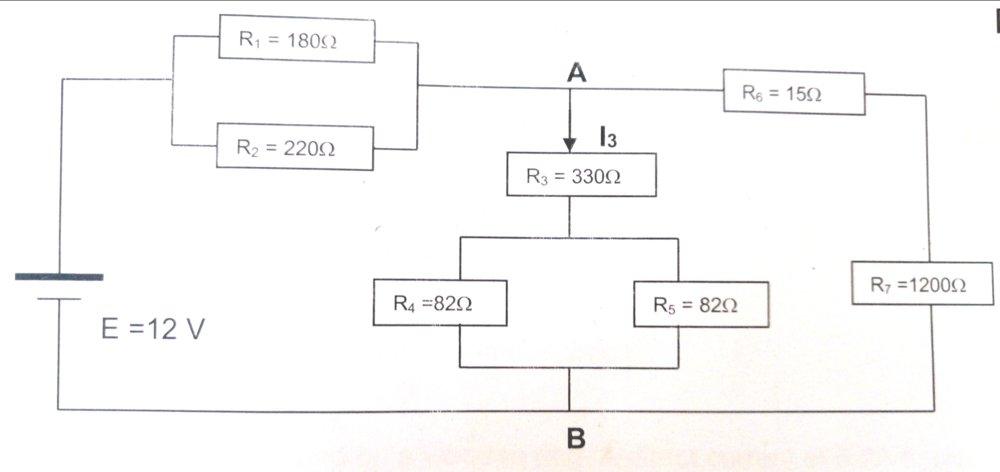
The discussion focuses on solving a series-parallel circuit using the voltage divider rule to find the voltage drop across resistor R4. The user calculated the total resistance as 383Ω, total current as 0.03A, and current through R3 as 0.023A, leading to a voltage of 2.97V across R1 and R2. They determined that the voltage for the rest of the circuit is 9.03V, and calculated the voltage across R4 and R5 to be 1V. However, there is uncertainty about the correctness of these calculations, and a request for detailed step-by-step work on the resistance reduction was made to verify the methods used.
LR5
Messages
17
Reaction score
1
Thread moved from the technical forums, so no Homework Template is shown.
Summary:: Solving series-parallel circuits using current and voltage divider rule
1586343491063.jpeg

For the attached circuit, I need to determine the voltage drop across R4 using the voltage divider rule.
So far, I have determined total resistance to be R = 383Ω, total current I = 0.03A, and I3 = 0.023A.
I think these are correct.
I then get V through R1 and R2 to be 2.97V, therefore V for the rest of the circuit is 9.03V. Then the voltage for AB should be 9.03V.
Then V for R4 and R5 would be V ab (R45/(R45 + R3) = 9.03 x (41/371) = 1V.
I'm not sure if my methods and calculations are correct as this is very confusing :nb)
 
Physics news on Phys.org
LR5 said:
I'm not sure if my methods and calculations are correct as this is very confusing :nb)
How would we know if you are correct, as you show no work on getting the resistance? Show ALL the work used in reducing the circuit, step by step.
 
The book claims the answer is that all the magnitudes are the same because "the gravitational force on the penguin is the same". I'm having trouble understanding this. I thought the buoyant force was equal to the weight of the fluid displaced. Weight depends on mass which depends on density. Therefore, due to the differing densities the buoyant force will be different in each case? Is this incorrect?

Similar threads

  • · Replies 3 ·
Replies
3
Views
2K
  • · Replies 3 ·
Replies
3
Views
2K
  • · Replies 5 ·
Replies
5
Views
2K
  • · Replies 10 ·
Replies
10
Views
3K
  • · Replies 13 ·
Replies
13
Views
1K
  • · Replies 6 ·
Replies
6
Views
2K
  • · Replies 8 ·
Replies
8
Views
2K
  • · Replies 9 ·
Replies
9
Views
3K
  • · Replies 13 ·
Replies
13
Views
2K
  • · Replies 21 ·
Replies
21
Views
1K