Solving series-parallel circuits

  • Thread starter Thread starter LR5
  • Start date Start date
  • Tags Tags
    Circuits
Click For Summary
SUMMARY

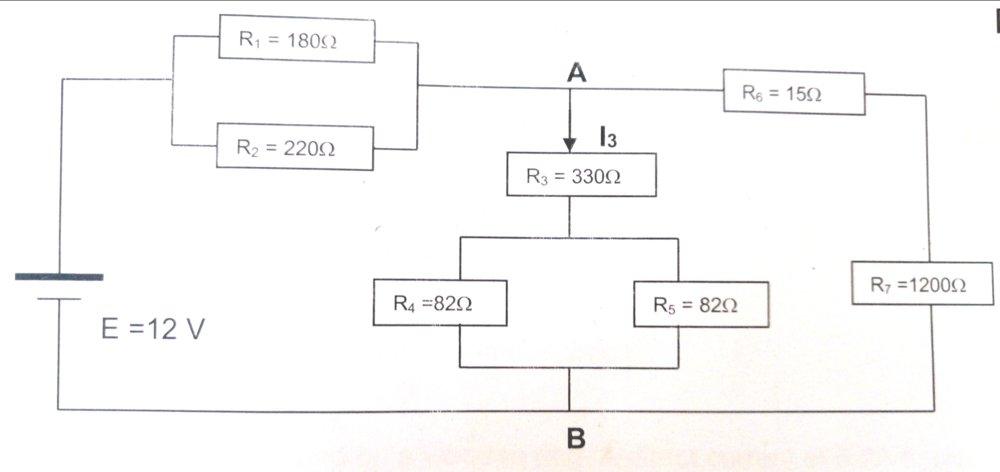
This discussion focuses on solving series-parallel circuits using the current and voltage divider rules. The total resistance calculated is 383Ω, with a total current of 0.03A and a current through R3 of 0.023A. The voltage across R1 and R2 is determined to be 2.97V, leading to a remaining voltage of 9.03V for the rest of the circuit. The voltage across R4 and R5 is calculated using the voltage divider rule, resulting in 1V for R4.

PREREQUISITES
  • Understanding of series-parallel circuit configurations
  • Familiarity with the voltage divider rule
  • Knowledge of Ohm's Law
  • Ability to perform basic circuit analysis
NEXT STEPS
  • Study the application of the current divider rule in series-parallel circuits
  • Learn detailed methods for calculating equivalent resistance in complex circuits
  • Explore advanced circuit analysis techniques using mesh and nodal analysis
  • Practice solving various circuit problems using simulation tools like LTspice
USEFUL FOR

Electrical engineering students, hobbyists working with circuits, and professionals involved in circuit design and analysis will benefit from this discussion.

LR5
Messages
17
Reaction score
1
Thread moved from the technical forums, so no Homework Template is shown.
Summary:: Solving series-parallel circuits using current and voltage divider rule
1586343491063.jpeg

For the attached circuit, I need to determine the voltage drop across R4 using the voltage divider rule.
So far, I have determined total resistance to be R = 383Ω, total current I = 0.03A, and I3 = 0.023A.
I think these are correct.
I then get V through R1 and R2 to be 2.97V, therefore V for the rest of the circuit is 9.03V. Then the voltage for AB should be 9.03V.
Then V for R4 and R5 would be V ab (R45/(R45 + R3) = 9.03 x (41/371) = 1V.
I'm not sure if my methods and calculations are correct as this is very confusing :nb)
 
Physics news on Phys.org
LR5 said:
I'm not sure if my methods and calculations are correct as this is very confusing :nb)
How would we know if you are correct, as you show no work on getting the resistance? Show ALL the work used in reducing the circuit, step by step.
 

Similar threads

  • · Replies 3 ·
Replies
3
Views
2K
  • · Replies 3 ·
Replies
3
Views
2K
  • · Replies 5 ·
Replies
5
Views
2K
  • · Replies 10 ·
Replies
10
Views
3K
  • · Replies 13 ·
Replies
13
Views
1K
  • · Replies 6 ·
Replies
6
Views
2K
  • · Replies 8 ·
Replies
8
Views
2K
  • · Replies 9 ·
Replies
9
Views
3K
  • · Replies 13 ·
Replies
13
Views
2K
  • · Replies 21 ·
Replies
21
Views
2K