Solving Slurry Bed Adsorption: Calculating Residence Time & Isotherm Selection

Click For Summary
SUMMARY

This discussion focuses on calculating residence time in slurry bed adsorption and selecting appropriate isotherms for data fitting. The equation governing the process is defined as dq/dt = (k_la * t_res) / (1 + k_la * t_res) * QS * [c_F - c^*], where t_res is the residence time in seconds, k_la is the volumetric mass transfer coefficient, and Q is the volumetric flow rate. The problem specifies a bed volume of 25 m3 and a calculated residence time of 12.5 seconds. Suggestions for alternative isotherms beyond Freundlich were also sought, emphasizing the need for experimental determination of parameters like k.

PREREQUISITES
  • Understanding of slurry bed adsorption principles
  • Familiarity with mass transfer coefficients and their significance
  • Knowledge of adsorption isotherms, particularly Freundlich
  • Basic mathematical skills for solving differential equations
NEXT STEPS
  • Research the derivation and application of the Langmuir isotherm for adsorption
  • Learn about the calculation of volumetric flow rates in chemical reactors
  • Explore methods for experimentally determining mass transfer coefficients
  • Investigate the impact of particle size and surface area on adsorption efficiency
USEFUL FOR

Chemical engineers, environmental scientists, and researchers involved in adsorption processes and reactor design will benefit from this discussion.

Will26040
Messages
21
Reaction score
3
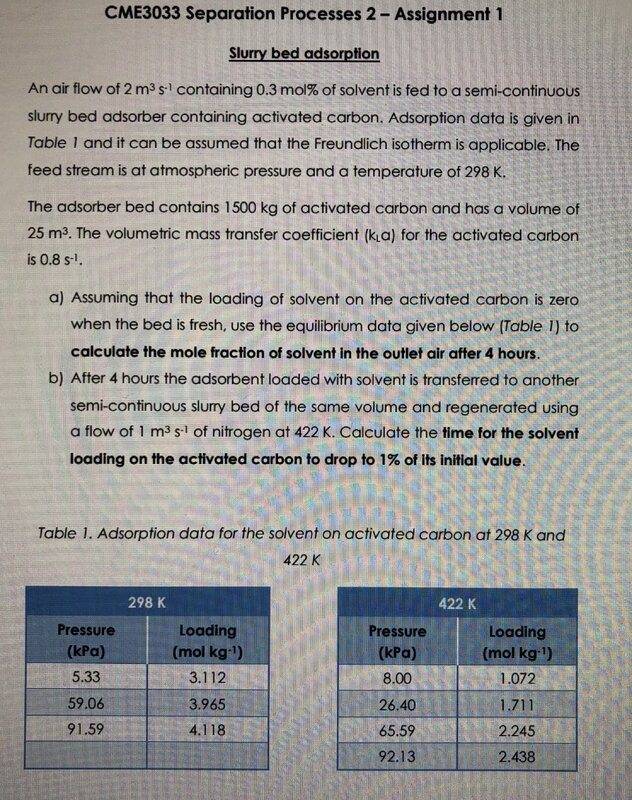
Summary:: I have an assignment on slurry bed adsorption and would like to know how to calculate residence time as it is not specified. I was also wondering if anyone had any suggestions for another isotherm to try and fit the data to (other than freundlich). Thanks
##\frac {dq} {dt} = \frac {k_la .t_{res}} {1+k_la.t_{res}}.\frac QS.[c_F-c^*] ##

where:
##t_{res} =## residence time ##(s)##
## k_la =## volumetric mass transfer coefficient ##(s^{-1})##
##Q= ##Volumetric flowrate
##S= ##adsorbent mass
##c_F=## feed concentration
##c^*= ##Concentration in solution in equilibrium with the loading on the adsorbent (suitable isotherm used)

I know that I need to use the equation specified above and solve numerically to get the loading after 4 hours. However, I am not sure how to get the residence time, as this has been specified in previous examples that I have done. I was also wondering if anyone had any suggestions for another isotherm to try and fit the data to (other than freundlich). Thanks
IMG_3614.jpg
 
Physics news on Phys.org
Please describe your understanding of the derivation of this equation. What is q defined as?
 
Thanks for the reply! q is the loading on the adsorbent at time t

Here is the derivation, where ##c_f## is concentration of adsorbate in feed and ##c_{out}## is the concentration of adsorbent in outlet. I understand it but we are usually given residence time, however it is not given in this question.
2.jpg
1.jpg
 
The parameter a is the total surface area of solid particles in the slurry divided by the total volume of slurry. So the total molar flow rate of solute to the solid surfaces is ##kaV(c_{out}-c^*)##, and this must equal to the volumetric flow rate Q of solvent through the unit times the change in concentration of solvent between inlet and outlet of the unit: $$Q(c_{out}-c_{F})=-kaV(c_{out}-c^*)$$What does that tell you about the residence time?
 
I'm not sure sorry. How would you get the total volume of slurry (V) in this example? as there is a continuous flow of liquid
 
Chestermiller said:
The parameter a is the total surface area of solid particles in the slurry divided by the total volume of slurry. So the total molar flow rate of solute to the solid surfaces is kaV(count−c∗), and this must equal to the volumetric flow rate Q of solvent through the unit times the change in concentration of solvent between inlet and outlet of the unit: Q(count−cF)=−kaV(count−c∗)What does that tell you about the residence time?
How would the parameter a be calculated? By using the the volume and the mass of the bed and researching particle size of activated carbon or by different means?
 
Will26040 said:
I'm not sure sorry. How would you get the total volume of slurry (V) in this example? as there is a continuous flow of liquid
The problem statement states "the absorber bed ..., has a volume of 25 m^3." The value of V is 25 ^3, and the residence time is 12.5 seconds.
 
Eskimo18 said:
Eskimo:
You. would have to know the average surface to volume ratio of the particles, the volume of the bed, and the volume fraction particles. The difficult parameter to obtain is k, or ka. In my judgment this would have to be determined experimentally.
 
Chestermiller said:
The problem statement states "the absorber bed ..., has a volume of 25 m^3." The value of V is 25 ^3, and the residence time is 12.5 seconds.
Is it really that simple? I thought the residence time was affected by how fast the adsorption equilibrium was reached
 
  • #10
Will26040 said:
Is it really that simple? I thought the residence time was affected by how fast the adsorption equilibrium was reached
No way. In a CSTR, the mean residence time is equal to the reactor volume divided by the volume rate of flow.
 
  • #11
Chestermiller said:
You. would have to know the average surface to volume ratio of the particles, the volume of the bed, and the volume fraction particles. The difficult parameter to obtain is k, or ka. In my judgment this would have to be determined experimentally.
Can the value of k not be found using adsoprtion isotherms using the loading and pressure data given?
How would you know the volume fraction of the solvent, would it be 0.3%*2m^3s^-1?
 
  • #12
Eskimo18 said:
Can the value of k not be found using adsoprtion isotherms using the loading and pressure data given?
No. k has nothing to do with the equilibrium behavior. It is related to the rate of diffusion of solute (outside the surface of particles) across the solute concentration boundary layer between the bulk solvent at solute concentration ##C_{out}## and the solvent at the surface of the particles at solute concentration ##C^*##. In terms of the solute concentration boundary layer thickness ##\delta##, k is defined as $$k=\frac{D}{\delta}$$where D is the diffusivity of the solute in the solvent.
How would you know the volume fraction of the solvent, would it be 0.3%*2m^3s^-1?
Where did the "2" come from? Volume fraction in a gas is a synonym for mole fraction.
 
  • #13
Please could you point me in the direction of an equation used for desorption (part b), I have no idea what to use. Thanks
 
  • #14
Will26040 said:
Please could you point me in the direction of an equation used for desorption (part b), I have no idea what to use. Thanks
You use the same equation, except that now, C* exceeds count
 
  • Like
Likes   Reactions: Will26040

Similar threads

  • · Replies 14 ·
Replies
14
Views
4K
Replies
8
Views
7K
  • · Replies 12 ·
Replies
12
Views
2K