Solving Special Relativity Problem with Train Walking

  • Thread starter Thread starter Amrator
  • Start date Start date
  • Tags Tags
    Train
Click For Summary
The discussion centers on solving a special relativity problem involving a train and a person walking inside it. The ground frame measures the train's length as contracted, leading to calculations of the distance traveled and the time taken for the person to walk from the front to the back of the train. Confusion arises regarding the proper time versus the time observed in the ground frame, with clarification that proper time is invariant and specific to the observer's frame. The conversation emphasizes the distinction between proper time and coordinate time, noting that each frame has its own proper time. Overall, the participants work through the complexities of time dilation and relative motion in special relativity.
Amrator
Messages
246
Reaction score
83
Homework Statement
A train with proper length ##L## and speed ##\frac{3c}{5}## approaches a tunnel with length ##L##. At the moment the front of the train enters the tunnel, a person leaves from the front of the train and walks (briskly) toward the back. She arrives at the back of the train right when it (the back) leaves the tunnel.

a) How much time does this take in the ground frame?
b) What is the person's speed with respect to the ground?
c) How much time elapses on the person's watch?
Relevant Equations
$$t_{observed} = \gamma t_{proper}$$
$$L_{observed} = \frac{L_{proper}} {\gamma}$$
$$t_R - t_L = \frac{Lv}{c^2}$$
$$V = \frac{u+v}{1+\frac{uv}{c^2}}$$
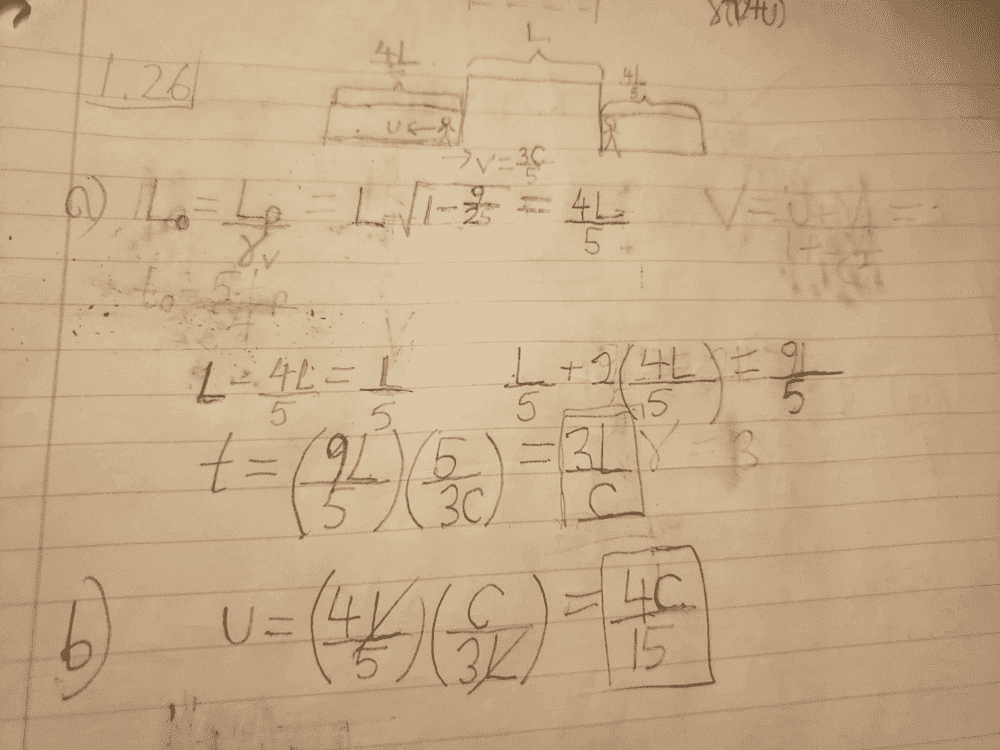
I've gone back to review special relativity in preparation for GR. I apologize for the horrific handwriting.

a) So the ground frame measures the length of the train to be contracted by ##\frac{4}{5}##. So ##L_G = \frac{4L}{5}##. To calculate the total distance the train travels in the ground frame, I simply added the length of the train + length of the train + (the length of the tunnel - the length of the train). This yields ##\frac{9L}{5}##. I then divided this length by the speed of the train to get the time ##\frac{3L}{c}##, which I think is the duration for her to walk from the front of the train to the back of the train in the ground frame. Is this correct?

b) I multiplied ##L_G## by the result above which gives me ##\frac{4c}{5}##. This makes no sense; in the ground frame, the person has to be moving way faster than this. What am I doing wrong?

c) I'm not even sure what this question is asking. Does it want me to find the reading of her clock in the ground frame? I'm guessing I use time dilation then.

Thank you.
1599699600216.png
 
Physics news on Phys.org
Your answer to a) is correct.

For b) what is the person's motion relative to the ground?

For c) you want the proper time of the person (i.e. the elapsed time on her watch).
 
For part b):
She started walking when level with the start of the tunnel.
She finished walking when level with end of the tunnel.
So (in the ground frame) she has moved the length of the tunnel - a distance L - in the time calculated in part a). This gives her speed relative to the ground.

For part c), remember her clock is running slower than the ground clock by a factor \gamma where \gamma is a new value to be calculated using her speed from part b).
 
PeroK said:
Your answer to a) is correct.

For b) what is the person's motion relative to the ground?

For c) you want the proper time of the person (i.e. the elapsed time on her watch).
b) I see. I simply hadn't finished the problem. I still have to plug ##u## into ##V = \frac{u+v}{1+\frac{uv}{c^2}}##. That gives me ##\frac{75c}{189}##. Is that right?
 
Steve4Physics said:
For part b):
She started walking when level with the start of the tunnel.
She finished walking when level with end of the tunnel.
So (in the ground frame) she has moved the length of the tunnel - a distance L - in the time calculated in part a). This gives her speed relative to the ground.

For part c), remember her clock is running slower than the ground clock by a factor \gamma where \gamma is a new value to be calculated using her speed from part b).
I'm confused. @PeroK says part c wants the proper time. But you're saying it wants the time on her watch in the ground frame. Which one is it?
 
Amrator said:
b) I see. I simply hadn't finished the problem. I still have to plug ##u## into ##V = \frac{u+v}{1+\frac{uv}{c^2}}##. That gives me ##\frac{75c}{189}##. Is that right?
That's not what i get. Why use velocity addition? See post #3.
 
Amrator said:
I'm confused. @PeroK says part c wants the proper time. But you're saying it wants the time on her watch in the ground frame. Which one is it?
The time shown on her watch is invariant. All frames agree on that. That is her proper time - in every frame.
 
PeroK said:
That's not what i get. Why use velocity addition? See post #3.
Oh, so it's simply ##\frac{c}{3}##? I just divide the length of the tunnel by the time in part a. That actually makes more sense. I don't know why I was using the contracted length of the train.
 
  • Like
Likes PeroK
PeroK said:
The time shown on her watch is invariant. All frames agree on that. That is her proper time - in every frame.
Ok, so then ##t_{observed} = \gamma t_{proper} = \frac{t_{proper}}{\sqrt{1 - \frac{1}{9}}}## -> ##\sqrt{1 - \frac{1}{9}} t_{observed}## = ##\frac{2\sqrt{2}}{3} t_{observed} = t_{proper}##. And I just plug the time from part a into ##t_{observed}##, right?
 
  • #10
Yes, the watch is moving at ##c/3## relative to the ground frame. It started at one end of the tunnel and moved to the other. The (proper) time shown on the clock is time-dilated in the ground frame.
 
  • #11
Amrator said:
I'm confused. @PeroK says part c wants the proper time. But you're saying it wants the time on her watch in the ground frame. Which one is it?

Care is needed using the term 'proper time'. There are two proper times here, depending on which frame you are in! Each frame has its own proper time.

Consider two observers, A and B, in different frames of reference.

For A, their proper time is what they measure on their clock. If A observes B moving, then B's clocks appear to run slow.
For B, their proper time is what they measure on their clock. If B observes A moving, A's clocks appear to run slow.
Note the symmetry. A sees B living in 'slow motion'. And B sees A living in slow motion. (This is very counter-intuitive.)

There is no single 'proper time', Your proper time is what you measure on your clock.
Someone else's proper time is what they measure on their clock.

The original question says "c) How much time elapses on the person's watch?"

The time elapsed on the person's watch is the proper time in the person's frame of reference. Suppose it is 30s (making up an unrealistic random figure).

On the ground we may time the walk as taking 40s. This is the proper time in the ground frame. The runner's clock appeared to run slow: in our (ground) frame, 40s elapsed - but the runner's clock is observed to read only 30s. The second hand was observed turning slower than ours. If we know \gammathen we simply divide 40s by \gammaand we get 30s.
 
  • Skeptical
Likes PeroK
  • #12
Steve4Physics said:
Care is needed using the term 'proper time'. There are two proper times here, depending on which frame you are in! Each frame has its own proper time.

Each frame has its coordinate time, but proper time is the time as measured by a single clock along its worldline. Proper time belongs to a worldline not a frame of reference.

Moreover, proper time is reference-frame invariant.
 
  • #13
M
PeroK said:
Each frame has its coordinate time, but proper time is the time as measured by a single clock along its worldline. Proper time belongs to a worldline not a frame of reference.

Moreover, proper time is reference-frame invariant.

Many thanks for clarifying/correcting that. I'm not familiar with 'coordinate time'. I'll have to do some reading!
 
  • #14
Steve4Physics said:
MMany thanks for clarifying/correcting that. I'm not familiar with 'coordinate time'. I'll have to do some reading!
Coordinate time is the time associated with a reference frame and which features in the Lorentz Transformation: ##t## might be the coordinate time of a reference frame and ##t'## the coordinate time of another frame. "Coordinate" is used to distinguish it from "proper" time, which is often denoted by ##\tau##.

Note that you can assign the proper time to a particle on any trajectory - in this case it happened to be a watch that was traveling inertially - but you can equally define the proper time as that measured by a hypothetical clock moving along with a particle. Effectively proper time is a measure of the length of a timelike spacetime interval.

Four vectors associated with a particle (such as velocity and energy-momentum) are calculated by differentiating with respect to the proper time of the particle and not wrt any (inertial) coordinate time.
 
  • #15
PeroK said:
Coordinate time is the time associated with a reference frame and which features in the Lorentz Transformation: ##t## might be the coordinate time of a reference frame and ##t'## the coordinate time of another frame. "Coordinate" is used to distinguish it from "proper" time, which is often denoted by ##\tau##.

Note that you can assign the proper time to a particle on any trajectory - in this case it happened to be a watch that was traveling inertially - but you can equally define the proper time as that measured by a hypothetical clock moving along with a particle. Effectively proper time is a measure of the length of a timelike spacetime interval.

Four vectors associated with a particle (such as velocity and energy-momentum) are calculated by differentiating with respect to the proper time of the particle and not wrt any (inertial) coordinate time.

Good. Thanks for coordinating your time to properly explain (some sort of pun intended)!
 
  • Like
Likes PeroK and Amrator

Similar threads

Replies
2
Views
2K
  • · Replies 6 ·
Replies
6
Views
4K
  • · Replies 13 ·
Replies
13
Views
2K
  • · Replies 36 ·
2
Replies
36
Views
3K
Replies
11
Views
3K
  • · Replies 2 ·
Replies
2
Views
1K
  • · Replies 13 ·
Replies
13
Views
3K
  • · Replies 67 ·
3
Replies
67
Views
5K
  • · Replies 4 ·
Replies
4
Views
1K
  • · Replies 1 ·
Replies
1
Views
1K