Some algebra in Schutz's textbook

  • Context: Graduate 
  • Thread starter Thread starter MathematicalPhysicist
  • Start date Start date
  • Tags Tags
    Algebra Textbook
Click For Summary
SUMMARY

The forum discussion centers on the algebraic manipulation of expressions related to the Kerr black hole, specifically deriving the expression for ##D=-\Delta \sin^2 \theta## as presented in Schutz's textbook. Users discuss the use of Maple software for step-by-step algebraic verification, with specific references to equations on pages 313 and 314. The conversation highlights the importance of correctly handling terms in the numerator and denominator during derivations, emphasizing the need for clarity in algebraic steps to avoid confusion.

PREREQUISITES
  • Understanding of algebraic manipulation in physics
  • Familiarity with the Kerr black hole equations
  • Basic knowledge of Maple software for symbolic computation
  • Concepts of angular momentum and metric tensors in general relativity
NEXT STEPS
  • Learn how to use Maple for algebraic manipulation and verification
  • Study the derivation of the Kerr black hole equations in detail
  • Explore the implications of angular momentum in general relativity
  • Investigate the relationship between metric tensors and geodesics
USEFUL FOR

Students and researchers in theoretical physics, particularly those focusing on general relativity and black hole physics, as well as anyone interested in mastering algebraic techniques for complex equations.

MathematicalPhysicist
Science Advisor
Gold Member
Messages
4,662
Reaction score
372
TL;DR
There's some algebraic manipulation which I need help with on pages 309-313 of Schutz's second edition of "A First Course in GR".
Until I understand how to use maple for my steps by steps algebra manipulation feature (which I learned it has), I'll use PF for some help in the algebra.
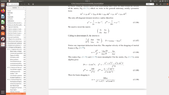
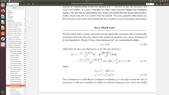
I want to derive the expression for ##D=-\Delta \sin^2 \theta## on page 313 in Equation (11.89).
Attachments of printscreen below.

I wrote two lines, and got discouraged because it seems a long calculation.

$$D=\bigg(\frac{a^2\sin^2 \theta-\Delta^2}{\rho^2}\bigg) \bigg(\frac{(r^2+a^2)^2-a^2\Delta\sin^2\theta}{\rho^2}\bigg)\sin^2\theta-\frac{4a^2M^2 r^2\sin^4\theta}{\rho^4}$$
$$=[a^2\sin^2\theta(r^2+a^2)^2-a^4\Delta \sin^4 \theta-\Delta^2(r^2+a^2)^2+a^2\Delta^3\sin^2\theta]\frac{\sin^2\theta}{\rho^4}-4a^2M^2r^2\sin^4\theta/\rho^4$$
##\Delta## and ##\rho^2## are given on page 309.
 
Physics news on Phys.org
Here are the attachments.
 

Attachments

  • Screenshot from 2021-08-26 15-51-59.png
    Screenshot from 2021-08-26 15-51-59.png
    38.1 KB · Views: 142
  • Screenshot from 2021-08-26 15-52-41.png
    Screenshot from 2021-08-26 15-52-41.png
    30.7 KB · Views: 139
I am not sure about your derivation. How did you get the term in the numerator of ##(-a^4 \sin^6\theta)##? after you extract ##\sin^2(\theta)## from the numerator you get: ##-a^4 \sin^4\theta## which in the denominator the suitable expression doesn't have a minus sign it has ##a^4 \sin^4\theta##. I assume you should be getting: ##-\Delta \sin^2\theta (\frac{A}{A})## where ##A## is some expression that depends on ##\theta,r,a## But you don't get the same expression in the numerator as in the denominator. This is why I wanted maple's to check it for me; but as of yet I don't understand how to use maple to expand this expression while showing all the steps.
There's no mistake! 😋\begin{align*}
K &= -\sin^2{\theta} \left[ \dfrac{\Delta(r^2+a^2)^2 - a^2\sin^2{\theta}(r^2+a^2)^2 - \Delta^2 a^2 \sin^2{\theta} + \Delta a^4 \sin^4{\theta}}{\Sigma^2}\right] \\
&\quad \quad \quad \quad \quad \quad \quad - \, \, \dfrac{a^2\sin^4{\theta}[(r^2+a^2)^2 - 2\Delta(r^2+a^2) + \Delta^2]}{\Sigma^2} \\ \\

&= \dfrac{\Delta \sin^2{\theta}}{\Sigma^2} \left[ 2a^2(r^2+a^2) \sin^2{\theta} - a^4 \sin^4{\theta} - (r^2 +a^2)^2 \right]
\end{align*}Recall that \begin{align*}\Sigma^2 = (r^2+a^2\cos^2{\theta})^2 &= r^4 + 2r^2 a^2(1-\sin^2{\theta}) + a^4 (1-\sin^2{\theta})^2 \\

&= r^4 + 2r^2 a^2 - 2r^2 a^2 \sin^2{\theta} + a^4 -2a^4 \sin^2{\theta} + a^4 \sin^4{\theta} \\

&= -\left[ 2a^2(r^2+a^2) \sin^2{\theta} - a^4 \sin^4{\theta} - (r^2 +a^2)^2 \right]

\end{align*}therefore ##K = -\Delta \sin^2{\theta}##
 
ergospherical said:
There's no mistake! 😋\begin{align*}
K &= -\sin^2{\theta} \left[ \dfrac{\Delta(r^2+a^2)^2 - a^2\sin^2{\theta}(r^2+a^2)^2 - \Delta^2 a^2 \sin^2{\theta} + \Delta a^4 \sin^4{\theta}}{\Sigma^2}\right] \\
&\quad \quad \quad \quad \quad \quad \quad - \, \, \dfrac{a^2\sin^4{\theta}[(r^2+a^2)^2 - 2\Delta(r^2+a^2) + \Delta^2]}{\Sigma^2} \\ \\

&= \dfrac{\Delta \sin^2{\theta}}{\Sigma^2} \left[ 2a^2(r^2+a^2) \sin^2{\theta} - a^4 \sin^4{\theta} - (r^2 +a^2)^2 \right]
\end{align*}Recall that \begin{align*}\Sigma^2 = (r^2+a^2\cos^2{\theta})^2 &= r^4 + 2r^2 a^2(1-\sin^2{\theta}) + a^4 (1-\sin^2{\theta})^2 \\

&= r^4 + 2r^2 a^2 - 2r^2 a^2 \sin^2{\theta} + a^4 -2a^4 \sin^2{\theta} + a^4 \sin^4{\theta} \\

&= -\left[ 2a^2(r^2+a^2) \sin^2{\theta} - a^4 \sin^4{\theta} - (r^2 +a^2)^2 \right]

\end{align*}therefore ##K = -\Delta \sin^2{\theta}##
Yeah, the mistake was on my part... :oldbiggrin:
 
@ergospherical have you also done the algebra of equation (11.91) on page 314?
The equation is: ##(\frac{dr}{d\lambda})^2=g^{rr}[(-g^{tt})E^2+2g^{t\phi}EL-g^{\phi \phi}L^2] \ \ \ (11.91)##.
 
Page 314 looks okay to me; which bit's causing you trouble?
 
ergospherical said:
Page 314 looks okay to me; which bit's causing you trouble?
How to derive it?
From which Equation or Equations does it follow?
Thanks!
 
Firstly, the photon is constrained to the equatorial plane, therefore ##p^{\theta} = 0##. Since ##g_{\mu \nu} p^{\mu} p^{\nu} = g^{\mu \nu}p_{\mu} p_{\nu} = 0## it follows that\begin{align*}
g^{tt} p_t p_t + g^{rr} p_r p_r + g^{\phi \phi} p_{\phi} p_{\phi} + 2g^{t\phi} p_t p_{\phi} &= 0 \\
\end{align*}then because ##E = -p_t## and ##L=p_{\phi}## we have\begin{align*}
g_{rr} (p^r)^2 &= -g^{tt} E^2 - g^{\phi \phi} L^2 + 2g^{t\phi}EL \\
(p^r)^2 &= g^{rr} \left[ -g^{tt} E^2 - g^{\phi \phi} L^2 + 2g^{t\phi}EL \right]
\end{align*}since ##g^{rr} = 1/g_{rr}## and ##p_r = g_{rr} p^r##. Putting ##p^r = dr/d\lambda## gives 11.91.
 
  • Like
Likes   Reactions: MathematicalPhysicist and vanhees71
  • #10
@ergospherical sorry to bother you again.

But there's something with equation (11.95) that got me stumped.
How did he get in the numerator the term: ##\pm r^2 \Delta^{1/2}##?
I get the following equations:
##\frac{g^{\phi\phi}}{g^{tt}}=\frac{a^2-\Delta}{(r^2+a^2)^2-a^2\Delta}##
So ##\omega^2 - \frac{g^{\phi \phi}}{g^{tt}}=\frac{4M^2r^2a^2-(a^2-\Delta)[(r^2+a^2)-a^2\Delta]}{[(r^2+a^2)^2-a^2\Delta]^2}##.
How does the numerator get in the end to: ##r^4\Delta##?

I get that the numerator becomes after substituting ##-2Mr= \Delta-(r^2+a^2)##:
the numerator: ##\Delta^2-2\Delta(r^2+a^2)+(r^2+a^2)^2-a^2(r^2+a^2)^2+\Delta (r^2+a^2)^2 -a^2\Delta^2+a^4 \Delta##.

Now, I am stuck.
How to proceed?, assuming I got until here correctly, which might be wrong... :-D
 
  • #12
I did see it yesterday, I just forgot about it... sorry :wink:
You just missed the factor of ##a^2## off of ##4M^2 r^2 a^2##. It should be\begin{align*}
((r^2+a^2)^2-a^2\Delta)^2 \left(\omega^2 - \frac{g^{\phi \phi}}{g^{tt}} \right)&=4M^2r^2a^2-(a^2-\Delta)((r^2+a^2)-a^2\Delta) \\

&= a^2 \Delta^2 - 2a^2 \Delta(r^2+a^2) + a^2(r^2 + a^2)^2 \\

&\quad \quad \quad \quad - a^2(r^2 + a^2)^2 + \Delta(r^2 + a^2)^2 + a^4 \Delta - a^2 \Delta ^2 \\ \\

&= \Delta((r^2 + a^2)^2 - 2a^2(r^2 + a^2) + a^4) \\
&= \Delta r^4
\end{align*}
 
  • Like
Likes   Reactions: vanhees71
  • #13
Damn, ****, dang... you are correct! :oldbiggrin:
 
  • Like
  • Haha
Likes   Reactions: vanhees71 and ergospherical

Similar threads

  • · Replies 7 ·
Replies
7
Views
2K
  • · Replies 30 ·
2
Replies
30
Views
2K
  • · Replies 1 ·
Replies
1
Views
929
  • · Replies 8 ·
Replies
8
Views
4K
  • · Replies 5 ·
Replies
5
Views
2K
  • · Replies 1 ·
Replies
1
Views
2K
Replies
5
Views
894
  • · Replies 1 ·
Replies
1
Views
2K
  • · Replies 19 ·
Replies
19
Views
6K
  • · Replies 16 ·
Replies
16
Views
4K