Some quick questions concerning uniform acceleration and linear motion

Click For Summary
SUMMARY

The discussion focuses on uniform acceleration and linear motion in physics, specifically addressing unit consistency and calculating displacement. It is confirmed that speed must be in meters per second (m/s) when acceleration is in meters per second squared (m/s²). To find total distance from a velocity-time graph, participants emphasize that displacement is determined by calculating the area under the graph, which involves using different geometric shapes for varying motion types. The relevant equations for displacement are provided, including x(t) = x0 + v × (t-t0) + 1/2 × a × (t-t0)².

PREREQUISITES
  • Understanding of basic physics concepts such as acceleration and velocity.
  • Familiarity with unit conversion, specifically between m/s and km/h.
  • Knowledge of graph interpretation, particularly velocity-time graphs.
  • Proficiency in using kinematic equations for motion analysis.
NEXT STEPS
  • Study the principles of kinematics in physics, focusing on uniform acceleration.
  • Learn how to calculate areas under curves in velocity-time graphs.
  • Explore the application of different kinematic equations in various motion scenarios.
  • Practice unit conversion techniques between different measurement systems.
USEFUL FOR

Students preparing for physics exams, educators teaching kinematics, and anyone interested in understanding the principles of motion and acceleration.

Ellio
Messages
19
Reaction score
1
Homework Statement
just general questions
Relevant Equations
x(t) = x0 + v × (t-t0)
x(t) = x0 + v × (t-t0) + 1/2 × a × (t-t0)
Hello, I hope you are all having a great day !
I've got a physics test in a couple of days and I have some questions:1.
In a calculation, if the acceleration is in m/s², I presume the speed also has to be in m/s and not in km/h ?

2.
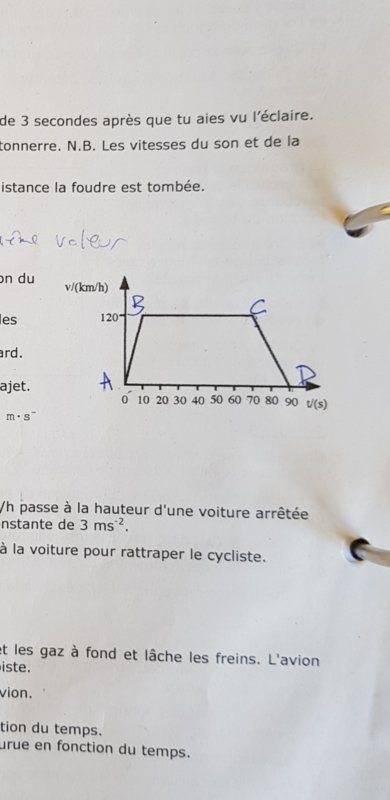
Screenshot_20191123-143522_Gallery.jpg


So with this graph (v with t), I have to find the total distance the object made.
The movement is at start an uniform acceleration then a linear motion and it finishes with an uniform acceleration again.
I have to find the total distance by doing v × t = x
But i thought this was just with linear motion (v = x/t)I hope the question were clear, I apologise if they weren't. Thank you in advance !
 
Physics news on Phys.org
1. Yes. You must use consistent units.

2. Displacement is area under a graph of velocity against time. You need to calculate this according to the shape of the graph: rectangles, triangles or other shapes. ##A = vt## only applies for a rectangle, where ##v## represents the constant velocity.
 
Ellio said:
Homework Equations: x(t) = x0 + v × (t-t0)
x(t) = x0 + v × (t-t0) + 1/2 × a × (t-t0)
Note that the latter equation should be $$x(t) = x_0 + v(t-t_0) + \frac{1}{2}a(t-t_0)^2$$
 

Similar threads

Replies
55
Views
3K
Replies
9
Views
2K
  • · Replies 31 ·
2
Replies
31
Views
4K
  • · Replies 6 ·
Replies
6
Views
2K
  • · Replies 3 ·
Replies
3
Views
2K
  • · Replies 35 ·
2
Replies
35
Views
5K
  • · Replies 6 ·
Replies
6
Views
2K
  • · Replies 98 ·
4
Replies
98
Views
6K
  • · Replies 9 ·
Replies
9
Views
1K
  • · Replies 5 ·
Replies
5
Views
3K