Pepurr
- 3
- 0
This occurred to me when I first heard of the Space Time Frame Drag effect, which was confirmed by the results of Gravity Probe B (GP-B). http://science.nasa.gov/science-news/science-at-nasa/2011/04may_epic/"
I am not a scientist or a mathematician, so I turn to my fellow humans who are. Do you think this would work?
Space Time Frame Drag Engine Concept
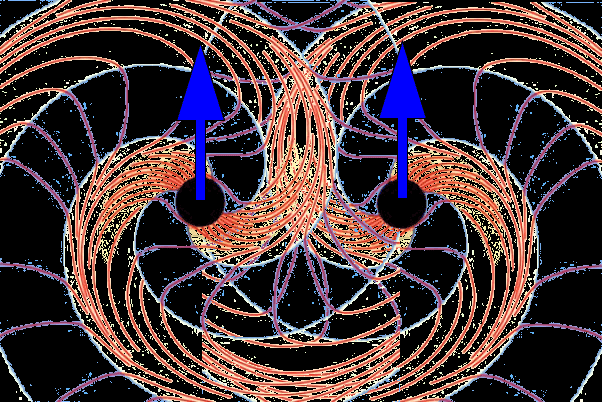
What if one was to have two super heavy, spiracle objects in space that were in close proximity to each other and their spin was in opposite directions? Would the effects of space time frame dragging cause both objects to move forward?
Perhaps one day in the future humanity could use two counter-rotating black holes. For now I propose using two objects made from the heaviest, stable element known to man. Perhaps something like Osmium.
Experiment:
Items needed:
2 ea. Spiracle, super heavy masses.
1 ea. Weightless environment.
1 ea. Laser range finder.
1 ea. Highest RPM motor man can build.
Set up in a way that the motor drives the Spiracle, super heavy masses so that they are counter-rotating.
Set up laser range finder in such a way as to detect any forward motion of the spires.
Possible Application:Use as drive for spacecraft .
I am not a scientist or a mathematician, so I turn to my fellow humans who are. Do you think this would work?
Space Time Frame Drag Engine Concept
What if one was to have two super heavy, spiracle objects in space that were in close proximity to each other and their spin was in opposite directions? Would the effects of space time frame dragging cause both objects to move forward?
Perhaps one day in the future humanity could use two counter-rotating black holes. For now I propose using two objects made from the heaviest, stable element known to man. Perhaps something like Osmium.
Experiment:
Items needed:
2 ea. Spiracle, super heavy masses.
1 ea. Weightless environment.
1 ea. Laser range finder.
1 ea. Highest RPM motor man can build.
Set up in a way that the motor drives the Spiracle, super heavy masses so that they are counter-rotating.
Set up laser range finder in such a way as to detect any forward motion of the spires.
Possible Application:Use as drive for spacecraft .
Last edited by a moderator:
