Speed of light circling around a black hole

Click For Summary
SUMMARY

The discussion centers on the behavior of photons circling a black hole and challenges the notion that light travels at a constant speed in all situations. Participants argue that observers moving at different velocities relative to a photon will measure different speeds due to the effects of spacetime geometry and non-inertial frames. The Sagnac effect is introduced as a relevant phenomenon that illustrates how light's speed can vary based on the observer's frame of reference. The conversation emphasizes the importance of understanding the second postulate of special relativity in relation to inertial and non-inertial frames.

PREREQUISITES
  • Understanding of general relativity and black hole physics
  • Familiarity with the Sagnac effect and its implications
  • Knowledge of inertial vs. non-inertial reference frames
  • Basic principles of spacetime geometry
NEXT STEPS
  • Research the Sagnac effect and its experimental validations
  • Study the implications of non-inertial frames in general relativity
  • Explore the concept of photon orbits around black holes
  • Learn about the second postulate of special relativity and its applications
USEFUL FOR

Physicists, astrophysicists, students of relativity, and anyone interested in the nuances of light behavior in gravitational fields.

Rozman
Messages
9
Reaction score
0
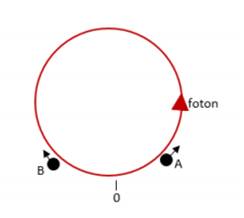
Let us imagine a photon circling around a black hole, as the picture shows.
Light_speed.jpg

The gravity of the black hole curves the movement path of the photon into the shape of a circle. From point 0, geometric points A and B appear simultaneously with the photon, each in its own direction. The points travel slowly along the photon circumference. After the finished circle, both points and the photon return simultaneously to point 0. The photon is faster, therefore, during the time of one full circle by points A and B it makes N circles. The points encounter the photon. They do not perceive the photon and their encounters are monitored at the level of geometry. Point B, moving in the opposite direction than the photon, encounters the photon N + 1 times. Point A, which moves in the direction of the photon motion, encounters the latter N-1 times. Points A and B finish the circle simultaneously. Equal times of the circling are the result of the simultaneous departure of the points from point 0 and their simultaneous return to point 0 after the completed round-trip. The points (observers at those points) find that point A detects less encounters with the photon than point B, and thereby also shorter photon paths. Point A detects the path of the photon in the length of (N-1)- times the 'length of the circumference', while the point B detects the path in the length of (N + 1)-times the 'length of the circumference'. The points detect different lengths of photons paths within the same time. They detect different photon speeds. Our belief that light has the same speed in all situations is thus perhaps not justified.
 

Attachments

  • Light_speed.jpg
    Light_speed.jpg
    3.5 KB · Views: 1,060
Last edited by a moderator:
Physics news on Phys.org
Your post is based on misconceptions about how spacetime geometry works. You cannot use arguments like this, which are essentially based on an underlying Euclidean spatial geometry. If the photon travels in a circle (for which there is only a single fixed radius for a Schwarzschild black hole that is possible), then nothing that moves slower than light can travel on the same circle. Your observers A and B would quickly fall into the black hole.
 
The circular path of a photon instead of a black hole can create a circular optical fiber. What would be the explanation in this case?
 
First of all, light does not propagate at the speed of light in an optical fibre. Second, both your observers would have different notions of both time and space as compared to the rest frame of the optical fibre so you cannot really use the concept of space from the optical fibre rest frame to deduce the speed as measured by the observers. The speed you are imagining is essentially a coordinate speed, not a physical one, which is what is measured locally by the observers.
 
Rozman said:
Our belief that light has the same speed in all situations is thus perhaps not justified
You are misunderstanding what it means to say that the speed of light is the same in all frames. If a freefalling observer at point A or point B were to measure the speed of the flash of light as if it passed them, they would get ##c## regardless of their state of motion. That's what we mean when we say the speed of light is constant.
 
It's possible to redesign both of your thought experiments (fiber optic cable, black hole orbit) to fix the defects that @Orodruin mentions (speed of light in cable is not speed of light in vacuum, one observer cannot meet the same flash of light twice). Doing this is a worthwhile exercise because in both cases the tweak needed to make the experiment "work" also exposes why the experiment isn't showing a "different speed of light".

In the fiber optic case, we can replace the cable with a series of mirrors bouncing the light around the path - yes, now the path is a polygon instead of a circle, but that doesn't change the general idea. But do our two observers, moving relative to one another, agree about the distances between the mirrors after allowing for length contraction? Do they calculate the same length for the path the light followed? Googling for "Sagnac effect" will find much more about this particular experiment (which, unlike the black hole one, can and has been done).

In the black hole case, it's impossible to arrange for the same freefalling observer to encounter the flash of light twice. The best we can do is to replace each observer with a pair of observers, and then carefully time when we drop them into the black hole so that they both encounter the flash of light. But that creates two new problems: first, how do we synchronize their clocks; and second, which two points in the orbit of the flash of light are we trying get to? These are arbitrary choices, and the "speed of light" that comes out of them is no less arbitrary.
 
  • Like
Likes   Reactions: gmax137 and russ_watters
Rozman said:
Our belief that light has the same speed in all situations is thus perhaps not justified.
Your belief may be not justified because it is based on a misunderstanding. My belief is justified. Your belief is not the same as mine.

The difference is that you mistakenly believe that the speed of light is c “in all situations”. On the other hand I recognize that there are some situations where it is not c. Specifically, if it is measured in a non-inertial frame then the speed of light is not necessarily equal to c. The second postulate refers only to inertial frames (and light in a vacuum)

The effect you are describing is commonly called the Sagnac effect. The correct understanding of the 2nd postulate can be used to derive the effect. So not only does it not represent a failure of SR, it is a result of SR.
 
  • Like
Likes   Reactions: Sorcerer and pervect
Nugatory said:
In the black hole case, it's impossible to arrange for the same freefalling observer to encounter the flash of light twice.

Actually, it isn't--the observer can be flying upwards in free fall at the first encounter and falling back down at the second.

Also, one could set up a scenario where the observers were not in free fall but using rocket power to hover at the same altitude as the photon orbit.

None of these refinements affect the main points of the comments by you, @Orodruin, and @Dale.
 
Dale said:
Your belief may be not justified because it is based on a misunderstanding. My belief is justified. Your belief is not the same as mine.

This may be true, but it is a bit harsh. At least the OP is thinking, not sitting passively in class absorbing the words of the lecturer.
 
  • #10
gmax137 said:
This may be true, but it is a bit harsh. At least the OP is thinking, not sitting passively in class absorbing the words of the lecturer.
It is accurate and clear, so as to prevent any possible misunderstanding. Based on previous interactions with @Rozman I think that clarity is absolutely essential. Particularly since he has previously indicated similar confusion about non inertial reference frames.

Also, at no point did I make any sort of ad-hominem remark saying anything negative about him as a person. I was entirely addressing his incorrect idea. I did so firmly, clearly, and without any personal attack.
 
  • Like
Likes   Reactions: Imager, Sorcerer, berkeman and 3 others

Similar threads

  • · Replies 9 ·
Replies
9
Views
1K
  • · Replies 7 ·
Replies
7
Views
954
  • · Replies 10 ·
Replies
10
Views
1K
  • · Replies 32 ·
2
Replies
32
Views
2K
  • · Replies 13 ·
Replies
13
Views
3K
  • · Replies 7 ·
Replies
7
Views
1K
  • · Replies 4 ·
Replies
4
Views
2K
  • · Replies 25 ·
Replies
25
Views
3K
  • · Replies 7 ·
Replies
7
Views
2K
  • · Replies 20 ·
Replies
20
Views
2K