Math Amateur
Gold Member
MHB
- 3,920
- 48
I am reading Dummit and Foote, Chapter 13 - Field Theory.
I am currently studying Section 13.4 : Splitting Fields and Algebraic Closures ... ...
I need some help with an aspect of Example 3 of Section 13.4 ... ...
Example 3 reads as follows:
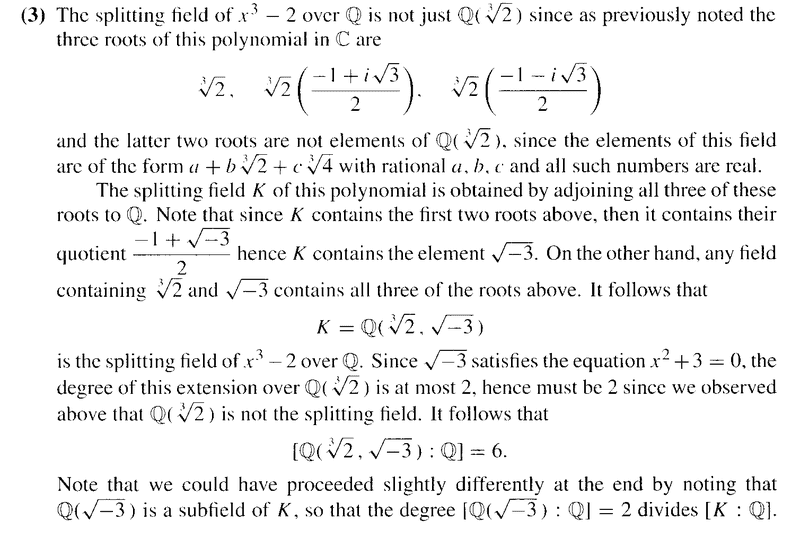
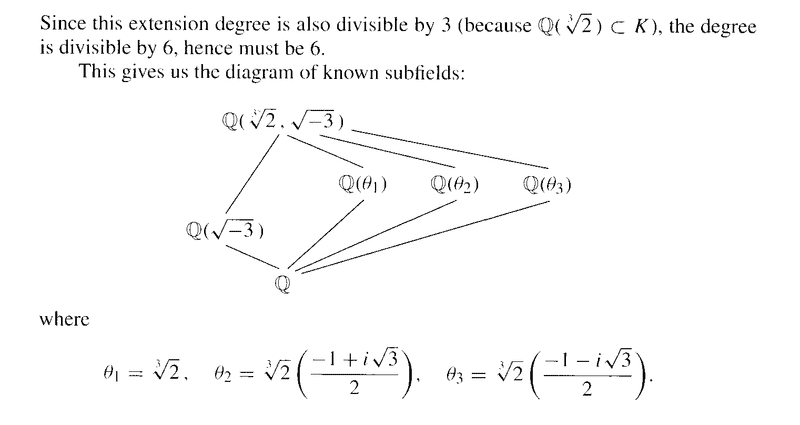
In the above text by Dummit and Foote, we read the following:
" ... ... Since ##\sqrt{ -3 }## satisfies the equation ##x^2 + 3 = 0## the degree of this extension over ##\mathbb{Q} ( \sqrt [3] {2} )## is at most ##2##, hence must be ##2## since we observed above that ##\mathbb{Q} ( \sqrt [3] {2} )## is not the splitting field ... ... "I do not understand why the degree of the extension ##K## over ##\mathbb{Q} ( \sqrt [3] {2} )## must be exactly ##2## ... ... why does ##\mathbb{Q} ( \sqrt [3] {2} )## not being the splitting field ensure this ... ...
Can someone please give a simple and complete explanation ...
Hope someone can help ...
Peter
I am currently studying Section 13.4 : Splitting Fields and Algebraic Closures ... ...
I need some help with an aspect of Example 3 of Section 13.4 ... ...
Example 3 reads as follows:
In the above text by Dummit and Foote, we read the following:
" ... ... Since ##\sqrt{ -3 }## satisfies the equation ##x^2 + 3 = 0## the degree of this extension over ##\mathbb{Q} ( \sqrt [3] {2} )## is at most ##2##, hence must be ##2## since we observed above that ##\mathbb{Q} ( \sqrt [3] {2} )## is not the splitting field ... ... "I do not understand why the degree of the extension ##K## over ##\mathbb{Q} ( \sqrt [3] {2} )## must be exactly ##2## ... ... why does ##\mathbb{Q} ( \sqrt [3] {2} )## not being the splitting field ensure this ... ...
Can someone please give a simple and complete explanation ...
Hope someone can help ...
Peter

