Spring constant matrix and normal modes (4 springs and 3 masses)

Click For Summary
SUMMARY

The discussion focuses on determining the normal modes of a system comprising four springs with stiffness values k1, k2, k3, and k4, and three masses m1, m2, and m3. The user aims to utilize direct matrix methods to construct the stiffness matrix K, defined by the elements Kij, which represent the equivalent spring stiffness when moving block j while analyzing block i's motion. The user encounters issues with obtaining only complex angular frequencies, indicating a potential error in the matrix formulation or determinant calculation. The suggestion is made to simplify the problem by testing the method on a more manageable arrangement to identify discrepancies in signs.

PREREQUISITES
  • Understanding of normal modes in mechanical systems
  • Familiarity with matrix methods in physics
  • Knowledge of spring constants and their role in system dynamics
  • Basic principles of linear algebra, particularly determinants
NEXT STEPS
  • Study the construction of stiffness matrices in multi-body systems
  • Learn about normal mode analysis in coupled oscillators
  • Explore the method of determinants for solving linear equations
  • Investigate simpler mechanical systems to validate matrix methods
USEFUL FOR

Students and professionals in mechanical engineering, physicists focusing on dynamics, and researchers analyzing coupled oscillatory systems will benefit from this discussion.

LCSphysicist
Messages
644
Reaction score
162
Homework Statement
ALl below
Relevant Equations
ALl below
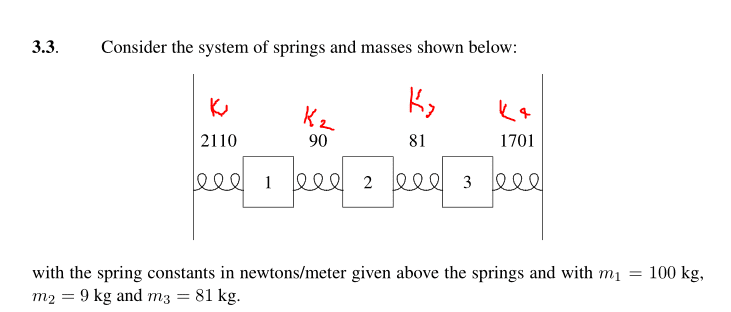
We need to find the normal modes of this system:
1596888481855.png

Well, this system is a little easy to deal when we put it in a system and solve the system... That's not what i want to do, i want to try my direct matrix methods.

We have springs with stiffness k1,k2,k3,k4 respectively, and block mass m1, m2, m3
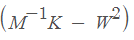
And we need to annul the determinant of
1596888665443.png
, not just, i supposed the displacement Z as complex, so we need real angular frequencies.

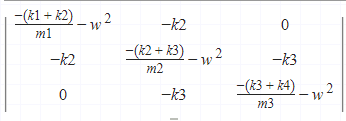
To mount the matrix K, we need to know all Kij, being Kij the spring stiffness equivalent if we move just block j and analyze the motion of block i, j can be equal i.

So making all the things, we end with:
1596889004699.png


Apparently this is wrong, i found just complex w, what is the problem?
 

Attachments

  • 1596888908395.png
    1596888908395.png
    2 KB · Views: 237
Physics news on Phys.org
Try the same method on a much simpler arrangement, one you can easily check from first principles. Note where the signs disagree.
 
  • Like
Likes   Reactions: LCSphysicist
haruspex said:
Try the same method on a much simpler arrangement, one you can easily check from first principles. Note where the signs disagree.
Yeh that's enough... thank
 

Similar threads

Replies
17
Views
2K
Replies
3
Views
2K
  • · Replies 2 ·
Replies
2
Views
4K
Replies
4
Views
2K
Replies
7
Views
1K
  • · Replies 3 ·
Replies
3
Views
2K
  • · Replies 19 ·
Replies
19
Views
3K
  • · Replies 2 ·
Replies
2
Views
1K
Replies
4
Views
886
  • · Replies 7 ·
Replies
7
Views
4K