Spring Force and Displacement: Understanding the Relationship

Click For Summary

Homework Help Overview

The discussion revolves around understanding the relationship between spring force and displacement, particularly in the context of work done during compression and the correct integration bounds for calculating this work.

Discussion Character

  • Exploratory, Conceptual clarification, Assumption checking

Approaches and Questions Raised

  • Participants explore the implications of integrating work done by a spring, questioning the direction of force and displacement, and the correct bounds for integration. There is also discussion about the interpretation of variables in the spring force equation.

Discussion Status

Some participants have provided guidance on the integration bounds and the relationship between force and displacement, while others are clarifying their understanding of the concepts involved. Multiple interpretations of the problem are being explored.

Contextual Notes

There is a mention of an external force acting on the spring, and confusion regarding the representation of displacement in the context of the spring force equation. Participants are navigating these assumptions as part of their discussion.

fireman2020
Messages
4
Reaction score
1
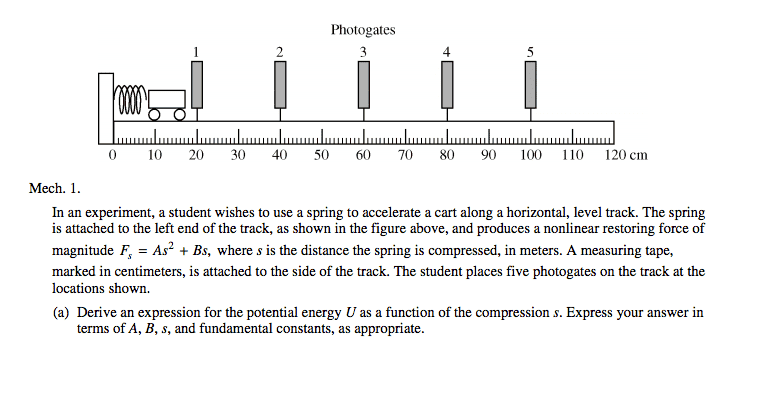
Problem:
zVFHw8X.jpg


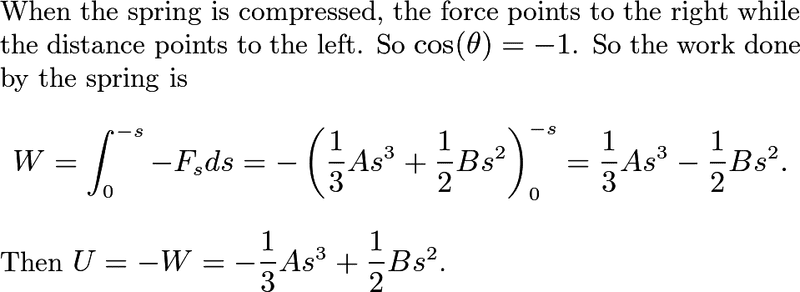
Attempted Solution:
3XEQJgA.jpg


The answer is actually (1/3)As^3+(1/2)Bs^2
 
Physics news on Phys.org
Actually there is work done by an external force (pointing toward the left) in order to compress the spring in the first place. The force and direction of motion are in the same direction. See if that helps it come out right for you. The spring will do work to move the cart, starting at some position -s like you said and moving towards 0, so you should integrate from -s to 0 to calculate the work done by the spring as it is released.
 
Firstly, well done noting that the force on the cart and the displacement of the cart point in opposite directions.

Secondly, your bounds should not be from zero to [itex]-s[/itex] but from zero to [itex]s[/itex]. This is because [itex]s[/itex] represents a displacement from equilibrium, not a particular point on the ruler. It is not important that you traveled from a specific location [itex]x_1[/itex] to [itex]x_2[/itex]. Rather, this equation wants you to input the distance [itex]s[/itex] that was traveled.
 
  • Like
Likes   Reactions: scottdave and fireman2020
I'm not real up-to-speed on these kinds of problems, so pardon me for that. But you have an equation F = As2 + Bs. So what that tells me is that as s gets larger, the force gets larger. So in compressing the spring, which you are doing, s should be getting larger. So why are you integrating from 0 to -s. Wouldn't that be stretching the spring, not compressing it?
 
  • Like
Likes   Reactions: scottdave
Daniel Gallimore said:
Firstly, well done noting that the force on the cart and the displacement of the cart point in opposite directions.

Secondly, your bounds should not be from zero to [itex]-s[/itex] but from zero to [itex]s[/itex]. This is because [itex]s[/itex] represents a displacement from equilibrium, not a particular point on the ruler. It is not important that you traveled from a specific location [itex]x_1[/itex] to [itex]x_2[/itex]. Rather, this equation wants you to input the distance [itex]s[/itex] that was traveled.

Oh so in the standard F=kx, the x is the distance? Not the position? That makes so much more sense. Thanks.
 

Similar threads

  • · Replies 18 ·
Replies
18
Views
2K
Replies
17
Views
2K
  • · Replies 56 ·
2
Replies
56
Views
5K
  • · Replies 14 ·
Replies
14
Views
2K
  • · Replies 2 ·
Replies
2
Views
848
Replies
6
Views
1K
  • · Replies 14 ·
Replies
14
Views
4K
Replies
29
Views
3K
  • · Replies 5 ·
Replies
5
Views
2K
  • · Replies 5 ·
Replies
5
Views
1K