Spring Force Resultant help please

Click For Summary
The discussion revolves around understanding the resultant force in a system involving a slider, a ball, and a spring. Participants debate whether the spring force should be considered the resultant force or just the x vector in a force diagram. Clarification is provided that the spring force, determined by Hooke's law, is equal to the normal contact force, which relates to the friction force. The importance of drawing a free body diagram to sum all forces is emphasized for accurate analysis. The conversation highlights the need for a clear understanding of forces involved in the system to avoid confusion.
gogogsr
Messages
9
Reaction score
0
Hey guys, how are you?

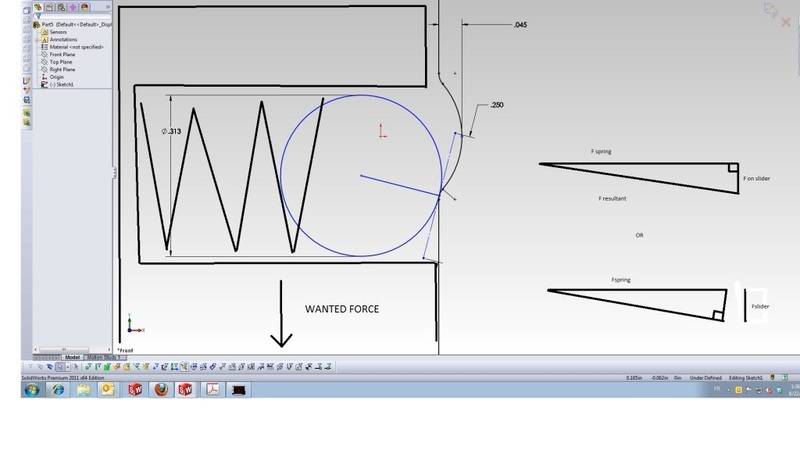
I feel so stupid right now, I'm having a hard time getting my mind straight, which of the two resultant force diagram on the right is right? Typically its a slider with a ball and spring that slides on a recess (cam type). I want to know the force required on the slider to make it slide, here is the diagram. Thanks guys
forcespring.jpg
 
Engineering news on Phys.org
hi gogogsr! :smile:

i don't understand your question

the diagram on the left clearly shows the applied force as being in the -y direction :confused:

(and btw, if there isn't another surface on the left (or some unshown x direction force), how does the slider stay in contact with the surface on the right?)
 
there is a surface on the left, it is just a quick diagram. The question is: Is the Fspring the resultant force (hypotenuse) of the triangle or just the x vector. I'm thinking it should be the resultant since it is the only applied external force , so it as to be the greatest force. (I know there is friction and everything, but keep it simple please)
 
Is this a continuation of this thread?

https://www.physicsforums.com/showthread.php?t=621559

To keep it simple the spring force pushes the ball against the detent with force F given by the spring constant times the extension.

This spring force is equal to the normal contact force so the force perpendicular to this is your 'wanted force'. This in turn is the friction force which is the normal force times the coefficient of friction.
 
Last edited:
could you draw it please ;-)
 
hi gogogsr! :smile:
gogogsr said:
I'm thinking it should be the resultant since it is the only applied external force , so it [h]as to be the greatest force.

i'm sorry, but this is nonsense, if you think like this it'll only confuse you :redface:

there are only two ways you can find the spring force …

i] from the spring displacement, using hooke's law (though you may not know the displacement, or the spring constant accurately enough for that)

ii] by choosing the whole or part of the system, drawing a free body diagram for it, and summing all the forces

(i still don't understand exactly what you're trying to investigate, but if it's the difference in spring force between the two extreme positions, then that will be simply the depth of the recess times the spring constant)
 
Had my central air system checked when it sortta wasn't working. I guess I hadn't replaced the filter. Guy suggested I might want to get a UV filter accessory. He said it would "kill bugs and particulates". I know UV can kill the former, not sure how he thinks it's gonna murder the latter. Now I'm finding out there's more than one type of UV filter: one for the air flow and one for the coil. He was suggesting we might get one for the air flow, but now we'll have to change the bulb...

Similar threads

  • · Replies 3 ·
Replies
3
Views
1K
  • · Replies 7 ·
Replies
7
Views
3K
Replies
3
Views
2K
  • · Replies 2 ·
Replies
2
Views
1K
Replies
6
Views
1K
Replies
20
Views
1K
Replies
5
Views
2K
  • · Replies 13 ·
Replies
13
Views
2K
Replies
2
Views
602
  • · Replies 9 ·
Replies
9
Views
2K