Discussion Overview
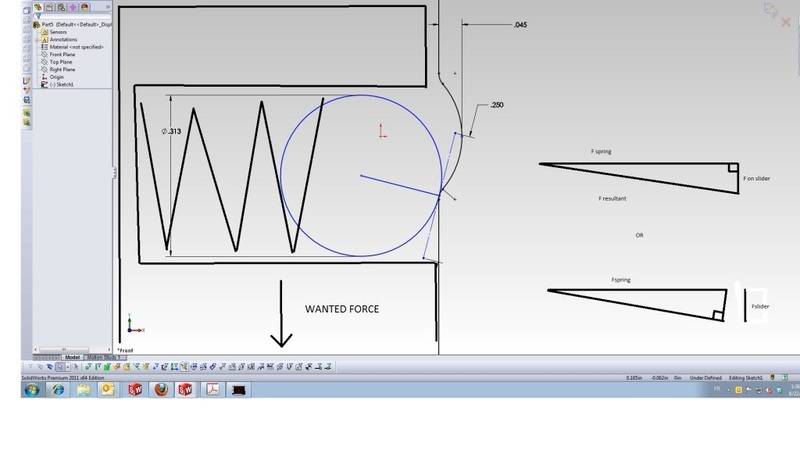
The discussion revolves around understanding the resultant force in a system involving a slider, a ball, and a spring. Participants are trying to clarify the forces acting on the slider and how to determine the force required to make it slide, considering factors like spring force and friction. The context includes technical reasoning and conceptual clarification related to force diagrams.
Discussion Character
- Technical explanation
- Conceptual clarification
- Debate/contested
Main Points Raised
- One participant questions which of the two resultant force diagrams is correct, specifically whether the spring force should be considered the resultant force or just the x vector.
- Another participant points out that the applied force in the diagram is directed in the -y direction and questions how the slider remains in contact with the surface without additional forces.
- A participant suggests that the spring force is the resultant force since it is the only external force, but acknowledges the presence of friction.
- One participant explains that the spring force can be determined using Hooke's law or by drawing a free body diagram and summing forces, indicating that the spring force is equal to the normal contact force.
- Another participant expresses confusion about the inquiry and suggests that understanding the difference in spring force between extreme positions may be relevant.
Areas of Agreement / Disagreement
Participants express differing views on how to interpret the resultant forces in the diagrams, and there is no consensus on the correct approach to determine the force required for the slider to move.
Contextual Notes
There are unresolved assumptions regarding the system's configuration, such as the exact nature of the surfaces involved and the values of the spring constant and displacement. The discussion also reflects uncertainty about the specific question being investigated.