Spring Paradox (apparently). Energy problem with one vertical spring.

Click For Summary
SUMMARY

The discussion centers on the "spring paradox," where a mass m is attached to a vertical spring, leading to confusion about the equilibrium position derived from energy conservation principles. The argument initially appears valid, suggesting that the equilibrium position is given by y = (2mg)/C. However, the paradox arises when considering the forces acting on the mass; the spring force of cy does not balance with the gravitational force mg, resulting in an upward force of 2mg, which is incorrect. The resolution highlights the importance of recognizing oscillatory motion in the absence of damping forces.

PREREQUISITES
  • Understanding of conservation of mechanical energy principles
  • Familiarity with gravitational potential energy (U = mgy)
  • Knowledge of elastic potential energy (U = 1/2 cy²)
  • Basic concepts of oscillatory motion and damping forces
NEXT STEPS
  • Study the dynamics of oscillatory systems and the role of damping forces
  • Explore Hooke's Law and its applications in spring mechanics
  • Learn about the conditions for static equilibrium in mechanical systems
  • Investigate energy conservation in non-conservative systems
USEFUL FOR

Students of physics, particularly those studying mechanics, engineers working with spring systems, and anyone interested in understanding oscillatory motion and energy conservation principles.

Anavra
Messages
4
Reaction score
0
Apologies if this is too basic, but I've been studying for a while and I'm stuck.


Homework Statement


Spring paradox. What is wrong with the following argument?
Consider a mass m held at rest at y = 0, the end of
an unstretched spring hanging vertically. The mass is now
attached to the spring, which will be stretched because of the
gravitational force mg on the mass. When the mass has lost
gravitational potential energy mgy and the spring has gained
the same amount of potential energy so that

mgy= 1/2 cy2

the mass will come to equilibrium. Therefore the position of
equilibrium is given by

y= (2mg)/C

Homework Equations


Conservation of total mechanical energy
K_1 + U_1 = K_2 + U_2

Potential Energy (gravitational)
U=mgy

Potential Energy (elastic)
1/2 cy2

Kinetic Energy
1/2 mv2


The Attempt at a Solution


At first glance, I can't seem to figure out what is wrong with the argument. So I began recreating the whole thing.

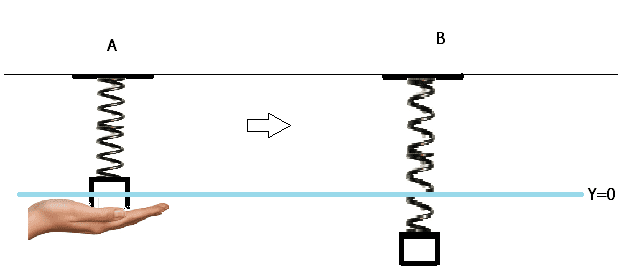
I started drawing it this way:
Vhoj5.png

A is the intial situation where the spring is at rest, not supporting the mass. It's just there.
B is the situation where the mass has been attached to the spring which supports the mass' weight. The blue line depicts y=0.

Since no non-conservative forces seem to be involved here, I applied the conservation of total mechanical energy, this makes:


EA=EB
KA+UA=KB+UB


Since the A situation is at the assigned zero, both elastic potential and gravitational potential will be 0. It's at rest so kinetic is also 0. In short, EA=0

0=1/2 cy2 - mgy + 1/2 mv2

The spring would go up and down and eventually reach equilibrium, where the kinetic energy is zero.

0=1/2 cy2 - mgy

So far nothing wrong has been found about the problem given. Because this leads to:

mgy=1/2 cy2

And then, solving for y, it becomes

y= (2mg)/C

Again, this matches the results given. So I can't find what's wrong. Is it a trick question and nothing is wrong? Am I missing something? Thanks!
 
Physics news on Phys.org
Anavra said:
Apologies if this is too basic, but I've been studying for a while and I'm stuck.

Homework Statement


Spring paradox. What is wrong with the following argument?
Consider a mass m held at rest at y = 0, the end of
an unstretched spring hanging vertically. The mass is now
attached to the spring, which will be stretched because of the
gravitational force mg on the mass. When the mass has lost
gravitational potential energy mgy and the spring has gained
the same amount of potential energy so that

mgy= 1/2 cy2

the mass will come to equilibrium. Therefore the position of
equilibrium is given by

y= (2mg)/C

Homework Equations


Conservation of total mechanical energy
K_1 + U_1 = K_2 + U_2

Potential Energy (gravitational)
U=mgy

Potential Energy (elastic)
1/2 cy2

Kinetic Energy
1/2 mv2

The Attempt at a Solution


At first glance, I can't seem to figure out what is wrong with the argument. So I began recreating the whole thing.

I started drawing it this way:
Vhoj5.png

A is the intial situation where the spring is at rest, not supporting the mass. It's just there.
B is the situation where the mass has been attached to the spring which supports the mass' weight. The blue line depicts y=0.

Since no non-conservative forces seem to be involved here, I applied the conservation of total mechanical energy, this makes:EA=EB
KA+UA=KB+UB
Since the A situation is at the assigned zero, both elastic potential and gravitational potential will be 0. It's at rest so kinetic is also 0. In short, EA=0

0=1/2 cy2 - mgy + 1/2 mv2

The spring would go up and down and eventually reach equilibrium, where the kinetic energy is zero.

0=1/2 cy2 - mgy

So far nothing wrong has been found about the problem given. Because this leads to:

mgy=1/2 cy2

And then, solving for y, it becomes

y= (2mg)/C

Again, this matches the results given. So I can't find what's wrong. Is it a trick question and nothing is wrong? Am I missing something? Thanks!

The 'paradox' part is now to consider forces on the balanced mass. The spring exerts a force of cy upwards. Gravity exerts a force of mg downwards. If you put y=(2mg)/c then you conclude the spring exerts a force of 2mg upwards. The forces don't balance. Paradox!
 
*slaps forehead* I should have seen that. O_O

The paradox is clear now. What's not clear is how did this happen. There are no other forces acting on it. That 2 shouldn't be there. I'm beyond exhausted, going to have to sleep on it. Thank you very much! (It seems weird to say 'thank you very much, Dick', but yeah. Thank you.)
 
Anavra said:
*slaps forehead* I should have seen that. O_O

The paradox is clear now. What's not clear is how did this happen. There are no other forces acting on it. That 2 shouldn't be there. I'm beyond exhausted, going to have to sleep on it. Thank you very much! (It seems weird to say 'thank you very much, Dick', but yeah. Thank you.)

Good idea. Sleep on it. Dream about what would REALLY happen if there were no other forces acting on the system.
 
Oh wait. If... there are no other forces, wouldn't it oscillate instead of just sitting there? When you release the mass, realistically it would go beyond the equilibrium point then back up, and keep oscillating. I assumed that 'eventually', it would stop moving. But that's only because in reality, oscillators are damped. By friction, usually. So the paradox happens because this system is not really free from non-conservative forces?
 
Anavra said:
Oh wait. If... there are no other forces, wouldn't it oscillate instead of just sitting there? When you release the mass, realistically it would go beyond the equilibrium point then back up, and keep oscillating. I assumed that 'eventually', it would stop moving. But that's only because in reality, oscillators are damped. By friction, usually. So the paradox happens because this system is not really free from non-conservative forces?

You've got it. It will just oscillate if something is not damping it. If something is damping it, it will stop at the force equilibrium point. Now you can sleep without disturbing dreams.
 

Similar threads

  • · Replies 4 ·
Replies
4
Views
2K
  • · Replies 14 ·
Replies
14
Views
3K
  • · Replies 4 ·
Replies
4
Views
2K
Replies
5
Views
2K
Replies
17
Views
2K
Replies
7
Views
1K
  • · Replies 58 ·
2
Replies
58
Views
3K
  • · Replies 20 ·
Replies
20
Views
4K
  • · Replies 5 ·
Replies
5
Views
2K
  • · Replies 2 ·
Replies
2
Views
2K