Spring Pendulum system in FORTRAN

Click For Summary
SUMMARY

The discussion focuses on troubleshooting a Spring Pendulum simulation program written in FORTRAN. The user encountered issues with the output graphs when a variable approaches zero, leading to confusion about the program's correctness. Key mistakes identified include a variable name typo (xc vs. cx) and the absence of strong typing due to the lack of "implicit none." Participants emphasized the importance of clear variable naming and adequate commenting for better code readability and maintenance.

PREREQUISITES
  • Understanding of FORTRAN programming language
  • Familiarity with numerical methods for solving ordinary differential equations
  • Knowledge of variable scoping and typing in programming
  • Experience with debugging techniques in code
NEXT STEPS
  • Implement "implicit none" in FORTRAN programs to enforce strong typing
  • Research best practices for naming conventions in programming
  • Learn about effective commenting strategies for code clarity
  • Explore numerical methods for simulating dynamic systems in FORTRAN
USEFUL FOR

FORTRAN developers, students working on physics simulations, and anyone involved in numerical analysis or debugging scientific computing applications.

Abhisheko07
Messages
5
Reaction score
0
TL;DR
Can anyone help me figure out what is going wrong?
I have checked the program several times the program is running but the graphs I am getting is not what I was accepting soon one of the variables approaches zero I don't know why is it happening. The program I have made is below and it's in the FORTRAN language. If anyone knows Fortran can they please help me it's really very important for my project work?

Fortran:
                            implicit real*8(a-h,o-z)
       real*8 m,l
       ti=0
       tf=1000
       dt=0.01
       n=(tf-ti)/dt

       ! initial values
       t1=0.5
       r=2.0
       td=0.3
       p=1.0
       l=3.0
       m=2.0
       t=ti
      
       open(1,file='elast1.dat',status='unknown')
       open(2,file='elast2.dat',status='unknown')
       open(3,file='elast3.dat',status='unknown')

       !starting the loop
       do i=1,n
       write(1,*)t,t1,td
       write(2,*)t,r,p
       write(3,*)t,t1,r
      
       fa=f(t1,r,td,p,m,l)*dt
       f1a=f1(td)*dt
      
       ea=e(t1,r,td,p,m,l)*dt
       e1a=e1(p)*dt
      
       fb=f(t1+0.5*f1a,r+0.5*e1a,td+0.5*fa,p+0.5*ea,m,l)*dt
       f1b=f1(td+0.5*fa)*dt
      
       eb=e(t1+0.5*f1a,r+0.5*e1a,td+0.5*fa,p+0.5*ea,m,l)*dt
       e1b=e1(p+0.5*ea)*dt
      
       fc=f(t1+0.5*f1b,r+0.5*e1b,td+0.5*fb,p+0.5*eb,m,l)*dt
       f1c=f1(td+0.5*fb)*dt

       ec=e(t1+0.5*f1b,r+0.5*e1b,td+0.5*fb,p+0.5*eb,m,l)*dt
       e1c=e1(p+0.5*eb)*dt

       fd=f(t1+f1c,r+e1c,td+fc,p+ec,m,l)*dt
       f1d=f1(td+fc)*dt

       ed=f(t1+f1c,r+e1c,td+fc,p+ec,m,l)*dt
       e1d=e1(p+ec)*dt
      
       td=td+(fa/6.0)+(fb/3.0)+(fc/3.0)+(fd/6.0)
       p=p+(ea/6.0)+(eb/3.0)+(ec/3.0)+(ed/6.0)
      
       t1=t1+(f1a/6.0)+(f1b/3.0)+(f1c/3.0)+(f1d/6.0)
       r=r+(e1a/6.0)+(e1b/3.0)+(e1c/3.0)+(e1d/6.0)
      
       t=t+dt
      
       enddo
       close(1)
       close(2)
       end       !Function (definition of theta double dot)
       function f(t1,r,td,p,m,l)
       implicit real*8(a-h,o-z)
       real*8 m,l
      
       g=9.8
       xa=-(g*dsin(t1))/(l+r)
       xb=-(2*p*td)/(l+r)
       f=xa+xb
      
       return
       end
      
      
       !Function (definition of theta dot)
       function f1(td)
       implicit real*8(a-h,o-z)
       f1=td

       return
       end
      
      
       ! Function (definition of r double dot)
       function e(t1,r,td,p,m,l)
       implicit real*8(a-h,o-z)
       real*8 m,l
       g=9.8
       k=10.0
       xc=-(k*r)/m
       xd=g*dcos(t1)
       xe=(l+r)*td**2
       e=cx+xd+xe
      
       return
       end
      
       ! Function (definition of r dot)
       function e1(p)
       implicit real*8(a-h,o-z)
       e1=p
       end

These are the four equations I have used (actually they are two 2nd order ordinary differential equation but i have to convert it into four equations to do the programming)
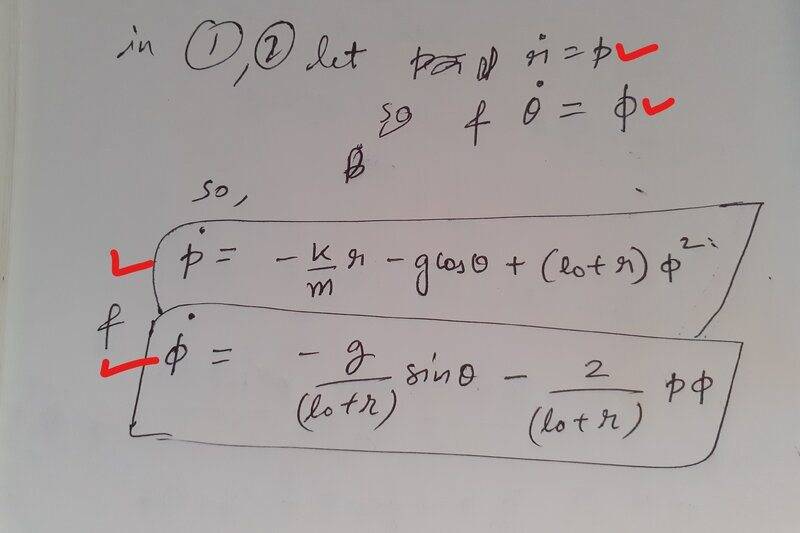
Inked20210530_081704_LI.jpg

if anyone finds anything please help me
 
Last edited by a moderator:
Technology news on Phys.org
Shouldn’t the sign of xd in function e be Negative?
 
Get rid of the implicit none!

On line 97, you mistyped xc as cx.

Implicit none is archaic and kept inly for backwards compatibility. Get into the habit of using strong typing. You will thank me later for it!
 
  • Like
  • Haha
Likes   Reactions: Abhisheko07, jedishrfu and Paul Colby
DrClaude said:
Implicit none is archaic and kept only for backwards compatibility.
Um, implicit none is what you need to give you strong typing.
 
  • Like
Likes   Reactions: DrClaude
Paul Colby said:
Shouldn’t the sign of xd in function e be Negative?
no actually there was a mistake the sign in the program is all ok but the picture sign was incorrect and finally after reviewing it again i got the mistake which is that in place of xc i used cx very silly but vital mistake.
 
thanks a lot it worked
 
Abhisheko07 said:
i got the mistake which is that in place of xc i used cx very silly but vital mistake.
This is a learning moment. As others have pointed out using,” implicit none“ would have caught this mistype right away.
 
Vanadium 50 said:
Um, implicit none is what you need to give you strong typing.
o:)
Oh my, what a brain fart! Of course, what I mean is to get rid of the implicit and replace it by implicit none.
 
DrClaude said:
On line 97, you mistyped xc as cx.
The two main problems are see are 1) the use of mostly meaningless names for variables and functions, and 2) the near-complete lack of comments.

All of the variable names in this program are one or two letters in length, so they don't give any clue to outside readers what they are being used for. Using extremely short variable names makes mistakes like switching xc to cx much more likely.

I count a grand total of four comments, all for the functions defined near the bottom of the code.
f -- theta double dot
f1 -- theta dot
e -- r double dot
e1 -- r dot
The comments are somewhat helpful, but a better choice of function names would have made it clearer what they're being used for. e, e1, f, and f1, especially at the point at which these functions are being called. Also, some of these functions take multiple parameters, of which there are exactly zero comments as to what the parameters represent.
 
  • Like
Likes   Reactions: DrClaude

Similar threads

  • · Replies 8 ·
Replies
8
Views
6K
  • · Replies 1 ·
Replies
1
Views
3K