Standard Gibbs energy change definition

Click For Summary
SUMMARY

The discussion focuses on the relationship between the equilibrium constant K and the change in Gibbs energy (ΔG) of a reaction. It highlights that knowing the free energies of formation of reactants and products allows for the calculation of K, simplifying the data management required for numerous reactions. The definition of ΔG is emphasized as being more meaningful than mere convenience, as it encapsulates essential thermodynamic information. The utility of tabulating free energies of formation is underscored, as it significantly reduces the amount of data needed compared to listing all possible equilibrium constants.

PREREQUISITES
  • Understanding of Gibbs free energy and its significance in thermodynamics
  • Familiarity with equilibrium constants and their role in chemical reactions
  • Knowledge of free energies of formation for various substances
  • Basic principles of chemical kinetics and reaction dynamics
NEXT STEPS
  • Research the derivation of the Gibbs-Helmholtz equation
  • Study the relationship between Gibbs energy and reaction spontaneity
  • Explore methods for calculating free energies of formation
  • Learn about the application of thermodynamic tables in chemical equilibrium
USEFUL FOR

Chemists, chemical engineers, and students studying thermodynamics who seek to understand the foundational principles of Gibbs energy and its application in calculating equilibrium constants.

gfd43tg
Gold Member
Messages
948
Reaction score
48
Hello

I am working on deriving the expression relating the equilibrium constant K to the change in Gibbs energy.
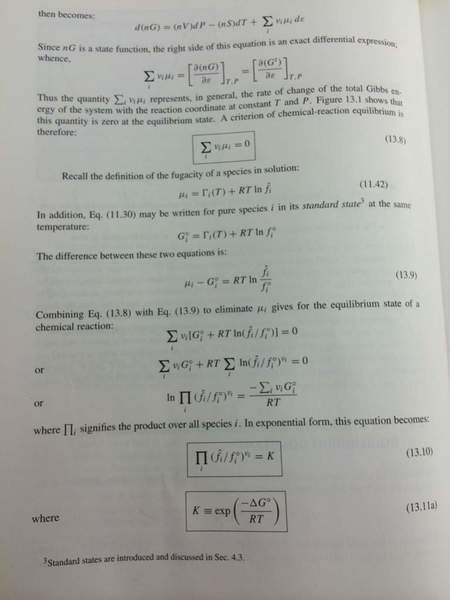
ImageUploadedByPhysics Forums1398545831.111039.jpg


This part seems to be followed okay, but here
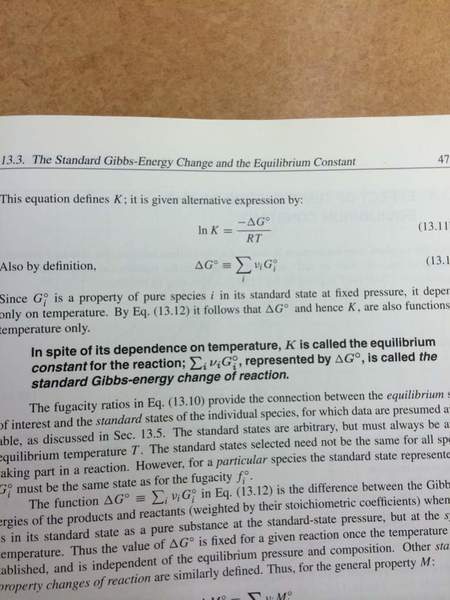
ImageUploadedByPhysics Forums1398545881.420781.jpg


I am not following why the change in Gibbs energy of reaction is defined this way. I can see why K is defined in a way because it's just easier to write K than the whole expression. I'm troubled by the fact that I can define something physical like the change in gibbs energy of a reaction. This definition has more meaning than simply that it's easier to write, but I'm not quite coming to the intended conclusion.
 
Chemistry news on Phys.org
Maylis said:
Hello

I am working on deriving the expression relating the equilibrium constant K to the change in Gibbs energy.

View attachment 69123

This part seems to be followed okay, but here

View attachment 69124

I am not following why the change in Gibbs energy of reaction is defined this way. I can see why K is defined in a way because it's just easier to write K than the whole expression. I'm troubled by the fact that I can define something physical like the change in gibbs energy of a reaction. This definition has more meaning than simply that it's easier to write, but I'm not quite coming to the intended conclusion.

The motivation is this: If you know the free energies of formation of the reactants and products participating in any reaction, then you can calculate the equilibrium constant. On the other hand, if you wanted to tabulate equilibrium constants, then you would have a table of a zillion items because each reactant or product could participate in a huge number of reactions. But, by tabulating the free energies of formation of the substances, the amount of data you need to tabulate is much more limited, especially for common substances. That's why tabulation of the free energies of formation of substances is so useful and convenient.

Chet
 

Similar threads

  • · Replies 4 ·
Replies
4
Views
3K
  • · Replies 10 ·
Replies
10
Views
4K
  • · Replies 3 ·
Replies
3
Views
2K
  • · Replies 1 ·
Replies
1
Views
2K
  • · Replies 6 ·
Replies
6
Views
3K
  • · Replies 11 ·
Replies
11
Views
3K
  • · Replies 9 ·
Replies
9
Views
3K
  • · Replies 15 ·
Replies
15
Views
12K
  • · Replies 1 ·
Replies
1
Views
2K
  • · Replies 81 ·
3
Replies
81
Views
9K