Standing waves - Wave Equation

Click For Summary
SUMMARY

The discussion focuses on the derivation of equation 4.4.4 in the context of standing waves and the wave equation 4.3.4. The necessity of negative signs in the wave equation is explained, emphasizing that the reflected wave travels in the opposite direction to the incident wave, requiring a sign flip in either the kx or ωt term. The choice to reverse the sign of kx to -kx is justified, while the phase term's sign is deemed arbitrary. The boundary conditions, particularly for fixed ends, influence the phase change ∅, which is crucial for accurate wave representation.

PREREQUISITES
  • Understanding of wave equations, specifically the basic wave equation 4.3.4
  • Familiarity with wave propagation concepts, including incident and reflected waves
  • Knowledge of boundary conditions in wave mechanics
  • Basic trigonometric functions and their application in wave equations
NEXT STEPS
  • Study the derivation of the wave equation 4.3.4 in detail
  • Explore the implications of boundary conditions on standing waves
  • Learn about phase shifts in wave mechanics and their physical significance
  • Investigate the mathematical representation of standing waves and their properties
USEFUL FOR

Students and educators in physics, particularly those focusing on wave mechanics, as well as anyone seeking to deepen their understanding of standing waves and wave equations.
elemis
Messages
162
Reaction score
1
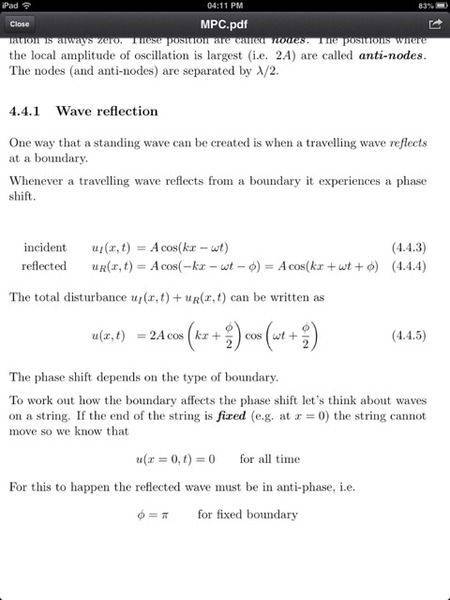
I don't completely understand how equation 4.4.4 was derived and determined. I understand the derivation behind the basic wave equation 4.3.4 but not what happened in 4.4.4. Why is there a need for all the negative signs ? Would a simple phase change suffice ?

Please do be a bit detailed in your explanation... Pretend I'm an idiot. Thank you !

ImageUploadedByPhysics Forums1365250425.424221.jpg
 
Physics news on Phys.org
Since the reflected wave travels in the opposite direction as the incident wave, you need to flip the sign on either the kx or the ωt term***. The author chose to reverse the sign of kx to make it -kx. There was already a - sign with -ωt. For the phase term, the choice of sign is arbitrary.

Just changing the phase would express a wave traveling in the same direction as the incident wave, but shifted in phase.

Hope that helps.

EDIT added:
*** This is because a rightward-traveling wave has the form f(kx-ωt) or f(-kx+ωt). A leftward-traveling wave has the form f(kx+ωt) or f(-kx-ωt).
 
Last edited:
So I could equally have written kx+wt ? Why is there a need for the phase change ∅ ?
 
elemis said:
So I could equally have written kx+wt ?
Yes; see the edit added to my earlier post.
Why is there a need for the phase change ∅ ?
As the book says, the type of boundary will determine ∅. Usually the boundary is either fixed or has a maximum amplitude. Also, the location of the boundary plays a role in what ∅ is.

Eg., for a fixed end located at x=x0:

\cos(kx_0 + \phi /2) = 0

You'd solve that for ∅, given k and x0. Your book is taking the fixed end to be at x=0, so that simplifies things somewhat.
 

Similar threads

  • · Replies 12 ·
Replies
12
Views
2K
  • · Replies 18 ·
Replies
18
Views
4K
  • · Replies 21 ·
Replies
21
Views
2K
  • · Replies 7 ·
Replies
7
Views
2K
Replies
8
Views
1K
  • · Replies 1 ·
Replies
1
Views
1K
  • · Replies 10 ·
Replies
10
Views
11K
  • · Replies 10 ·
Replies
10
Views
8K
Replies
20
Views
5K
  • · Replies 6 ·
Replies
6
Views
2K