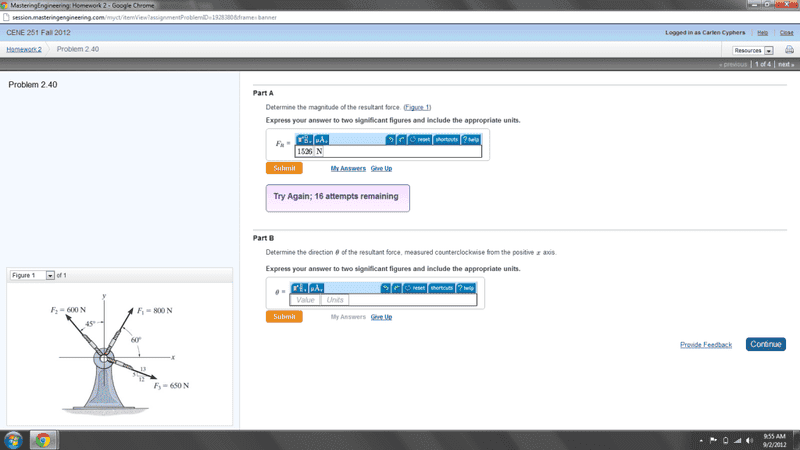
Statics: Determine the magnitude of the resultant force

Click For Summary
SUMMARY

The discussion focuses on resolving forces in a statics problem to determine the magnitude of the resultant force. Participants shared their calculations for the x and y components of three forces, with initial values leading to confusion over the correct resultant magnitude. Key errors identified included neglecting the signs of components and incorrect angle usage for force calculations. Ultimately, one participant resolved their issue by correctly applying negative signs where necessary, emphasizing the importance of direction in vector calculations.

PREREQUISITES
  • Understanding of vector components in physics
  • Knowledge of trigonometric functions (sine and cosine)
  • Familiarity with the concept of resultant forces
  • Ability to perform calculations involving significant figures
NEXT STEPS
  • Review vector resolution techniques in statics problems
  • Practice using trigonometric functions to find force components
  • Learn about force triangles for visualizing vector addition
  • Study the significance of direction and signs in vector calculations
USEFUL FOR

Students studying physics, particularly those focusing on statics and vector analysis, as well as educators seeking to clarify common misconceptions in force resolution.

C268
Messages
26
Reaction score
0
1. Homework Statement :

Untitled-2.png


The Attempt at a Solution


I keep attempting this problem and so far I have got this:

F1x: 150
F1y:260
F2x:424
F2y:424
F3x:600
F3y:250

Then I add the x's together and y's together, square both and take the square root for magnitude, but can't seem to get the right answer
 
Physics news on Phys.org
F1= 800 N at 60 degrees, so F1x = 800cos(60) = 400 N. You have it as 150.
 
rock.freak667 said:
F1= 800 N at 60 degrees, so F1x = 800cos(60) = 400 N. You have it as 150.

alright so I get 1697 in the end...still didn't work, and I noticed it says to 2 significant digits...I am completely stuck...I have no idea what else would be wrong
 
Have you gotten any more progress? I have gotten an answer but nowhere near 1697 or 1526. I would recommend splitting up the equation into the x and y components. As you probably have already done. Also when doing it make sure that you are using the correct angle.
 
No, I kinda gave up for now...as seen in my post I already split up the components into x and y, so not sure what else to do..its such a simple problem I am not sure why I am having trouble with it
 
Please show your workings so we can better assist in finding your errors. Might be due to an error in detremining force components ( as has been pointed out), or might be an error in the pesty plus or minus sign,...or both.
 
C268 said:
No, I kinda gave up for now...as seen in my post I already split up the components into x and y, so not sure what else to do..its such a simple problem I am not sure why I am having trouble with it

Well, if you decide to try the problem again we will be here to help you if you still cannot figure it out.
 
It looks like I have made some small mistakes, I am going to attempt it again this afternoon and hopefully it should work now.
 
Well I tried again and I am running out of time..but here is my work:

F1x: 400
F1y:693
F2x:424
F2y:424
F3x:600
F3y:250

Fx's:1424
Fy's:1367

(1424^2+1367^2)^(1/2)

As far as how I found the x and y components I simply used the magnitude of the vector times cosine of the angle for x's and sine for y's...

I am very frustrated because this is such a simple problem and I don't see what else I would be doing wrong
 
  • #10
What angles are you using for each force? Primarily F3?

Check the angle that you are using for F2. Are you sure you want to use 45 degrees?
 
Last edited:
  • #11
Figured it out...and of course it was something stupid...I forgot to add the negatives to the numbers that needed it...I just figured I didn't need them since I was finding the magnitude anyways, but of course that affects the x and y resultant that you square
 
  • #12
Exactly! Force is a vector so its direction matters ergo the sign also matters. I'm glad that you figured it out! :smile:
 
  • #13
I find it quite easy to always use force triangles when given problems like this since its always easy to make mistakes when resolving( you have more equations obviously high chances of sign mistakes)... wherez you could pplug all the values in one geometric equation and instantly find the magnitude and direction! :)
 

Similar threads

  • · Replies 4 ·
Replies
4
Views
2K
Replies
12
Views
2K
  • · Replies 5 ·
Replies
5
Views
2K
  • · Replies 2 ·
Replies
2
Views
3K
  • · Replies 1 ·
Replies
1
Views
6K
  • · Replies 3 ·
Replies
3
Views
2K
  • · Replies 1 ·
Replies
1
Views
4K
  • · Replies 4 ·
Replies
4
Views
6K
  • · Replies 13 ·
Replies
13
Views
5K
  • · Replies 3 ·
Replies
3
Views
10K