Statistical Mechanics, partition function for mixing

Click For Summary
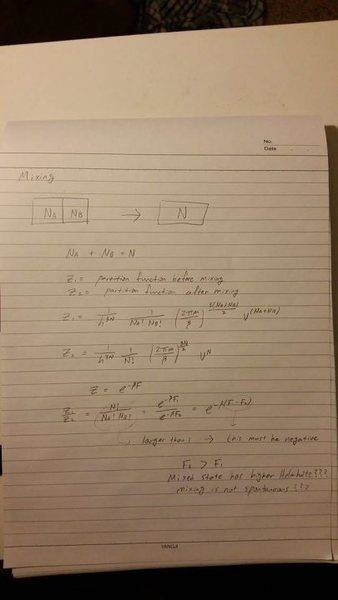
The discussion revolves around the partition functions Z1 and Z2 in statistical mechanics, specifically regarding mixing and its implications for spontaneity. The initial equations suggest that Z1 is significantly larger than Z2, leading to the conclusion that the Helmholtz free energy before mixing is lower than after, which contradicts the expectation that mixing should be spontaneous due to increased entropy. A key point raised is the inconsistency in treating volumes, as the total volume must be correctly accounted for during mixing. By ensuring that the volumes of the components add up to the total volume, the relationship between the partition functions changes, indicating that mixing can indeed be spontaneous. This highlights the importance of consistent volume treatment in statistical mechanics calculations.
jin94
Messages
4
Reaction score
0
Hi! The following image is taken from my note in Stat Mech. Please excuse my ugly handwriting...

I copied this from my professor's note on a whiteboard, and I'm not so sure if it is correct. The equations for Z1 (partition function before mixing) and Z2 (partition function after mixing) seems to imply that Z1 is much larger than Z2 (since N!/(NA! *NB!) is a large number). However, the Z=exp(-bF) then implies that the Helmlholtz free energy before mixing is lower that after mixing, indicating that mixing is not spontaneous. This is against what I have learned so far, since mixing increases entropy and, therefore, spontaneous. Could you please clarify this for me? I have been struggling with this all day long ... thank you so much! If it is hard to read, please let me know.

This is from my note in stat mech.
12822732_10207393493649837_670698776_o.jpg
 
Physics news on Phys.org
It's been years since I've done this stuff, so I might be off-base with this, but it looks to me like the problem is that you don't treat volume consistently. So you have (correctly) ##N_A+N_B=N##, but you also need ##V_A+V_B=V##, because otherwise, you've got box ##N_A## with volume ##V## and box ##N_B## with volume ##V## and you're trying to cram them both into box ##N## with the same volume ##V##, so you're increasing the pressure in the final box (therefore it's not spontaneous--you have to do work on the system). Reworking it with ##V_A+V_B=V## gives you
$$\frac{Z_1}{Z_2} = \frac{V_A^{N_A} V_B^{N_B}}{V^N} \frac{N!}{N_A!N_B!}$$
This is kind of a gross expression that I don't want to think very hard about first thing in the morning, but if you just examine a simple case where ##V_A=V_B##, then you get
$$\frac{Z_1}{Z_2} = \frac{N!}{2^N N_A!N_B!}$$
which is less than 1. To see this, notice that
$$ \frac{N!}{N_A!N_B!} = \binom{N}{N_A}$$
is a binomial coefficient and recall the relation:
$$\sum_{k=0}^n \binom{n}{k} = 2^n$$
Again, I don't know if this is right, but the volume thing jumped out at me.
 

Similar threads

  • · Replies 1 ·
Replies
1
Views
2K
Replies
2
Views
2K
  • · Replies 3 ·
Replies
3
Views
2K
  • · Replies 1 ·
Replies
1
Views
1K
  • · Replies 4 ·
Replies
4
Views
3K
  • · Replies 2 ·
Replies
2
Views
2K
  • · Replies 3 ·
Replies
3
Views
2K
  • · Replies 5 ·
Replies
5
Views
2K
  • · Replies 2 ·
Replies
2
Views
2K
  • · Replies 9 ·
Replies
9
Views
3K