Stem Cell Injections Improve Motor, Sensory Function Post Spinal Cord Injury

Click For Summary

Discussion Overview

The discussion centers around the potential of stem cell injections to improve motor and sensory function following spinal cord injuries. Participants explore various aspects of this therapeutic approach, including its mechanisms, challenges, and implications for future research and treatment.

Discussion Character

  • Exploratory
  • Technical explanation
  • Debate/contested

Main Points Raised

  • Some participants express optimism about the use of patient-derived stem cells for therapeutic injections, noting promising early results in individual cases.
  • Others highlight historical challenges in spinal cord injury treatments, particularly the difficulty of getting new nerves to connect correctly within the complex structure of the spinal cord.
  • There are discussions about the role of scar tissue and glial cells as barriers to nerve regeneration, with some suggesting that treatments may need to focus on overcoming these obstacles.
  • One participant raises questions about the specific functions of stem cells in the treatment, speculating on their potential to create new glial cells or neurons, and the need for animal studies to better understand these mechanisms.
  • Another participant introduces the idea that extravasated blood and associated neurotoxins at injury sites might inhibit nerve growth, suggesting that addressing this issue could complement stem cell therapies.
  • There is mention of neuroprotective drugs and their potential role in mitigating damage from injuries, with some arguing that preventing collateral damage may be as crucial as promoting new neuron growth.

Areas of Agreement / Disagreement

Participants do not reach a consensus, as multiple competing views and uncertainties remain regarding the mechanisms of stem cell therapy and the challenges associated with spinal cord injuries.

Contextual Notes

Limitations include unresolved questions about the specific actions of stem cells in the treatment, the impact of scar tissue and neurotoxins, and the need for further research, particularly in animal models.

berkeman
Admin
Messages
69,479
Reaction score
25,001
TL;DR
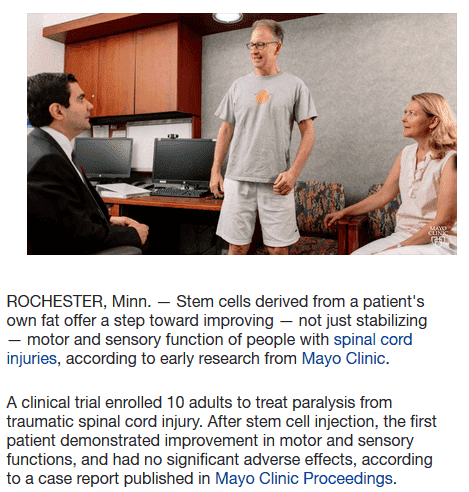
Stem cell injections into injured spinal cord sections are showing promise for improved motor/sensory function after injury
This is a wonderful area of active research. Early in my EE career, I was interested in trying to use IC-scale nerve interfaces to bypass spinal cord injuries, but the science of interfacing electronics to nerve cells for long-term use was not developed enough. Even today, it is a problematic approach to trying to repair spinal cord injuries.

But this different approach of using stem cells from the patient (Pt) as part of therapeutic injections into the injured spinal cord sections seems to be very promising. Certainly this particular "Patient #1" has had a remarkable recovery. Here's hoping that these trials keep providing good information on how to improve the treatments, and that this becomes a mainstream treatment for restoring function to those who experience spinal cord injury.

This is the best thing I've read all week (and the Pt is even a local surfer!). :smile:

https://newsnetwork.mayoclinic.org/...or-sensory-function-after-spinal-cord-injury/
1574899953750.png
 
Last edited:
  • Like
Likes   Reactions: WWGD, Choppy, Tom.G and 2 others
Biology news on Phys.org
If my memory serves me correctly this is quite an old idea but the problems were never really about getting stem cells to develop into neurones. The spinal cord is a thick bundle of nerves and the work was stuck on how to get the new nerves to connect to the right nerves. There is a similar problem in the natural healing that occurs after cord injuries, I expect the extent of the damage is the key to the effectiveness of this procedure.
 
  • Like
Likes   Reactions: WWGD and BillTre
As I recall, part of the problem in the CNS is that some scar tissue or intervening glia can form barriers to nerve regeneration. In the periphery, this is less of a problem, but here are still the kind of problems @Laroxe mentioned of getting nerves to reconnect to their proper targets.
In grad school, I knew people who went into this field (CNS regeneration), but I did not think it was ripe for success at the time (and I was right).

I now have a vague understanding that there are treatments that can help get nerves through the scar tissue of an injury and get started on regenerating a connection.
Not sure where things are with making the proper connections.

Its not clear what the stem cells are doing in this treatment. Perhaps making new glial cells, perhaps more embryonic glial cells more conducive to nerves growing through the area they are in. Normally the most of the nerve cells affected by such injuries would have their cells bodies and inputs far removed from the spinal injury. Perhaps they are inserting new neurons at the site of injury that receive the descending inputs (from higher up in the CNS) and then extending axons to the inputs targets.
These are all questions for animal experiments, not human subjects unfortunately.
It would be interesting to see what similar things do in animals. It would probably require killing the subject and sectioning up its spinal cord after the regeneration.
 
  • Like
Likes   Reactions: Laroxe
One might wonder whether the targeting of the damage being caused by the extravasated blood at the site of injury might be inhibiting any neurite outgrowth? Researchers are actively targeting this iron, from the lysed red blood cells, so with the removal of iron showing neurite outgrowth, one might think it would be a interesting adjunct to stem cell therapy? "Neuroprotective molecular mechanisms of (-)-epigallocatechin-3- gallate: a reflective outcome of its antioxidant, iron chelating and neuritogenic properties." "Deferoxamine promotes recovery of traumatic spinal cord injury by inhibiting ferroptosis "
 
  • Like
Likes   Reactions: BillTre and Laroxe
ironjustice01 said:
One might wonder whether the targeting of the damage being caused by the extravasated blood at the site of injury might be inhibiting any neurite outgrowth? Researchers are actively targeting this iron, from the lysed red blood cells, so with the removal of iron showing neurite outgrowth, one might think it would be a interesting adjunct to stem cell therapy? "Neuroprotective molecular mechanisms of (-)-epigallocatechin-3- gallate: a reflective outcome of its antioxidant, iron chelating and neuritogenic properties." "Deferoxamine promotes recovery of traumatic spinal cord injury by inhibiting ferroptosis "

Yes, this is an interesting area that goes beyond spinal cord injuries, it seems that most types of injury in the CNS is associated with the release of a range of neurotoxins that significantly increase the area of damage. I know there is considerable interest in the development of neuroprotective drugs.

This is one I haven't come across but bleeding into the CNS is associated with considerable local inflammation so it does make perfect sense and sounds as if it may have a role in traumatic brain injuries and stroke as well as in spinal cord injuries. It may be that the prevention of the collateral damage may be more important than new neurone growth as it would preserve the structures already in place. Interesting stuff !
 
  • Like
Likes   Reactions: BillTre

Similar threads

  • · Replies 1 ·
Replies
1
Views
2K
  • · Replies 2 ·
Replies
2
Views
4K
Replies
1
Views
4K
  • · Replies 2 ·
Replies
2
Views
5K
  • · Replies 13 ·
Replies
13
Views
8K