Step unclear in Peebbles' Probability Book

  • Context: Undergrad 
  • Thread starter Thread starter snatchingthepi
  • Start date Start date
  • Tags Tags
    Book Probability
Click For Summary
SUMMARY

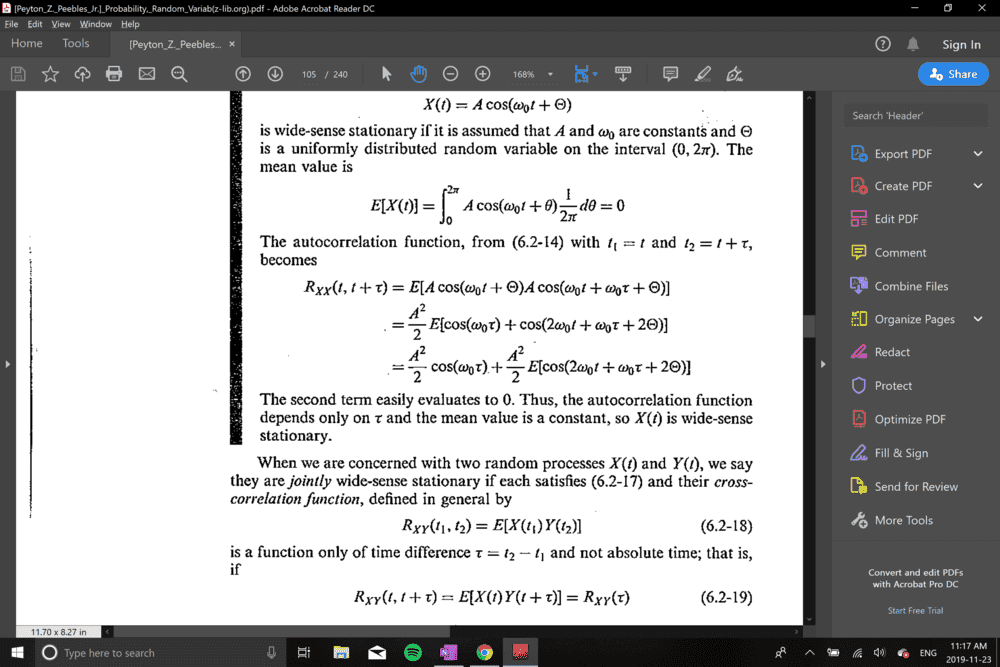
The discussion centers on understanding a specific step in Peebles' Probability Book related to autocorrelation functions. Participants clarify the transition from a product in the expectation value to a sum, specifically in the context of calculating the autocorrelation function \( R_{X,X}(t,t+\tau) \). The formula \( \cos(a) \cos(b) = \frac{1}{2}(\cos(a+b) + \cos(a-b)) \) is identified as a critical identity that facilitates this transformation. This insight resolves the confusion regarding the mathematical manipulation involved.

PREREQUISITES
  • Understanding of autocorrelation functions in probability theory
  • Familiarity with expectation values in statistical analysis
  • Knowledge of trigonometric identities, specifically the cosine product-to-sum formula
  • Basic concepts of signal processing and time series analysis
NEXT STEPS
  • Study the derivation of autocorrelation functions in probability theory
  • Learn about expectation values and their applications in statistical mechanics
  • Explore trigonometric identities and their uses in mathematical proofs
  • Investigate the role of autocorrelation in signal processing and time series forecasting
USEFUL FOR

Students and researchers in probability theory, statisticians, and anyone studying signal processing who seeks to deepen their understanding of autocorrelation and expectation values.
snatchingthepi
Messages
145
Reaction score
37
TL;DR
There's a step from one line to another that isn't clear to me.
If anyone could help me understand how Peebles gets from line one of the autocorrelation to the second line, I'd be most grateful. I don't understand what identity or property is being used to go from a product in the expectation value to a sum in the expectation value.
2019-11-23.png
 
Physics news on Phys.org
I'm not sure I understand the step you are struggling with. Is it where they calculate ##R_{X,X}(t,t+\tau)##?

In that case, the formula

$$\cos(a) \cos(b)= 1/2(\cos(a+b)+\cos(a-b))$$ can be useful.
 
  • Like
Likes   Reactions: snatchingthepi
Sorry for the lateness of my thanks, but #gradschool. Yeah I feel slightly stupid now for not realizing that. It was exactly what I needed. Thank you.
 
  • Like
Likes   Reactions: member 587159

Similar threads

  • · Replies 1 ·
Replies
1
Views
2K
  • · Replies 3 ·
Replies
3
Views
2K
  • · Replies 18 ·
Replies
18
Views
3K
  • · Replies 1 ·
Replies
1
Views
2K
  • · Replies 4 ·
Replies
4
Views
3K
  • · Replies 10 ·
Replies
10
Views
3K
  • · Replies 11 ·
Replies
11
Views
3K
  • · Replies 29 ·
Replies
29
Views
4K
  • · Replies 17 ·
Replies
17
Views
4K
  • · Replies 14 ·
Replies
14
Views
2K