Strange fluid-mechanics formula made by crazy textbook author

Click For Summary

Discussion Overview

The discussion revolves around a fluid mechanics formula presented in a textbook, specifically addressing the role of surface tension in balancing the weight of a fluid column in a tube. Participants explore concepts related to capillary action, the behavior of fluids in tubes, and the explanations (or lack thereof) provided in the textbook.

Discussion Character

  • Exploratory
  • Technical explanation
  • Conceptual clarification
  • Debate/contested

Main Points Raised

  • Some participants question how surface tension forces at the top of a fluid column can support the weight of the fluid, suggesting that pressure differences are more relevant in lifting the fluid.
  • Others argue that the tube does not need to be closed at the top, indicating that there are other forces at play that counteract the weight of the fluid.
  • One participant inquires about the mechanism of fluid adhesion to the tube walls and whether the fluid can stick to the tube when lifted.
  • Capillary action is introduced as a phenomenon that explains how fluids can rise in tubes, with a reference to its role in biological systems like trees.
  • Questions are raised about the nature of surface tension in relation to the tube walls and whether it contributes to vertical tension throughout the fluid.
  • Concerns are expressed regarding the lack of explanation in the textbook about the mechanisms involved before presenting calculations.
  • A participant mentions that the behavior of mercury in capillary action leads to a depression in fluid level, presenting a corollary to the discussed phenomena.
  • One participant expresses dissatisfaction with the textbook used, suggesting a preference for an alternative resource that they found more helpful.

Areas of Agreement / Disagreement

Participants express varying views on the role of surface tension and pressure in fluid mechanics, with no consensus reached on the explanations provided in the textbook or the mechanisms involved.

Contextual Notes

Some participants note that the textbook lacks a thorough explanation of the mechanisms behind the phenomena discussed, which may lead to confusion regarding the principles of fluid mechanics.

Nikitin
Messages
734
Reaction score
27
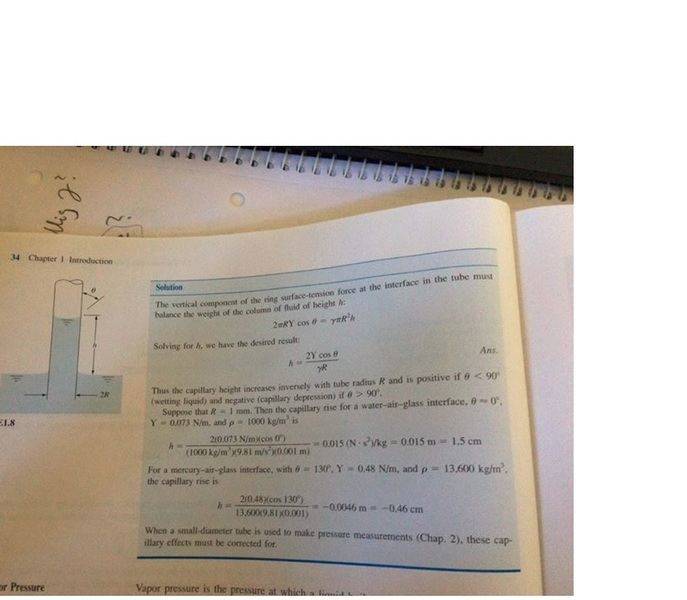
Please look at the picture I uploaded.
attachment.php?attachmentid=61194&d=1377612599.jpg


Can somebody explain to me how the author of my book can claim that the "vertical component of the ring surface-tension force at the interface in the tube balances the weight of the column of fluid of height h"? This stuff is weird. How can TENSION FORCES which are on the TOP of a column of fluid support the weight of the column?

I mean, it's obviously the pressure-difference between the air inside the tube and outside which lifts the water, assuming that the tube is closed on the top.
 

Attachments

  • Untitled.jpg
    Untitled.jpg
    34.8 KB · Views: 717
Last edited by a moderator:
Physics news on Phys.org
The tube need not be closed at the top. The air pressure is equal at the top of the fluid in the tube and at its base outside. So there must be something else that counteracts the weight of the fluid in the tube. This is what the author states.
 
Then how does it work? Does the fluid actually "stick" to the sides of the tubes, and thus drags some of the rest of the fluid along with it? So, if you lift the tube very carefully, theoretically the water would stick to it?

How can the fluid, say H2O, stick to a normal glass or plastic tube? I mean neither of those substances are polarized...

And can somebody pls help me here too? https://www.physicsforums.com/showthread.php?p=4484367#post4484367
 
Hmm, thanks. But 2 questions remain:

1) Why is the surface-tension connecting the water to the tube-wall the same as the regular surface-tension?

2) Doesn't this mean that there will be a tension vertically throughout the water, which lifts the water up the tube?
 
Given how the solution is framed in your book, I would expect that it should have an explanation of the mechanism before it plunges into the calculation. Is it completely silent on that?
 
1. surface tension is surface tension. It's the fluid and the size (diameter) of the tube which produces this phenomenon.

2. At least in the tube.

Weird corollary to capillary action. When the fluid is mercury, Cap Action produces a depression in the fluid level relative to the level of the rest of the liquid.
 
voko said:
Given how the solution is framed in your book, I would expect that it should have an explanation of the mechanism before it plunges into the calculation. Is it completely silent on that?

The book we use is called Fluid Mechanics by Frank M. White, and it is only fit as firewood.

Anyway I have understood this subject thanks to you guys and Cengel & Cimbala's far superior text on fluid mechanics. thanks :)
 
Last edited:

Similar threads

  • · Replies 19 ·
Replies
19
Views
7K
  • · Replies 8 ·
Replies
8
Views
1K
  • · Replies 5 ·
Replies
5
Views
3K
  • · Replies 10 ·
Replies
10
Views
6K
  • · Replies 27 ·
Replies
27
Views
5K
  • · Replies 1 ·
Replies
1
Views
3K
  • · Replies 9 ·
Replies
9
Views
2K
Replies
1
Views
2K
  • · Replies 6 ·
Replies
6
Views
5K
  • · Replies 2 ·
Replies
2
Views
27K