How Do You Calculate the Buoyant Force for a Stratospheric Balloon?

  • Thread starter Thread starter nicky670
  • Start date Start date
  • Tags Tags
    Balloon
Click For Summary
SUMMARY

The buoyant force for a stratospheric balloon can be calculated using Archimedes' Principle, which states that the buoyant force is equal to the weight of the fluid displaced by the object. To find the buoyant force, one must determine the volume of fluid displaced and then calculate its weight using the formula F(buoyant force) = ρ * V * g, where ρ is the fluid density, V is the volume displaced, and g is the acceleration due to gravity (9.8 m/s²). The discussion emphasizes the importance of understanding the relationship between volume and weight in calculating buoyancy.

PREREQUISITES
  • Understanding of Archimedes' Principle
  • Knowledge of fluid density (ρ)
  • Familiarity with basic physics concepts such as force and weight
  • Ability to apply the formula F = m * g
NEXT STEPS
  • Research the application of Archimedes' Principle in various contexts
  • Learn how to calculate the density of different fluids
  • Explore the effects of altitude on buoyancy for stratospheric balloons
  • Study the relationship between volume, mass, and weight in fluid mechanics
USEFUL FOR

This discussion is beneficial for physics students, aerospace engineers, and hobbyists interested in ballooning and buoyancy calculations.

nicky670
Messages
21
Reaction score
1
Homework Statement
The figure on the right shows a stratospheric balloon
carrying a payload. The density of helium at 1.0 atm and 15 oC
is 0.168 kg/m3 and the density for air is 1.225 kg/m3. The mass
of the balloon (skin without helium) and the payload is 260 kg.
The volume of the balloon at ground level is 300 m3
Relevant Equations
Upthrust?
I have gathered the formula:
F(buoyant force) - (Mballoon + Mpayload)g - (Mhelium)g = (Mballoon + Mhelium + Mpayload)a
But i can't seem to figure out what is the buoyant force to find a. Or am i mistaking something?
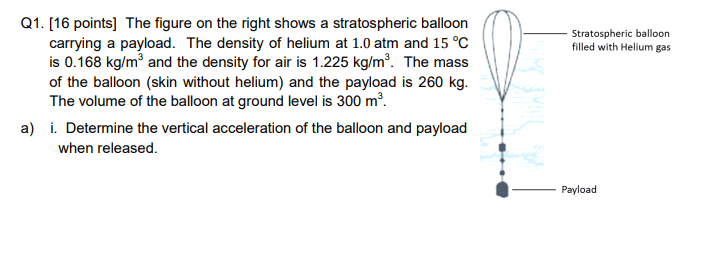
phy5.PNG
 
Physics news on Phys.org
nicky670 said:
F(buoyant force) - (Mballoon + Mpayload)g - (Mhelium)g = (Mballoon + Mhelium + Mpayload)a
Ok
But i can't seem to figure out what is the buoyant force to find a. Or am i mistaking something?
Have you covered Archimedes' Principle?
 
Yes i have.
 
According to Archimedes' principle, how would you find the buoyant force on a rock of volume V that is completely submerged in water?
 
  • Like
Likes   Reactions: Chestermiller
it is the volume of water displaced by the rock that will get you the buoyant force right?
TSny said:
According to Archimedes' principle, how would you find the buoyant force on a rock of volume V that is completely submerged in water?
It will be the volume of water displaced by the rock right? For buoyant force
 
nicky670 said:
it is the volume of water displaced by the rock that will get you the buoyant force right?

It will be the volume of water displaced by the rock right? For buoyant force
A volume is not a force. What attribute of that volume of fluid?
 
haruspex said:
A volume is not a force. What attribute of that volume of fluid?
The weight of the volume of water displaced
 
nicky670 said:
The weight of the volume of water displaced
Yes, that's right. Does this help with finding the buoyant force on the balloon?
 
TSny said:
Yes, that's right. Does this help with finding the buoyant force on the balloon?
So i use rho = m/v formula to find the mass and then multiply by g=9.8 to get the weight?
 
  • #10
nicky670 said:
So i use rho = m/v formula to find the mass and then multiply by g=9.8 to get the weight?
That's the right idea. For what substance are you going to find the mass in order to get the buoyant force?
 

Similar threads

Replies
17
Views
3K
  • · Replies 10 ·
Replies
10
Views
4K
  • · Replies 10 ·
Replies
10
Views
2K
  • · Replies 7 ·
Replies
7
Views
4K
  • · Replies 0 ·
Replies
0
Views
855
  • · Replies 8 ·
Replies
8
Views
2K
Replies
4
Views
2K
  • · Replies 11 ·
Replies
11
Views
4K
  • · Replies 3 ·
Replies
3
Views
4K
Replies
6
Views
8K