Strong force as exchange of mesons, or of quark and antiquark

Click For Summary
SUMMARY

The discussion centers on the interpretation of the strong force between nucleons, specifically through the exchange of mesons versus the exchange of quarks and antiquarks. Participants clarify that while mesons are composed of a quark and an antiquark, the exchange mechanism does not imply a direct equivalence between the two descriptions. The role of time in Feynman diagrams is also debated, with consensus that the diagrams represent initial and final states without a strict time ordering for intermediate states.

PREREQUISITES
  • Understanding of quantum field theory concepts
  • Familiarity with Feynman diagrams and their interpretations
  • Knowledge of particle physics, specifically nucleons and mesons
  • Basic grasp of quark-antiquark interactions
NEXT STEPS
  • Study the principles of quantum chromodynamics (QCD)
  • Learn about the role of mesons in mediating strong forces
  • Explore advanced Feynman diagram techniques and time ordering
  • Investigate the implications of particle-antiparticle interactions in quantum physics
USEFUL FOR

Physicists, students of particle physics, and anyone interested in the fundamental interactions of matter at the subatomic level.

crick
Messages
39
Reaction score
4
The (residual) strong force between nucleons can be desribed as

- The exchange of a meson (from a nucleon to the other), as in picture b)
- The exchange of a quark and an antiquark: in picture a) one nucleon "gives" a quark and receive an antiquark and it's the opposite for the other
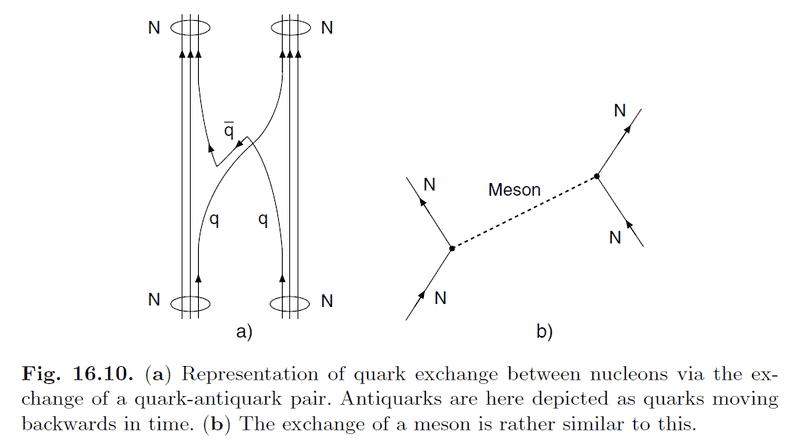
2mK5f.png


I do no see how these two description are consistent with each other since in picture b) the meson (a quark + an antiquark) goes from one nucleon to the other, while in a) there is an exchange. So are these two interpretation equivalent? The nucleon that gives the quark also gives the antiquark (and therefore a meson) or receives it instead?
 

Attachments

  • 2mK5f.png
    2mK5f.png
    21.7 KB · Views: 1,127
Physics news on Phys.org
Same thing. You don't have an actual time axis anyway in these diagrams, only initial and final states.

Here is your meson going from left to right in the left diagram:

meson.png
 

Attachments

  • meson.png
    meson.png
    5.1 KB · Views: 1,114
  • Like
Likes   Reactions: crick
mfb said:
Same thing. You don't have an actual time axis anyway in these diagrams, only initial and final states.

Here is your meson going from left to right in the left diagram:

View attachment 227384

Thanks for the answer.

But there is actually a time axis and it is vertical (going from down to up). I'm aware that antiparticles move backwards in time (in the picture it moves downward a bit) but the fact is that it moves from left to right "in space".

Is this wrong? So actually (besides moving backwards in time) the direction in space indicated by the arrow in the feynman diagram should be reversed for an antiparticle?
 
crick said:
I'm aware that antiparticles move backwards in time

No they don't.
 
  • Like
Likes   Reactions: Klystron
crick said:
But there is actually a time axis and it is vertical (going from down to up).
The only meaningful times in a Feynman diagram are the initial and final states. Everything inside doesn't have a time ordering, and in fact you have to consider all times for all vertices for calculating such a diagram.
 

Similar threads

  • · Replies 1 ·
Replies
1
Views
1K
  • · Replies 9 ·
Replies
9
Views
3K
  • · Replies 9 ·
Replies
9
Views
1K
  • · Replies 2 ·
Replies
2
Views
2K
  • · Replies 14 ·
Replies
14
Views
4K
  • · Replies 4 ·
Replies
4
Views
3K
  • · Replies 4 ·
Replies
4
Views
2K
  • · Replies 10 ·
Replies
10
Views
3K
Replies
7
Views
2K
  • · Replies 5 ·
Replies
5
Views
2K