Struggling to Find My Mistake in Circuit Analysis | Beginner Level

Join the discussion
Ask a follow-up here, or get your own question answered by working scientists, mathematicians and engineers — people, not an autocomplete.
Real named experts · corrections over time · the nuance an AI answer skips
6 replies · 2K views
Fjolvar
Messages
156
Reaction score
0
[Moderator Note: Thread content restored from archive. Relevant portions of the original attachment have been uploaded and included here]

Hello,

I am working on a beginner level circuit analysis problem due tomorrow, but my branch current values aren't making sense. I've been struggling to figure out what I'm doing wrong, but still everything seems right to me.

Please see the attachment for my solution.
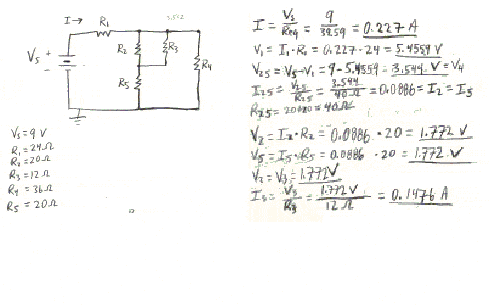
Fig1.gif


My issue is that the following relation isn't calculating to be true:

I = I (through resistor 2&5) + I (through resistor 3) + I (through resistor 4)

I keep getting a value of .3346 amps instead of .227 amps as I calculated in the beginning of the problem.

Any help would be greatly appreciated. Thank you in advance.
 
Last edited by a moderator:
Physics news on Phys.org
Fjolvar, please use the homework posting template when you start a thread in the homework sections.

When you calculate I25 you ignore the effect of R3. R2 and R5 are not in series because R3 also connects where they join. This is throwing off your further calculations.
 
gneill said:
When you calculate I25 you ignore the effect of R3. R2 and R5 are not in series because R3 also connects where they join. This is throwing off your further calculations.

Thanks you Gneill, I see that now, however I'm still not sure how to approach this problem. I'm trying to solve for the current through all branches. Wouldn't the current I split into three branch currents R2+R5 & R3+R5 & R4?
 
I don't think the first reduction you did is legitimate. When you made R2 and R3 in parallel and made an equivalent circuit R23 you had to move the connection point of R3 past a node, which is not kosher.

I think you will have to do this problem using Kirchhoff's rules instead of trying to make equivalent circuits.
 
Fjolvar said:
Thanks you Gneill, I see that now, however I'm still not sure how to approach this problem. I'm trying to solve for the current through all branches. Wouldn't the current I split into three branch currents R2+R5 & R3+R5 & R4?
Current will flow through all the resistors, yes.

Unless you want to bring in more powerful techniques such as mesh or nodal analysis, or KVL and KCL, you can proceed piecemeal as you've been doing, by combining resistors temporarily to find currents and potentials, summing or subtracting currents, etc..

For example, I note that you reduced all the resistors down to an equivalent resistance to find the total current I. You then found the potential drop across R1 using this current, giving you the potential at the top of R2, R3, and R4.

Well, R4 is a simple case. You have the potential across it so you can determine the current through it. If you subtract this current from the total you're left with what must end up going through R5 via r2 and R3. So you can determine the potential drop across R5, and you now know the potential at both ends of R2 and R3...
 
NascentOxygen said:
The first post in this thread appears to have been swallowed up by a voracious microdot. :confused:

Or something more sinister... o_O
I've restored the relevant content.