Struggling with Plane Motion Homework?

Join the discussion
Ask a follow-up here, or get your own question answered by working scientists, mathematicians and engineers — people, not an autocomplete.
Real named experts · corrections over time · the nuance an AI answer skips
7 replies · 2K views
AmazingDonuts
Messages
3
Reaction score
2
Member has been warned to show some effort.
Hey guys!

I´m having a lot of trouble , even on starting this problem. Can someone give me a help??
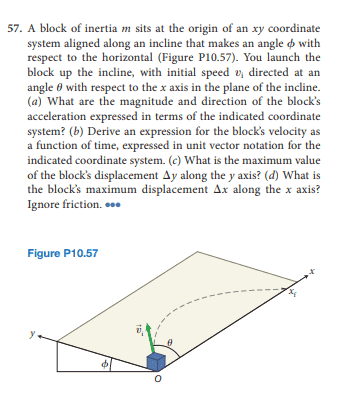
mazurP1057.PNG


[Moderator's note: Moved from a technical forum and thus no template.]
 
Last edited by a moderator:
  • Like
Likes   Reactions: Lnewqban and Delta2
Physics news on Phys.org
Welcome to the PF. :smile:

I'm not sure about the screenshot translation, but "a block of inertia m" is pretty hard to decode for me. But leaving that aside for now...

Can you show us your Free Body Diagram (FBD) for the mass in this problem? Show the x-y axes and the forces on the mass, and post the Relevant Equations for the motion of the mass (velocity, acceleration, etc.) based on that FBD.

After you do that work, we should be able to help you more. :smile:
 
  • Like
Likes   Reactions: AmazingDonuts
to clarify inertia m means that the block has a m mass
 
Thanks :D
I got to this
I am truly confused now
Document 24_2.jpg
 
What exactly are the forces ##F_x,f_x,F_y,f_y##? I mean to what physical forces they do correspond?

In my opinion there are only 2 forces acting on the block, gravity and the normal force, but they are immersed into 3D and not in 2D as we are used to for this kind of problems. So extra care is needed when analysing these two forces into x,y components(and possibly z component, though the z-axis is not shown in the picture i believe we can take the z-axis to be in the direction of the normal force).
 
  • Like
Likes   Reactions: Lnewqban
You are showing an equation that contains acceleration; however, it seems to me that there is no other acceleration involved than gravity in this case.
The reason is that the body starts its trajectory with certain velocity and nothing tells us about additional external forces acting upon it, other than its own weight.

It is perhaps a simplistic and incorrect approach, but I would try the calculations of this problem as a regular projectile one with trajectory on the vertical plane.
The actual initial velocity, velocity's angle and trajectory over the incline plane (x-y plane) could be decomposed into two projections: one natural projectile trajectory on the vertical or gravity plane and another trajectory on the horizontal plane.
 
Lnewqban said:
You are showing an equation that contains acceleration; however, it seems to me that there is no other acceleration involved than gravity in this case.
The reason is that the body starts its trajectory with certain velocity and nothing tells us about additional external forces acting upon it, other than its own weight.

It is perhaps a simplistic and incorrect approach, but I would try the calculations of this problem as a regular projectile one with trajectory on the vertical plane.
The actual initial velocity, velocity's angle and trajectory over the incline plane (x-y plane) could be decomposed into two projections: one natural projectile trajectory on the vertical or gravity plane and another trajectory on the horizontal plane.
You omit the normal force.
It will be simpler to use coordinates within the plane, i.e. make y distance up the plane, as in the diagram.
Maybe you did not mean "vertical".
 
haruspex said:
You omit the normal force.
It will be simpler to use coordinates within the plane, i.e. make y distance up the plane, as in the diagram.
Maybe you did not mean "vertical".
Normal force is what makes the block deviate to its right, producing another parabola projection on the horizontal plane.

I agree, working on the given x-y plane simplifies things.

I meant vertical, like the direction of the natural gravity acceleration.