Struggling with Truss Analysis in Statics?

  • Thread starter Thread starter Fat Ryan
  • Start date Start date
  • Tags Tags
    Lost Statics
Click For Summary

Discussion Overview

The discussion revolves around challenges faced in understanding truss analysis within the context of a statics course. Participants express difficulties with concepts related to force moments, equilibrium at nodes, and the application of equations in solving homework problems related to truss assemblies.

Discussion Character

  • Homework-related
  • Technical explanation
  • Debate/contested

Main Points Raised

  • One participant expresses frustration with the lack of clear explanations from their teacher and the inadequacy of available resources, leading to confusion about truss analysis.
  • Another participant emphasizes that every node must be in a state of equilibrium, suggesting that focusing on individual nodes is crucial for analysis.
  • Concerns are raised about how to account for forces at multiple nodes, particularly regarding the interaction between nodes D and E.
  • Some participants suggest that drawing free body diagrams for each joint can help clarify the situation and facilitate the writing of equations for each joint.
  • There is a discussion about the statically indeterminate nature of reactions at certain joints and the need to consider the geometry of the members to determine forces accurately.
  • A later reply critiques the initial equations provided by one participant, highlighting the importance of including all support reactions and correctly summing forces and moments.
  • Suggestions are made to use the Method of Sections or Method of Joints for solving the truss problem, indicating different approaches that may be taken.

Areas of Agreement / Disagreement

Participants generally agree on the importance of equilibrium at nodes and the necessity of free body diagrams, but there is disagreement on the interpretation of how forces interact between nodes and the best methods to solve the problems presented.

Contextual Notes

Participants express uncertainty about the application of moments and the role of external forces in the overall system, indicating that some assumptions may not be fully articulated or understood.

Fat Ryan
Messages
48
Reaction score
0
Im so lost in Statics :( :( HELP!

first of all i need to say that i do not go to a school that is known for its sciences. this of course means that we have crappy science teachers because our budget is very low. my teacher is horrible at explaining the material and whenever i ask him a question he does not explain the solution even remotely clear. I've tried the book but its pretty useless too (2 examples per 30-40 problems). the tutors on campus can pretty much only help with general physics so i guess this is my last hope.

Homework Statement


we are working on truss assemblys and i can't understand how this whole force moment thing works. the solutions that i calculate don't make sense when i try to visualize the situation.

here is one of my homework problems that i have been stuck on for a while now:
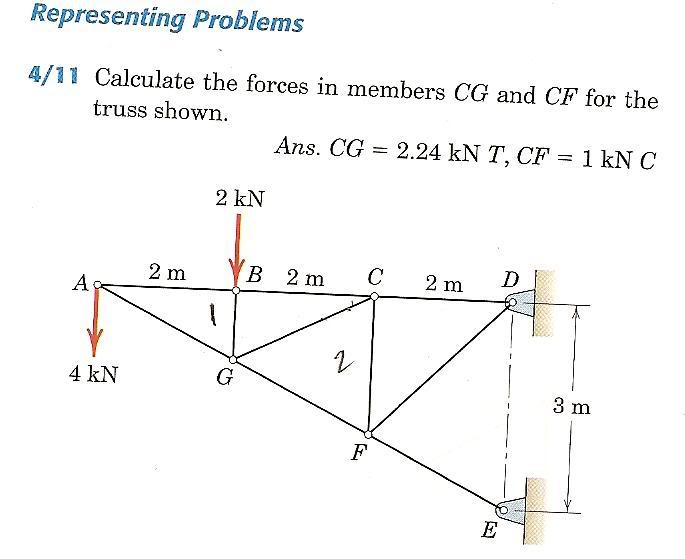
statics411.jpg


Homework Equations


where do i begin the calculations?
when calculating the Fy forces should i include point E or just use one at a time (D & E)?
do i need to take the moment about some point? (i tried C and D, but both didnt seem right)
can someone PLEASE give me a clear and precise explanation on how to solve problems like this?


The Attempt at a Solution


this is all i have so far and i doubt its correct:

Code:
SUM Fx=0...Dx=0

SUM Md=0...4kN(6m) + 2kN(4m) - A(6m)=0
                   A= 5.333kN

SUM Fy=0...5.333kN - 4kN - 2kN + D = 0
                   D= 0.667kN

but this just doesn't make sense for D...
 
Physics news on Phys.org
Hint: every node must be in the state of equilibrium.
 
yeah i know that but i don't understand how you can just look at 1 node and say it must balance out. like look at node D, if you balance the forces on that youll have a certain Fy force right? well doesn't node E take part of that load too? i just don't understand how you can set each node to equalibrium without looking at the big picture. and how are you supposed to know when and when not to calculate moments?

i tried to talk to my professor today after class. i told him i just don't understand this stuff and I've run out of resources for help. he immediatly jumped on the defense and told me i need to do the homework...how am i supposed to do the homework if i don't understand the material? i tried to tell him that, but he just says "come on, this stuff is simple" like he ALWAYS says when anyone asks him a question. he really makes you feel like a dumbass and he's doing a good job. christ, what am i supposed to do to pass this damn class?? I am so frustrated, sorry.
 
^ That's probably the most difficult part of Statics...or Dynamics, for that matter. You have to be able to ignore the whole system and just focus on a single point. If you're able to do this, it's not such a difficult class.

You're right in thinking that outside forces affect the entire system...but if you break things down, this gets accounted for in the end. So look at each joint individually (drawing them separately always helps!) and write the equations for each joint. You'll be sick of free body diagrams by the time you're finished...but that's the main concept behind pretty much everything in the class.
 
SlideMan said:
^ That's probably the most difficult part of Statics...or Dynamics, for that matter. You have to be able to ignore the whole system and just focus on a single point. If you're able to do this, it's not such a difficult class.

You're right in thinking that outside forces affect the entire system...but if you break things down, this gets accounted for in the end. So look at each joint individually (drawing them separately always helps!) and write the equations for each joint. You'll be sick of free body diagrams by the time you're finished...but that's the main concept behind pretty much everything in the class.

yeah that's everything we've been told to do. but for instance, on this problem. if i go and solve for the Dy then that means the forces don't act on E because Dy balances them out, but that's not true...
 
Fat Ryan said:
yeah that's everything we've been told to do. but for instance, on this problem. if i go and solve for the Dy then that means the forces don't act on E because Dy balances them out, but that's not true...
You are quite right, you have made a good observation. The Fy reactions at D and E are statically indeterminate and you must examine the geometry of the members at those joints to determine them. The horizontal Fx componnets of the D and E reactions can be determined by summing moments about each support. Then it's plug and chug.
 
i hate this stuff, i just want to have a job already
 
SUM Fx=0...Dx=0

SUM Md=0...4kN(6m) + 2kN(4m) - A(6m)=0
A= 5.333kN

SUM Fy=0...5.333kN - 4kN - 2kN + D = 0
D= 0.667kN

OK...let's go over your equations. For the first one, we're summing forces in the x-direction, right? Don't forget the support reaction at E. That would give us: \Sigma F_{x}=D_{x}+E_{x}=0. Thus, D_{x} = -E_{x}

Next, it looks like you're summing the moments about D. That's the force perpendicular to a line intersecting D times the distance from point D. So, we should have \Sigma M_{D}=4kN(6m) + 2kN(4m) - E_{x}(3m)=0. And E_{x} = 32/3. Note that the force at A is given as 4kN, so you don't need to figure this out.

Finally, you're summing forces in the y-direction. Again, don't forget the support reaction at E. So, \Sigma F_{y}=-4kN - 2kN + D_{y} + E_{y}. This really won't yield anything useful at this point, but you'll end up with D_{y} = 6 - E_{y}.

Hopefully, this makes sense. You now have the horizontal support reactions at D and E. Unfortunately, for this problem, those won't get you too far without some additional work. Turns out, you're better off ignoring the support reactions for now and solving the truss using the Method of Sections. Method of Joints will work, too...but you're looking at a little extra work. Try cutting the truss in a logical point and summing the forces at each edge point for the remaining section. You'll use the same methods we just used for the whole truss, except this time you'll be just analyzing a small section.
 

Similar threads

  • · Replies 1 ·
Replies
1
Views
2K
  • · Replies 6 ·
Replies
6
Views
3K
  • · Replies 2 ·
Replies
2
Views
1K
  • · Replies 2 ·
Replies
2
Views
7K
  • · Replies 2 ·
Replies
2
Views
2K
  • · Replies 5 ·
Replies
5
Views
2K
  • · Replies 2 ·
Replies
2
Views
3K
  • · Replies 5 ·
Replies
5
Views
2K
Replies
2
Views
3K
  • · Replies 1 ·
Replies
1
Views
2K