Studying materials for basics physics: exercises, not theory

Click For Summary

Discussion Overview

The discussion revolves around the challenges faced by a first-year non-physics student who is attempting to self-study physics concepts and solve related tasks within a limited timeframe. The focus is on finding resources that provide exercises and solutions rather than theoretical content, covering various topics such as dynamics, thermodynamics, and electromagnetism.

Discussion Character

  • Homework-related
  • Debate/contested
  • Exploratory

Main Points Raised

  • The original poster expresses a need for resources that focus on exercises with solutions, as they have a limited time to prepare for physics tasks.
  • Some participants suggest that workbooks and used textbooks available online could be helpful resources.
  • There is a discussion about the effectiveness of the teaching methods experienced by the original poster, with some participants questioning the rationale behind needing to solve problems without prior class instruction on calculations.
  • One participant mentions the importance of mastering classical mechanics before advancing to other physics topics, suggesting that it could facilitate understanding of later material.
  • Another participant provides a specific book recommendation that contains numerous worked examples, which aligns with the original poster's request for resources focused on exercises.
  • Concerns are raised about the unusual structure of the original poster's course and the challenges posed by language barriers in understanding the lectures.

Areas of Agreement / Disagreement

Participants generally agree on the need for practical resources, but there are differing views on the effectiveness of the current teaching approach and the necessity of prior knowledge in classical mechanics. The discussion remains unresolved regarding the appropriateness of the course structure described by the original poster.

Contextual Notes

The original poster's situation is complicated by language barriers and an unconventional teaching format, which may affect their ability to learn and apply physics concepts effectively.

vxr
Messages
25
Reaction score
2
Not sure if this thread belongs in this section. I was thinking who could give a better advice than the teachers themselves? Please do move the thread if it does not belong here. Thank you.

I am first year non-physics student. I kind of never had any experience with physics. I have about 3 weeks to teach myself physics to solve tasks presented below (everything that covers standard first year studies), almost from scratch. If that matters I am at least decent~ish at Calculus, so probably no math barrier for the things I will calculate, and anyway most likely rarely will I need to integrate anything or do something fancy.

To give you an idea how difficult or how easy the tasks we are dealing with are:

- Tasks from kinematics/dynamics:
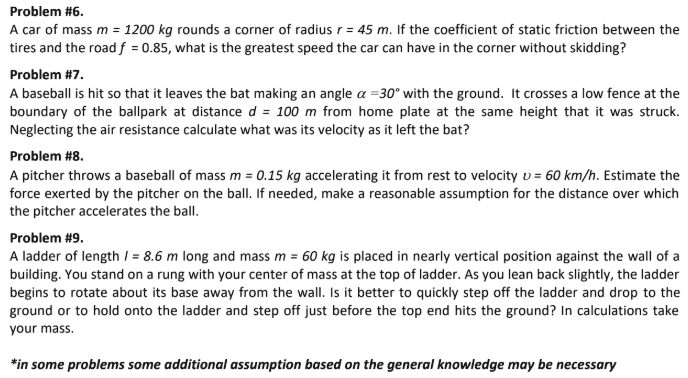
244014


- Tasks from "Conversation principles of material point":
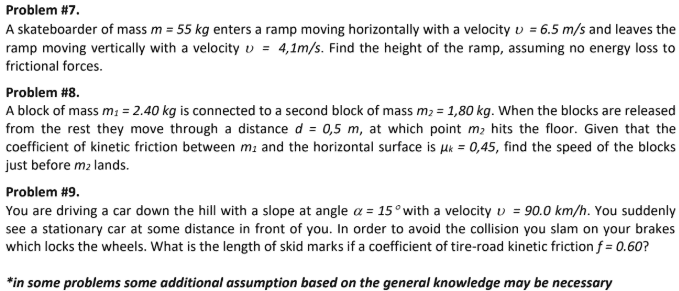
244015


In total there are about ~10 different "subjects" of physics that we have to quickly teach ourselves, covering things like: dynamics, gravitation, thermodynamics, optics, mechanical vibrations, electromagnetism/electrostatic field and whatnot.

I found plenty of online resources, including long .pdf books, that cover theory I need. I hopefully will not have problems with theory.

But I sort of did not find any books that have only tasks with full solutions preferably. I need some book that will not really cover theory, just have bunch of exercies with solutions. Of course I have found some resources online with exercies, but usually there just a few exercises and that's it.

Would anyone be able to share with me with some good resources? Anything is useful for me. Thanks for your time and any advices.
 
Physics news on Phys.org
Amazon has plenty of workbooks available for $20 or less. A used physics textbook can cost even less and should also come with plenty of problems. Here's one for $5.
 
vxr said:
I am first year non-physics student. I kind of never had any experience with physics. I have about 3 weeks to teach myself physics to solve tasks presented below
That makes no sense, IMO. Why are you needing to work on and solve these problems if you are not in a class?
 
I don't know. We had plenty of lectures covering theory and no calculations at all. Now that the lectures are over, we will only have 3 weeks of classes. Each week 2 classes in a row, so that's 6 classes. And we have to come prepared to the classes beforehand, because each class is started with a test.

Not my idea of teaching.
 
So is it this

vxr said:
I kind of never had any experience with physics.
vxr said:
almost from scratch

or this

vxr said:
We had plenty of lectures covering theory

?
 
  • Like
Likes   Reactions: berkeman
Good point. It is both. We had in total about 20 hours of lectures of pure theory.

Problem is I am not from an english-speaking country, and our studies are taught in english. Even though I believe the teacher who held the lectures is a person of great mind, cited often around the world and whatnot, he simply had some serious issues with teaching in english. Simply communication was an issue here. That combined with unpleasant late schedule of the lectures resulted in most people not attending the lectures almost at all.

Anyway, the word I was looking for was... workbook. I had forgotten such word existed. Simply googling "physics workbook" instead of "physics book" gave me so many results I don't know where to begin.

So I found what I was looking for... :P
 
  • Like
Likes   Reactions: Dr.AbeNikIanEdL and berkeman
I have heard somewhere that someone who is studying basics of physics should pay a lot of attention and should spend a lot of time learning classical mechanics (kinematics, dynamics I believe), before proceeding further? By doing that it should be easier to grasp further chapters of physics.

Is that true?
 
vxr said:
Is that true?

Yes.

Here is the book for you - it has an amazing number of worked examples to help with your original question:
https://www.amazon.com/dp/0521876222/?tag=pfamazon01-20

Excellent preparation for my favorite book - Landau - Mechanics which you should also get - but Landau does not have the large number of worked examples Morin has.

Thanks
Bill
 
vxr said:
I have heard somewhere that someone who is studying basics of physics should pay a lot of attention and should spend a lot of time learning classical mechanics (kinematics, dynamics I believe), before proceeding further? By doing that it should be easier to grasp further chapters of physics.

Is that true?

This is now different and deviating from your original post.

Your situation is very puzzling. I've heard many strange stories on here over many, many years, but never quite one like yours. Frankly, I find it hard to believe there is a system or program like what you had described.

Zz.
 
  • Like
Likes   Reactions: symbolipoint

Similar threads

  • · Replies 102 ·
4
Replies
102
Views
9K
  • · Replies 10 ·
Replies
10
Views
2K
  • · Replies 3 ·
Replies
3
Views
2K
  • · Replies 8 ·
Replies
8
Views
2K
  • · Replies 6 ·
Replies
6
Views
2K
  • · Replies 2 ·
Replies
2
Views
1K
  • · Replies 33 ·
2
Replies
33
Views
5K
  • · Replies 29 ·
Replies
29
Views
3K
  • · Replies 11 ·
Replies
11
Views
4K
  • · Replies 7 ·
Replies
7
Views
3K