Math Amateur
Gold Member
MHB
- 3,920
- 48
- TL;DR
- I need help in order to understand some remarks by Singh made prior to his definition of a sub-basis ...
I am reading Tej Bahadur Singh: Elements of Topology, CRC Press, 2013 ... ... and am currently focused on Chapter 1, Section 1.4: Basis ... ...
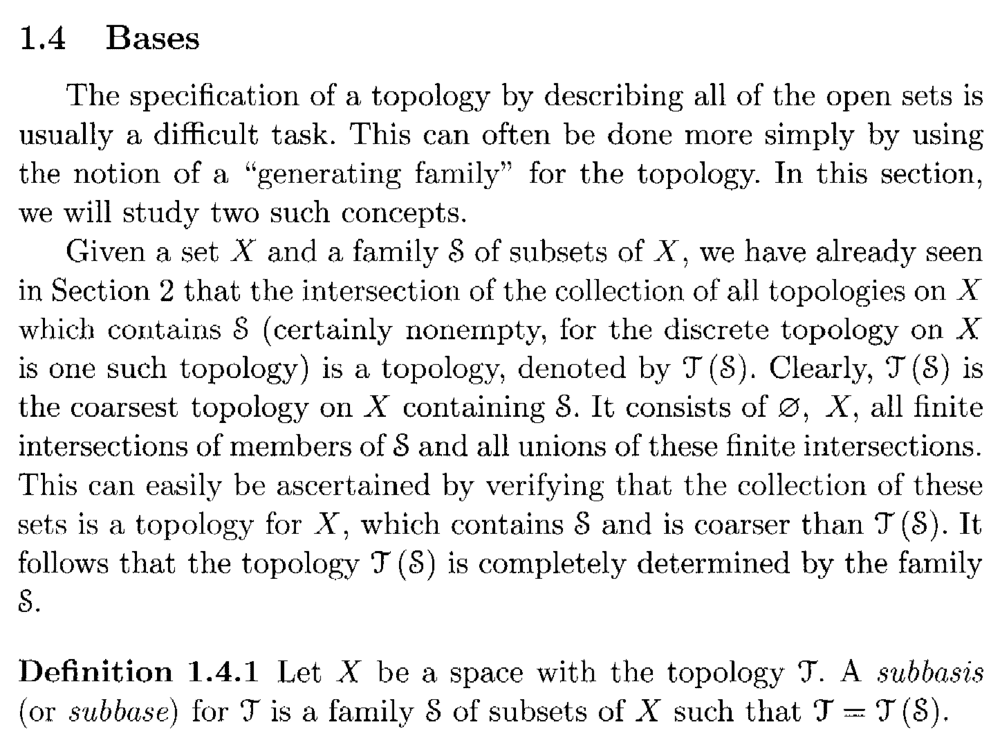
I need help in order to fully understand some remarks by Singh just before he defines a sub-basis ... .. The relevant text reads as follows:
To try to fully understand the above text by Singh I tried to work the following example:
##X = \{ a, b, c \}## and ##\mathcal{S} = \{ \{ a \}, \{ b \} \}##
Topologies containing ##\mathcal{S}## are as follows:
##\mathcal{ T_1 } = \{ X, \emptyset, \{ a, b \} , \{ a, c \}, \{ b, c \}, \{ a \}, \{ b \}, \{ c \} \}##
##\mathcal{ T_2 } = \{ X, \emptyset, \{ a, b \} , \{ a, c \}, \{ a \}, \{ b \} \}##
##\mathcal{ T_3 } = \{ X, \emptyset, \{ a, b \} , \{ b, c \}, \{ a \}, \{ b \} \}##
##\mathcal{ T_4 } = \{ X, \emptyset, \{ a, b \} , \{ a \}, \{ b \} \}##Therefore ##\mathcal{ T } ( \mathcal{S} ) = \mathcal{ T_1 } \cap \mathcal{ T_2 } \cap \mathcal{ T_3 } \cap \mathcal{ T_4 }##
##= \{ X, \emptyset, \{ a, b \} , \{ a \}, \{ b \} \}##
But ... now Singh writes the following ... " ... Clearly ##\mathcal{ T } ( \mathcal{S} )## is the coarsest topology. It consists of ##\emptyset, X##, all finite intersections of members of ##\mathcal{S}## and all unions of these finite intersections. ... ..."
However ... all finite intersections of members of ##\mathcal{S}## comprises ##\{ a \} \cap \{ b \} = \emptyset## ... and so, by this reckoning ... ##\mathcal{ T } ( \mathcal{S} )## consists of ##X## and ##\emptyset## ...
Can someone clarify the above ...
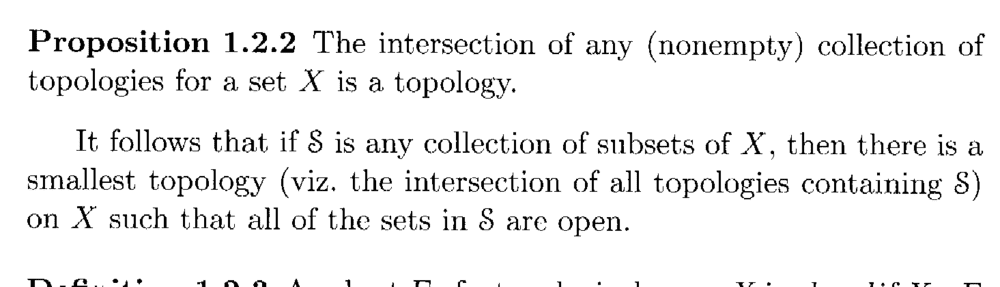
Peter===================================================================================There is a small fragment of relevant text in Singh Section 1.2 ... it reads as follows:
Hope that helps ... ...
Peter
I need help in order to fully understand some remarks by Singh just before he defines a sub-basis ... .. The relevant text reads as follows:
To try to fully understand the above text by Singh I tried to work the following example:
##X = \{ a, b, c \}## and ##\mathcal{S} = \{ \{ a \}, \{ b \} \}##
Topologies containing ##\mathcal{S}## are as follows:
##\mathcal{ T_1 } = \{ X, \emptyset, \{ a, b \} , \{ a, c \}, \{ b, c \}, \{ a \}, \{ b \}, \{ c \} \}##
##\mathcal{ T_2 } = \{ X, \emptyset, \{ a, b \} , \{ a, c \}, \{ a \}, \{ b \} \}##
##\mathcal{ T_3 } = \{ X, \emptyset, \{ a, b \} , \{ b, c \}, \{ a \}, \{ b \} \}##
##\mathcal{ T_4 } = \{ X, \emptyset, \{ a, b \} , \{ a \}, \{ b \} \}##Therefore ##\mathcal{ T } ( \mathcal{S} ) = \mathcal{ T_1 } \cap \mathcal{ T_2 } \cap \mathcal{ T_3 } \cap \mathcal{ T_4 }##
##= \{ X, \emptyset, \{ a, b \} , \{ a \}, \{ b \} \}##
But ... now Singh writes the following ... " ... Clearly ##\mathcal{ T } ( \mathcal{S} )## is the coarsest topology. It consists of ##\emptyset, X##, all finite intersections of members of ##\mathcal{S}## and all unions of these finite intersections. ... ..."
However ... all finite intersections of members of ##\mathcal{S}## comprises ##\{ a \} \cap \{ b \} = \emptyset## ... and so, by this reckoning ... ##\mathcal{ T } ( \mathcal{S} )## consists of ##X## and ##\emptyset## ...
Can someone clarify the above ...
Peter===================================================================================There is a small fragment of relevant text in Singh Section 1.2 ... it reads as follows:
Hope that helps ... ...
Peter