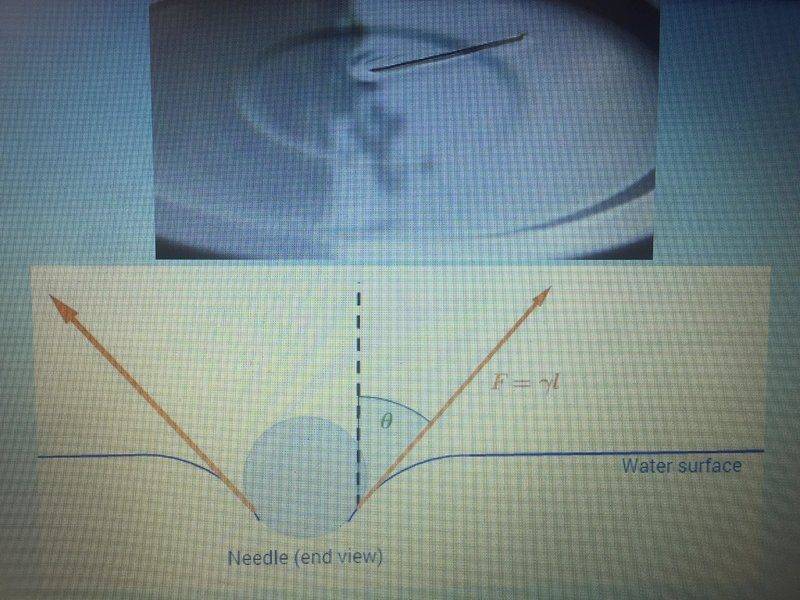
Surface Tension of needle on water

Click For Summary
SUMMARY

The discussion centers on calculating the maximum mass of a needle that can be supported by the surface tension of water, given a surface tension coefficient (γ) of 0.0730 N/m and an acceleration due to gravity of 9.80 m/s². Participants clarified that the initial calculations were incomplete, as only half of the necessary force was considered. It was confirmed that to find the maximum weight, one must double the initial force calculation and recognize that the angle (θ) is zero at maximum weight. This understanding is crucial for accurate calculations in physics problems involving surface tension.

PREREQUISITES
  • Understanding of surface tension and its effects on objects in fluids
  • Basic knowledge of physics principles, particularly forces and weight
  • Familiarity with the formula for calculating force (F = m * g)
  • Ability to perform calculations involving angles and trigonometric functions
NEXT STEPS
  • Study the principles of surface tension in fluids
  • Learn about the relationship between force, mass, and gravity in physics
  • Explore the concept of equilibrium in fluid mechanics
  • Investigate the effects of angle on buoyancy and stability in fluids
USEFUL FOR

Students studying physics, particularly those focusing on fluid mechanics, as well as educators seeking to enhance their teaching methods regarding surface tension and related calculations.

Aleisha
Messages
25
Reaction score
0
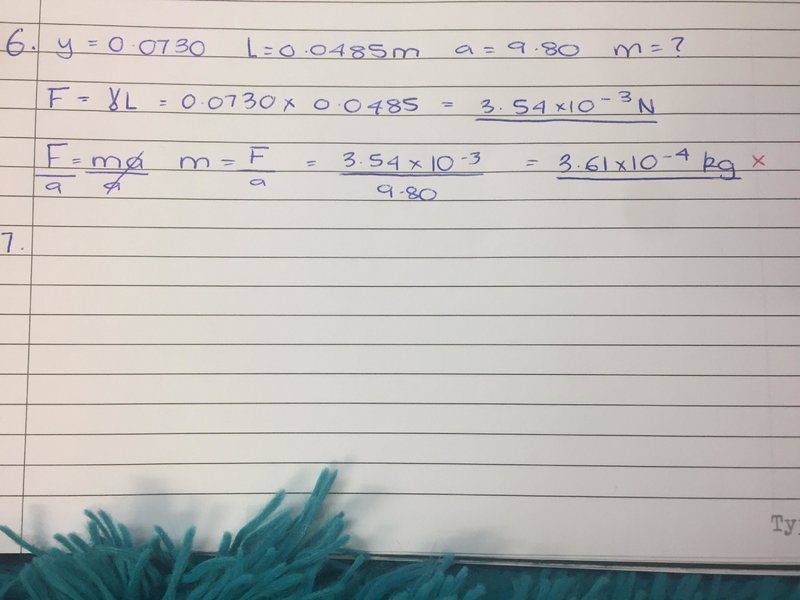
I attempted the question but it was wrong... I don't understand where i went wrong my working seems logical, can someone please help.

When a needle is gently placed on the surface of still water (γ = 0.0730 N.m-1) it can be supported by surface tension if the mass of the needle is small enough.
Calculate the maximum mass of a needle that is 4.85 cm long that can be supported by the water. Take the acceleration due to gravity to be 9.80 m/s/s.
31381199_1893831640647070_8660203576972279808_n.jpg
31239535_1893831870647047_6752479602028838912_n.jpg
 

Attachments

  • 31381199_1893831640647070_8660203576972279808_n.jpg
    31381199_1893831640647070_8660203576972279808_n.jpg
    47.5 KB · Views: 1,671
  • 31239535_1893831870647047_6752479602028838912_n.jpg
    31239535_1893831870647047_6752479602028838912_n.jpg
    75.5 KB · Views: 1,683
Physics news on Phys.org
Aleisha said:
I attempted the question but it was wrong... I don't understand where i went wrong my working seems logical, can someone please help.

When a needle is gently placed on the surface of still water (γ = 0.0730 N.m-1) it can be supported by surface tension if the mass of the needle is small enough.
Calculate the maximum mass of a needle that is 4.85 cm long that can be supported by the water. Take the acceleration due to gravity to be 9.80 m/s/s.View attachment 224645 View attachment 224646
You only included half the force.

P.S., Please use the Homework Template in the future.
 
So all I have to do is double my answer to get the full force?
 
Aleisha said:
So all I have to do is double my answer to get the full force?
Yes. You also have to understand that, at the maximum weight, ##\theta=0##.
 
I understand that now it makes sense, thank you!
 

Similar threads

  • · Replies 4 ·
Replies
4
Views
2K
Replies
2
Views
2K
  • · Replies 4 ·
Replies
4
Views
3K
  • · Replies 18 ·
Replies
18
Views
2K
  • · Replies 5 ·
Replies
5
Views
2K
Replies
2
Views
3K
  • · Replies 4 ·
Replies
4
Views
3K
Replies
1
Views
3K
  • · Replies 19 ·
Replies
19
Views
2K
Replies
9
Views
2K